1
 →
→
A unified AI model hub for aggregation & distribution. It supports cross-converting various LLMs into OpenAI-compatible, Claude-compatible, or Gemini-compatible formats.
QuantumNous/new-api is an open-source project on GitHub, mainly written in Go. A unified AI model hub for aggregation & distribution. It supports cross-converting various LLMs into OpenAI-compatible, Claude-compatible It currently holds 48,607 stars and 11,663 forks with 1,338 open issues, and was last pushed on 2026-09-21 (repository created 2023-11-10).
Git Homed tracks it on the Today's Trending board, currently at rank #35 with 103 new stars today.

An AI gateway for models, applications, and agents
简体中文 | 繁體中文 | English | Français | 日本語







Capabilities • Quick start • Deployment • Development • Documentation
---
New API is a self-hosted AI gateway for applications, agents, and teams. Connect upstream model services, expose a consistent API to your clients, and manage routing, access, usage, and costs in one place.
Use it to share authorized model access across a team, switch providers without configuring every client again, or operate a private multi-model service with a web console. Upstreams include OpenAI, Anthropic, Google Gemini, Azure OpenAI, AWS Bedrock, Vertex AI, DeepSeek, Qwen, and other compatible services.
[!IMPORTANT]
- This project is intended solely for lawful and authorized AI API gateway, organization-level authentication, multi-model management, usage analytics, cost accounting, and private deployment scenarios.
- Users must lawfully obtain upstream API keys, accounts, model services, and interface permissions, and must comply with upstream terms of service and applicable laws and regulations.
- Users should ensure their use complies with upstream terms of service and applicable laws and regulations.
- When providing generative AI services to the public, users should comply with applicable regulatory requirements and fulfill all filing, licensing, content safety, real-name verification, log retention, tax, and upstream authorization obligations required by their jurisdiction.
[!WARNING]
When operating this project as a public generative AI service or API resale service, users should first complete all required filing, licensing, content safety, real-name verification, log retention, tax, payment, and upstream authorization obligations.
---
No particular order






---

Thanks to JetBrains for providing free open-source development license for this project
---
| Area | What you can do | | --- | --- | | Model access | Use OpenAI Chat Completions, Responses, Anthropic Messages, and Gemini APIs; stream responses and use tools, reasoning, and multimodal inputs where supported | | Routing | Configure model mappings, channel priorities and weights, retries, channel affinity, and multiple upstream keys | | Usage and costs | Manage quotas, subscriptions, usage logs, cache accounting, and expression-based pricing for different usage tiers | | Access control | Manage users, groups, fine-grained permissions, and API key restrictions; use OAuth/OIDC, passkeys, two-factor authentication, and login session management | | Asynchronous tasks | Extend image, video, and other task APIs with JavaScript plugins, including task status and output retrieval | | Web console | Configure channels and models, inspect usage and audit logs, and try models in the playground; available in English, Simplified Chinese, Traditional Chinese, French, Japanese, Russian, and Vietnamese |
| Interface | Common endpoints |
| --- | --- |
| OpenAI Chat / Responses | POST /v1/chat/completions, POST /v1/responses |
| Anthropic Messages | POST /v1/messages |
| Gemini | POST /v1beta/models/{model}:generateContent, POST /v1beta/models/{model}:streamGenerateContent |
| Realtime / Responses WebSocket | GET /v1/realtime, GET /v1/responses (WebSocket upgrade) |
| Images / audio | /v1/images/generations, /v1/images/edits, /v1/audio/speech, /v1/audio/transcriptions, /v1/audio/translations |
| Embeddings / rerank | POST /v1/embeddings, POST /v1/rerank |
| Task plugins | POST /v1/tasks/{pluginKey}, GET /v1/tasks/{taskId}, plus routes declared by each plugin |
RelayKit provides request, response, and streaming conversion between the four text protocols. Available features depend on the channel, upstream model, and conversion path; protocol-specific tools and fields may not map exactly. WebSocket support also requires a compatible upstream and channel configuration.
This README describes the current source tree. Check the release notes for the version you deploy.
This starts a single instance with SQLite and binds it to localhost:
mkdir -p data
docker run --name new-api -d --restart unless-stopped \
  -p 127.0.0.1:3000:3000 \
  -e TZ=Asia/Shanghai \
  -v "$(pwd)/data:/data" \
  calciumion/new-api:latest
Open http://localhost:3000 and complete the setup wizard to create the administrator account. The data directory persists the SQLite database across container replacements.
1. Add a channel with your upstream API key, available models, and group assignment; run a channel test.
2. Configure model pricing and ensure the user has quota or a valid subscription.
3. Create an API key in the console with access to the same group and models.
4. Set your client's base URL to http://localhost:3000/v1 for OpenAI-compatible clients and use the New API-issued key.
Set NEW_API_KEY in your shell to that key. List the models accessible to it:
curl --fail-with-body http://localhost:3000/v1/models \
  -H "Authorization: Bearer ${NEW_API_KEY}"
Then call Responses, replacing your-enabled-model with an enabled model that supports this interface:
curl --fail-with-body http://localhost:3000/v1/responses \
  -H "Authorization: Bearer ${NEW_API_KEY}" \
  -H "Content-Type: application/json" \
  -d '{"model":"your-enabled-model","input":"Hello!"}'
The repository's Compose configuration starts New API + PostgreSQL + Redis by default. It also contains examples for MySQL and a separate ClickHouse log database.
git clone https://github.com/QuantumNous/new-api.git
cd new-api
Before starting, edit docker-compose.yml: replace the database and Redis example passwords in both the services and connection strings, and set a persistent random SESSION_SECRET (generate one with openssl rand -hex 32). For an HTTPS console, configure SESSION_COOKIE_SECURE=true and SESSION_COOKIE_TRUSTED_URL with its exact public HTTPS origin.
docker compose up -d
docker compose logs -f new-api
| Component | Options |
| --- | --- |
| Main database | SQLite, MySQL ≥ 5.7.8, or PostgreSQL ≥ 9.6 |
| Separate log database | Configure with LOG_SQL_DSN; also supports ClickHouse |
| Cache | Optional Redis plus in-memory caching; use shared Redis when application nodes need shared rate limits |
| Container platforms | Linux amd64 / arm64 |
| Variable | Purpose |
| --- | --- |
| SQL_DSN | Main database connection; unset uses SQLite |
| LOG_SQL_DSN | Optional separate log database connection |
| REDIS_CONN_STRING | Redis connection string |
| SESSION_SECRET | Persistent authentication secret; all nodes must use the same value |
| CRYPTO_SECRET | Defaults to SESSION_SECRET; nodes sharing Redis must use the same effective value |
| SESSION_COOKIE_SECURE | Set to true for an HTTPS console; enables Secure refresh cookies and strict refresh/logout origin checks |
| SESSION_COOKIE_TRUSTED_URL | Required in Secure mode: comma-separated exact HTTPS origins, without paths or wildcards; leave unset for local HTTP |
| TRUSTED_PROXIES | Trusted reverse-proxy IPs/CIDRs, or none; explicitly configure for your network |
See the environment example, environment reference, and authentication and session guide for full configuration. Configure container variables in Compose's environment or env_file; copying .env.example alone does not inject variables into the container.
For production, put the console behind HTTPS and configure your reverse proxy for streaming and WebSocket upgrades. Persist and back up the database and mounted data. Multi-node deployments must share the main database and authentication secrets; separate Redis instances or in-memory rate limiters count limits independently per node. The session guide describes propagation behavior for each topology.
Pin an image version from Releases, review its upgrade notes, and back up before upgrading. The latest tag follows published builds and can change; migrations and compatibility must be assessed for your existing installation.
The backend uses Go and Gin. The web console uses React 19, TypeScript, Rsbuild, TanStack, and Tailwind CSS 4. Use Bun for frontend dependencies and scripts; see go.mod for the Go language baseline and Dockerfile for the container build toolchain.
Build the frontend before starting the backend, which embeds web/dist:
# Repository root
cd web
bun install --frozen-lockfile
bun run build
cd ..
go run .
In a second terminal, start the frontend development server:
cd web
bun run dev -- --port 5173
Open http://localhost:5173; the development server proxies API requests to the backend on port 3000. For a containerized development backend, see docker-compose.dev.yml and the make dev target in makefile.
| Location | Responsibility |
| --- | --- |
| router/, middleware/, controller/ | HTTP routes, access checks, and API handlers |
| relay/ | Upstream adapters and request routing |
| service/, model/ | Business logic and persistence |
| relaykit/ | Independently buildable Go module for protocol DTOs and conversions |
| plugins/tasks/ | JavaScript task plugins; see Task Plugin API v1 for authoring and host boundaries |
| web/ | Web console; see frontend conventions |
| electron/ | Desktop wrapper and packaging |
Read AGENTS.md before contributing. Run checks appropriate to your change, including make test for the Go modules and bun run typecheck, bun run lint, bun run test, and bun run build in web/ for frontend changes. Changes to RelayKit must also pass GOWORK=off go build ./... from relaykit/.
| Resource | Link | | --- | --- | | Official documentation | Guides · Installation · API reference | | Project exploration | DeepWiki | | Questions and discussion | FAQ · Community | | Bugs and feature requests | GitHub Issues | | Security reports | Follow the security policy for private reporting |
For bug reports, include the version, deployment method, reproduction steps, and redacted logs. Documentation, translations, provider integrations, and focused regression tests are all welcome contributions.
---
| Project | Description | |------|------| | One API | Original project base | | Midjourney-Proxy | Midjourney interface support |
| Project | Description | |------|------| | new-api-key-tool | Key quota query tool | | new-api-horizon | New API high-performance optimized version |
---
This project is licensed under the GNU Affero General Public License v3.0 (AGPLv3).
Additional terms under AGPLv3 Section 7 apply. Modified versions must preserve the author attribution notice `Frontend design and development by New API contributors.` in the appropriate legal notices and in any prominent about, legal, footer, or attribution location presented by the user interface.
Modified versions that present a user interface must also preserve a visible link to the original project: .
This is an open-source project developed based on One API (MIT License).
If your organization's policies do not permit the use of AGPLv3-licensed software, or if you wish to avoid the open-source obligations of AGPLv3, please contact us at: [email protected]
See NOTICE and third-party licenses for attribution and dependency notices.
---
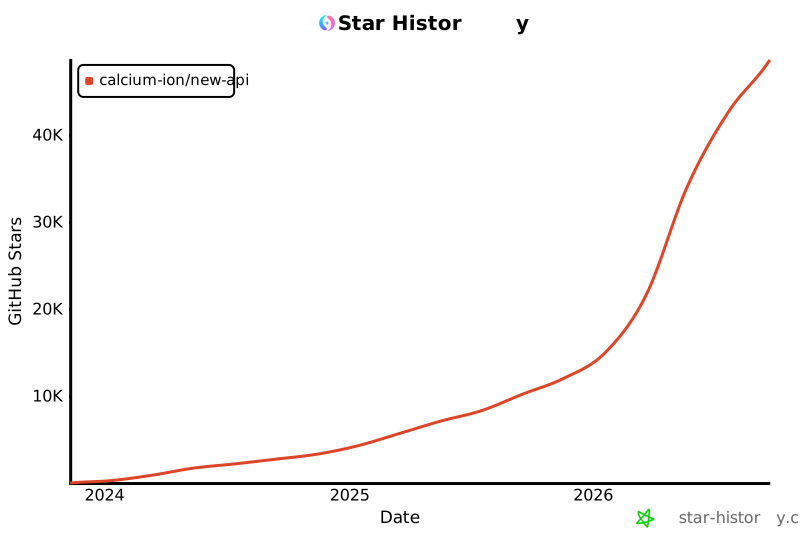
---
If this project is helpful to you, welcome to give us a ⭐️ Star!
Official Documentation • Issue Feedback • Latest Release
Built with ❤️ by QuantumNous
→ →
→ →
→ →
→ →
→ →
→ →
→ →
→