1
 →
→
An open-source model family for long-form speech, dialogue synthesis, voice design, sound effects, and real-time streaming TTS










MOSS‑TTS Family is an open‑source speech and sound generation model family from MOSI.AI and the OpenMOSS team. It is designed for high‑fidelity, high‑expressiveness, and complex real‑world scenarios, covering stable long‑form speech, multi‑speaker dialogue, voice/character design, environmental sound effects, and real‑time streaming TTS.
Start here: Quickstart · Model weights · Listen to samples · Fine-tuning · Serving backends
| What you want to build | Start with | | --- | --- | | Speech and voice cloning on a CPU or in a browser | MOSS-TTS-Nano | | Multilingual long-form narration and voice cloning | MOSS-TTS-v1.5 · Local Transformer v1.5 | | Multi-speaker dialogue, podcasts, and dubbing | MOSS-TTSD | | Real-time streaming speech | MOSS-TTS-Realtime | | Voice design or environmental sound effects | Released models · MOSS-SoundEffect v2 |
MossTTSLocal architecture, with an OpenAI-compatible /v1/audio/speech endpoint, streaming, and voice cloning. See the cookbooks: moss_tts_local, moss_tts.MossTTSLocal checkpoint that inherits all v1.5 features (language tags, stable cloning, explicit pause control, etc.), scales the backbone from Qwen3-1.7B to Qwen3-4B, and uses MOSS-Audio-Tokenizer-v2 for native 48 kHz stereo output.MossTTSDelay, MossTTSRealtime, and MossTTSNano architectures), including MOSS-TTS-v1.5, MOSS-TTS, MOSS-TTSD, MOSS-SoundEffect, MOSS-VoiceGenerator, MOSS-TTS-Realtime, and MOSS-TTS-Nano. See the recipe and examples.moss_soundeffect_v2/.[pause X.Ys].mlx-audio. Visit the mlx-audio GitHub repository for details.llama.cpp implementation in the companion repository OpenMOSS/llama.cpp, including end-to-end docs and a runnable pipeline for GGUF backbone inference plus ONNX audio codec decoding. See the first-class e2e guide.MossTTSDelay architecture, enabling efficient inference for MOSS-TTS (Delay) and MOSS-SoundEffect, with around 3× faster generation throughput!uv
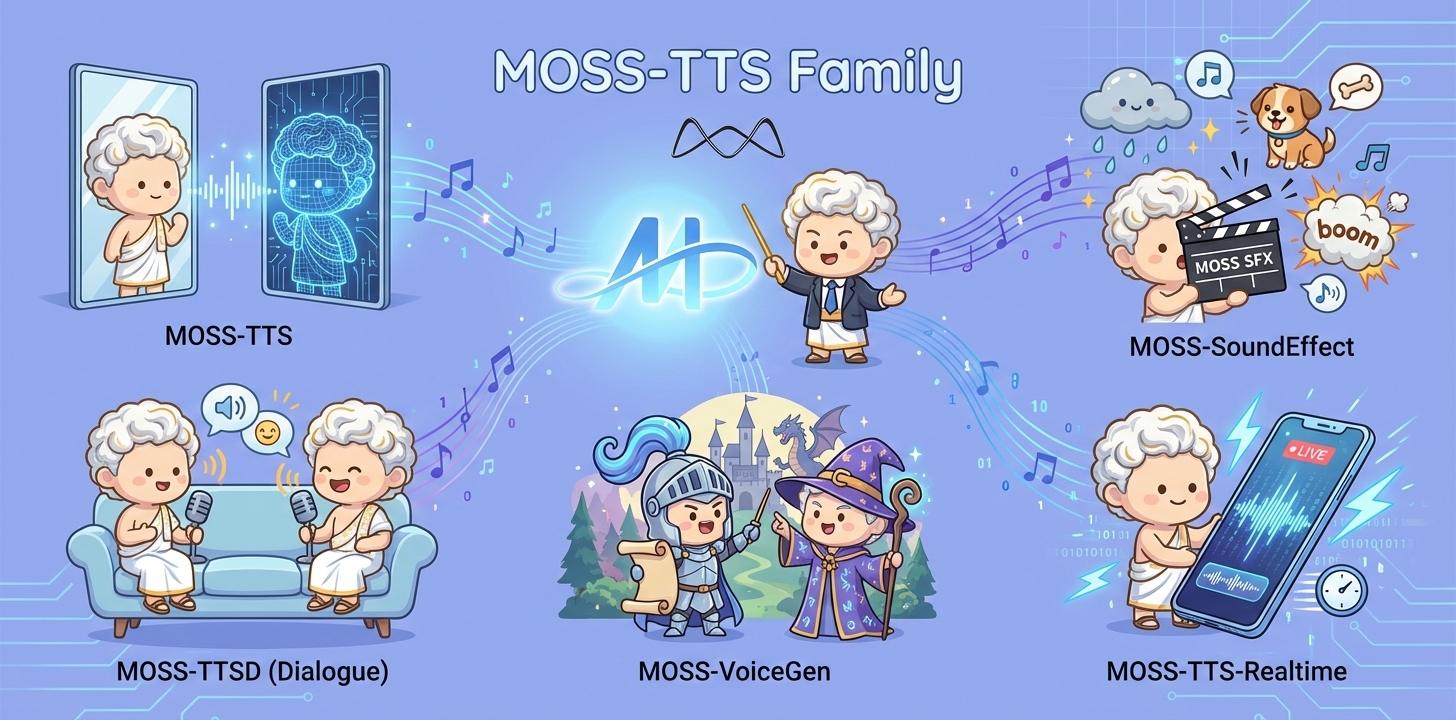
When a single piece of audio needs to sound like a real person, pronounce every word accurately, switch speaking styles across content, remain stable over tens of minutes, and support dialogue, role‑play, and real‑time interaction, a single TTS model is often not enough. The MOSS‑TTS Family breaks the workflow into five production‑ready models that can be used independently or composed into a complete pipeline.
We train MossTTSDelay and MossTTSLocal as complementary baselines under one training/evaluation setup: Delay emphasizes long-context stability, inference speed, and production readiness, while Local emphasizes lightweight flexibility and strong objective performance for streaming-oriented systems. Together they provide reproducible references for deployment and research.
MossTTSRealtime is not a third comparison baseline; it is a capability-driven design for voice agents. By modeling multi-turn context from both prior text and user acoustics, it delivers low-latency streaming speech that stays coherent and voice-consistent across turns.
| Architecture | Core Mechanism | Arch Details |
|---|---|---|
| MossTTSDelay | Multi‑head parallel RVQ prediction with delay‑pattern scheduling | |
|
MossTTSLocal | Time‑synchronous RVQ blocks with a depth transformer | |
|
MossTTSRealtime | Hierarchical text–audio inputs for realtime synthesis | |
| Model | Architecture | Size | Model Card | Hugging Face | ModelScope |
|---|---|---:|---|---|---|
| MOSS-TTS-v1.5 | MossTTSDelay | 8B | |
|
|
| MOSS-TTS 1.0 | MossTTSDelay | 8B | |
|
|
| MOSS-TTS-Local-Transformer-v1.5 | MossTTSLocal | 4B | |
|
|
| MOSS-TTS-Local-Transformer | MossTTSLocal | 1.7B | |
|
|
| MOSS‑TTSD‑V1.0 | MossTTSDelay | 8B | |
|
|
| MOSS‑VoiceGenerator | MossTTSDelay | 1.7B | |
|
|
| MOSS‑SoundEffect | MossTTSDelay | 8B | |
|
|
| MOSS‑SoundEffect‑v2.0 | MossSoundEffectPipeline | 1.3B DiT | |
|
|
| MOSS‑TTS‑Realtime | MossTTSRealtime | 1.7B | |
|
|
MOSS-TTS-v1.5 and MOSS-TTS-Local-Transformer-v1.5 currently support 31 languages. They keep the 20 languages supported by MOSS-TTS 1.0 and extend multilingual continued training to Cantonese, Dutch, Finnish, Hindi, Macedonian, Malay, Romanian, Swahili, Tagalog, Thai, and Vietnamese.
MOSS-TTSD and MOSS-TTS-Realtime follow their own model cards for supported language coverage.
| Language | Code | Flag | Language | Code | Flag | Language | Code | Flag | |---|---|---|---|---|---|---|---|---| | Chinese | zh | 🇨🇳 | Cantonese | yue | 🇭🇰 | English | en | 🇺🇸 | | Arabic | ar | 🇸🇦 | Czech | cs | 🇨🇿 | Danish | da | 🇩🇰 | | Dutch | nl | 🇳🇱 | Finnish | fi | 🇫🇮 | French | fr | 🇫🇷 | | German | de | 🇩🇪 | Greek | el | 🇬🇷 | Hebrew | he | 🇮🇱 | | Hindi | hi | 🇮🇳 | Hungarian | hu | 🇭🇺 | Italian | it | 🇮🇹 | | Japanese | ja | 🇯🇵 | Korean | ko | 🇰🇷 | Macedonian | mk | 🇲🇰 | | Malay | ms | 🇲🇾 | Persian (Farsi) | fa | 🇮🇷 | Polish | pl | 🇵🇱 | | Portuguese | pt | 🇵🇹 | Romanian | ro | 🇷🇴 | Russian | ru | 🇷🇺 | | Spanish | es | 🇪🇸 | Swahili | sw | 🇹🇿 | Swedish | sv | 🇸🇪 | | Tagalog | tl | 🇵🇭 | Thai | th | 🇹🇭 | Turkish | tr | 🇹🇷 | | Vietnamese | vi | 🇻🇳 | | | | | | |
MOSS-TTS-v1.5 is continued from MOSS-TTS 1.0. It preserves the main 1.0 capabilities, including zero-shot voice cloning, long-form speech generation, token-level duration control, Pinyin/IPA pronunciation control, multilingual synthesis, and code-switching.
Compared with MOSS-TTS 1.0, v1.5 focuses on these improvements:
processor.build_user_message(text=text, language="French") or the equivalent API field.[pause 3.2s], for example 我今天学习了一首中国的古诗,它的名字是[pause 3.2s]静夜思!.MOSS-TTS-Local-Transformer-v1.5 is the 48 kHz stereo local-transformer release. It uses MOSS-Audio-Tokenizer-v2 as the audio tokenizer and adds realtime streaming decode examples in moss_tts_local_v1.5/.
Compared with MOSS-TTS-Local-Transformer-v1.0, v1.5 focuses on these improvements:
processor.build_user_message(text=text, language="French") or the equivalent API field.[pause 3.2s], for example 我今天学习了一首中国的古诗,它的名字是[pause 3.2s]静夜思!.We add MOSS-TTS skills in ClawHub of 🦞 OpenClaw. You can get your API key from MOSI AI Studio.
| Skill | Description | Install |
|---|---|---|
| feishu-voice-tts | Send voice messages in Feishu | clawhub install feishu-voice-tts |
| moss-tts-voice | Call MOSS-TTS API to generate speech | clawhub install moss-tts-voice |
We recommend a clean, isolated Python envi
→ →
→ →
→ →
→ →
→ →
→