1
 →
→
Port of OpenAI's Whisper model in C/C++



High-performance inference of OpenAI's Whisper automatic speech recognition (ASR) model:
ggml machine learning library.
Having such a lightweight implementation of the model allows to easily integrate it in different platforms and applications. As an example, here is a video of running the model on an iPhone 13 device - fully offline, on-device: whisper.objc
https://user-images.githubusercontent.com/1991296/197385372-962a6dea-bca1-4d50-bf96-1d8c27b98c81.mp4
You can also easily make your own offline voice assistant application: command
https://user-images.githubusercontent.com/1991296/204038393-2f846eae-c255-4099-a76d-5735c25c49da.mp4
On Apple Silicon, the inference runs fully on the GPU via Metal:
https://github.com/ggml-org/whisper.cpp/assets/1991296/c82e8f86-60dc-49f2-b048-d2fdbd6b5225
First clone the repository:
git clone https://github.com/ggml-org/whisper.cpp.git
Navigate into the directory:
cd whisper.cpp
Then, download one of the Whisper models converted in ggml format. For example:
sh ./models/download-ggml-model.sh base.en
Now build the whisper-cli example and transcribe an audio file like this:
# build the project
cmake -B build
cmake --build build -j --config Release
transcribe an audio file
./build/bin/whisper-cli -f samples/jfk.wav
---
For a quick demo, simply run make base.en.
The command downloads the base.en model converted to custom ggml format and runs the inference on all .wav samples in the folder samples.
For detailed usage instructions, run: ./build/bin/whisper-cli -h
Note that the whisper-cli example currently runs only with 16-bit WAV files, so make sure to convert your input before running the tool.
For example, you can use ffmpeg like this:
ffmpeg -i input.mp3 -ar 16000 -ac 1 -c:a pcm_s16le output.wav
If you want some extra audio samples to play with, simply run:
make -j samples
This will download a few more audio files from Wikipedia and convert them to 16-bit WAV format via ffmpeg.
You can download and run the other models as follows:
make -j tiny.en
make -j tiny
make -j base.en
make -j base
make -j small.en
make -j small
make -j medium.en
make -j medium
make -j large-v1
make -j large-v2
make -j large-v3
make -j large-v3-turbo
| Model | Disk | Mem | | ------ | ------- | ------- | | tiny | 75 MiB | ~273 MB | | base | 142 MiB | ~388 MB | | small | 466 MiB | ~852 MB | | medium | 1.5 GiB | ~2.1 GB | | large | 2.9 GiB | ~3.9 GB |
whisper.cpp supports POWER architectures and includes code which
significantly speeds operation on Linux running on POWER9/10, making it
capable of faster-than-realtime transcription on underclocked Raptor
Talos II. Ensure you have a BLAS package installed, and replace the
standard cmake setup with:
# build with GGML_BLAS defined
cmake -B build -DGGML_BLAS=1
cmake --build build -j --config Release
./build/bin/whisper-cli [ .. etc .. ]
whisper.cpp supports integer quantization of the Whisper ggml models.
Quantized models require less memory and disk space and depending on the hardware can be processed more efficiently.
Here are the steps for creating and using a quantized model:
# quantize a model with Q5_0 method
cmake -B build
cmake --build build -j --config Release
./build/bin/quantize models/ggml-base.en.bin models/ggml-base.en-q5_0.bin q5_0
run the examples as usual, specifying the quantized model file
./build/bin/whisper-cli -m models/ggml-base.en-q5_0.bin ./samples/gb0.wav
On Apple Silicon devices, the Encoder inference can be executed on the Apple Neural Engine (ANE) via Core ML. This can result in significant
speed-up - more than x3 faster compared with CPU-only execution. Here are the instructions for generating a Core ML model and using it with whisper.cpp:
  pip install ane_transformers
  pip install openai-whisper
  pip install coremltools
coremltools operates correctly, please confirm that Xcode is installed and execute xcode-select --install to install the command-line tools.conda create -n py311-whisper python=3.11 -yconda activate py311-whisperbase.en model, use: ./models/generate-coreml-model.sh base.en
This will generate the folder models/ggml-base.en-encoder.mlmodelc
whisper.cpp with Core ML support: # using CMake
cmake -B build -DWHISPER_COREML=1
cmake --build build -j --config Release
  $ ./build/bin/whisper-cli -m models/ggml-base.en.bin -f samples/jfk.wav
...
whisper_init_state: loading Core ML model from 'models/ggml-base.en-encoder.mlmodelc'
  whisper_init_state: first run on a device may take a while ...
  whisper_init_state: Core ML model loaded
system_info: n_threads = 4 / 10 | AVX = 0 | AVX2 = 0 | AVX512 = 0 | FMA = 0 | NEON = 1 | ARM_FMA = 1 | F16C = 0 | FP16_VA = 1 | WASM_SIMD = 0 | BLAS = 1 | SSE3 = 0 | VSX = 0 | COREML = 1 |
...
The first run on a device is slow, since the ANE service compiles the Core ML model to some device-specific format. Next runs are faster.
For more information about the Core ML implementation please refer to PR #566.
On platforms that support OpenVINO, the Encoder inference can be executed on OpenVINO-supported devices including x86 CPUs and Intel GPUs (integrated & discrete).
This can result in significant speedup in encoder performance. Here are the instructions for generating the OpenVINO model and using it with whisper.cpp:
  cd models
  python -m venv openvino_conv_env
  openvino_conv_env\Scripts\activate
  python -m pip install --upgrade pip
  pip install -r requirements-openvino.txt
Linux and macOS:
  cd models
  python3 -m venv openvino_conv_env
  source openvino_conv_env/bin/activate
  python -m pip install --upgrade pip
  pip install -r requirements-openvino.txt
base.en model, use: python convert-whisper-to-openvino.py --model base.en
This will produce ggml-base.en-encoder-openvino.xml/.bin IR model files. It's recommended to relocate these to the same folder as ggml models, as that
is the default location that the OpenVINO extension will search at runtime.
whisper.cpp with OpenVINO support:After downloading & extracting package onto your development system, set up required environment by sourcing setupvars script. For example:
Linux:
source /path/to/openvino_toolkit_ubuntu/setupvars.sh
Windows (cmd):
C:\Path\To\openvino_toolkit_windows\setupvars.bat
And then build the project using cmake:
  cmake -B build -DWHISPER_OPENVINO=1
  cmake --build build -j --config Release
  $ ./build/bin/whisper-cli -m models/ggml-base.en.bin -f samples/jfk.wav
...
whisper_ctx_init_openvino_encoder: loading OpenVINO model from 'models/ggml-base.en-encoder-openvino.xml'
  whisper_ctx_init_openvino_encoder: first run on a device may take a while ...
  whisper_openvino_init: path_model = models/ggml-base.en-encoder-openvino.xml, device = GPU, cache_dir = models/ggml-base.en-encoder-openvino-cache
  whisper_ctx_init_openvino_encoder: OpenVINO model loaded
system_info: n_threads = 4 / 8 | AVX = 1 | AVX2 = 1 | AVX512 = 0 | FMA = 1 | NEON = 0 | ARM_FMA = 0 | F16C = 1 | FP16_VA = 0 | WASM_SIMD = 0 | BLAS = 0 | SSE3 = 1 | VSX = 0 | COREML = 0 | OPENVINO = 1 |
...
The first time run on an OpenVINO device is slow, since the OpenVINO framework will compile the IR (Intermediate Representation) model to a device-specific 'blob'. This device-specific blob will get cached for the next run.
For more information about the OpenVINO implementation please refer to PR #1037.
On AMD Ryzen™ AI 300 and 400 Series processors with a dedicated NPU, whisper.cpp can fully offload the Whisper encoder to the NPU via VitisAI, delivering significant speedup over CPU-only inference.
Supported Platforms
xrt-smi diagnostic tool — on Windows this is bundled with the NPU driver; on Linux install it separately following the NPU driver installation guideflexmlrt): VitisAI inference engine used by whisper.cpp — download from the FlexML runtime releases# Linux
source /opt/xilinx/xrt/setup.sh
source /path/to/flexmlrt/setup.sh
:: Windows
cd /path/to/flexmlrt && call setup.bat
You can verify the NPU is visible with:
xrt-smi examine
Download the ggml model and the matching prebuilt VitisAI encoder cache:
# Linux / macOS
sh ./models/download-ggml-model.sh base
sh ./models/download-vitisai-model.sh base
:: Windows
.\models\download-ggml-model.cmd base
.\models\download-vitisai-model.cmd base
Use the same model name with both scripts. To see all available VitisAI encoder caches:
sh ./models/download-vitisai-model.sh --list
.\models\download-vitisai-model.cmd --list
The VitisAI script queries the AMD Ryzen AI Whisper NPU collection on Hugging Face and downloads the .rai encoder cache as models/ggml--encoder-vitisai.rai.
Depending on the .rai cache, VitisAI may offload the encoder only, or the encoder plus cross-projection layers. whisper.cpp detects this at runtime and logs the selected offload mode during model initialization.
cmake -B build -DWHISPER_VITISAI=1
cmake --build build -j --config Release
./build/bin/whisper-cli -m models/ggml-base.bin -f samples/jfk.wav
For more information see the Ryzen AI documentation.
With NVIDIA cards the processing of the models is done efficiently on the GPU via cuBLAS and custom CUDA kernels.
First, make sure you have installed cuda: https://developer.nvidia.com/cuda-downloads
Now build whisper.cpp with CUDA support:
cmake -B build -DGGML_CUDA=1
cmake --build build -j --config Release
or for newer NVIDIA GPU's (RTX 5000 series):
cmake -B build -DGGML_CUDA=1 -DCMAKE_CUDA_ARCHITECTURES="86"
cmake --build build -j --config Release
Now build whisper.cpp with Vulkan support:
cmake -B build -DGGML_VULKAN=1
cmake --build build -j --config Release
With AMD GPUs the processing can be accelerated via HIP/ROCm. First, make sure you have installed ROCm.
Now build whisper.cpp with HIP support:
cmake -B build -DGGML_HIP=1 -DAMDGPU_TARGETS="gfx1201"
cmake --build build -j --config Release
Replace gfx1201 with your GPU architecture. You can find it with:
rocminfo | grep "gfx"
Common architectures: gfx1100 (RX 7900 XTX), gfx1101 (RX 7800 XT), gfx1201 (RX 9070 XT).
For multiple GPUs with different architectures: -DAMDGPU_TARGETS="gfx1100;gfx1201".
Encoder processing can be accelerated on the CPU via OpenBLAS.
First, make sure you have installed openblas: https://www.openblas.net/
Now build whisper.cpp with OpenBLAS support:
cmake -B build -DGGML_BLAS=1
cmake --build build -j --config Release
Ascend NPU provides inference acceleration via CANN and AI cores.
First, check if your Ascend NPU device is supported:
Verified devices | Ascend NPU | Status | |:-----------------------------:|:-------:| | Atlas 300T A2 | Support | | Atlas 300I Duo | Support |
Then, make sure you have installed CANN toolkit . The latest version of CANN is recommended.
Now build whisper.cpp with CANN support:
cmake -B build -DGGML_CANN=1
cmake --build build -j --config Release
Run the inference examples as usual, for example:
./build/bin/whisper-cli -f samples/jfk.wav -m models/ggml-base.en.bin -t 8
Notes:
Verified devices.With Moore Threads cards the processing of the models is done efficiently on the GPU via muBLAS and custom MUSA kernels.
First, make sure you have installed MUSA SDK rc4.2.0: https://developer.mthreads.com/sdk/download/musa?equipment=&os=&driverVersion=&version=4.2.0
Now build whisper.cpp with MUSA support:
cmake -B build -DGGML_MUSA=1
cmake --build build -j --config Release
or specify the architecture for your Moore Threads GPU. For example, if you have a MTT S80 GPU, you can specify the architecture as follows:
cmake -B build -DGGML_MUSA=1 -DMUSA_ARCHITECTURES="21"
cmake --build build -j --config Release
By default, the examples in this repo use the miniaudio library to decode audio files.
Some of the examples also can use FFmpeg for decoding and broader format support. To enable that, build with WHISPER_COMMON_FFMPEG.
First, you need to install required libraries:
# Debian/Ubuntu
sudo apt install libavcodec-dev libavformat-dev libavutil-dev
RHEL/Fedora
sudo dnf install libavcodec-free-devel libavformat-free-devel libavutil-free-devel
Then you can build the project as follows:
cmake -B build -D WHISPER_COMMON_FFMPEG=yes
cmake --build build
Run the following example to confirm it's working:
# Convert an audio file to Opus format
ffmpeg -i samples/jfk.wav jfk.opus
Transcribe the audio file
./build/bin/whisper-cli --model models/ggml-base.en.bin --file jfk.opus
We have multiple Docker images available for this project:
1. ghcr.io/ggml-org/whisper.cpp:main: This image includes the main executable file as well as curl and ffmpeg. (platforms: linux/amd64, linux/arm64)
2. ghcr.io/ggml-org/whisper.cpp:main-cuda: Same as main but compiled with CUDA support. (platforms: linux/amd64)
3. ghcr.io/ggml-org/whisper.cpp:main-musa: Same as main but compiled with MUSA support. (platforms: linux/amd64)
4. ghcr.io/ggml-org/whisper.cpp:main-vulkan: Same as main but compiled with Vulkan support. (platforms: linux/amd64)
# download model and persist it in a local folder
docker run -it --rm \
  -v path/to/models:/models \
  whisper.cpp:main "./models/download-ggml-model.sh base /models"
transcribe an audio file
docker run -it --rm \
  -v path/to/models:/models \
  -v path/to/audios:/audios \
  whisper.cpp:main "whisper-cli -m /models/ggml-base.bin -f /audios/jfk.wav"
transcribe an audio file in samples folder
docker run -it --rm \
  -v path/to/models:/models \
  whisper.cpp:main "whisper-cli -m /models/ggml-base.bin -f ./samples/jfk.wav"
run the web server
docker run -it --rm -p "8080:8080" \
  -v path/to/models:/models \
  whisper.cpp:main "whisper-server --host 127.0.0.1 -m /models/ggml-base.bin"

run the bench too on the small.en model using 4 threads
docker run -it --rm \
  -v path/to/models:/models \
  whisper.cpp:main "whisper-bench -m /models/ggml-small.en.bin -t 4"
You can install pre-built binaries for whisper.cpp or build it from source using Conan. Use the following command:
conan install --requires="whisper-cpp/[*]" --build=missing
For detailed instructions on how to use Conan, please refer to the Conan documentation.
This is a naive example of performing real-time inference on audio from your microphone. The stream tool samples the audio every half a second and runs the transcription continuously. More info is available in issue #10. You will need to have sdl2 installed for it to work properly.
cmake -B build -DWHISPER_SDL2=ON
cmake --build build -j --config Release
./build/bin/whisper-stream -m ./models/ggml-base.en.bin -t 8 --step 500 --length 5000
https://user-images.githubusercontent.com/1991296/194935793-76afede7-cfa8-48d8-a80f-28ba83be7d09.mp4
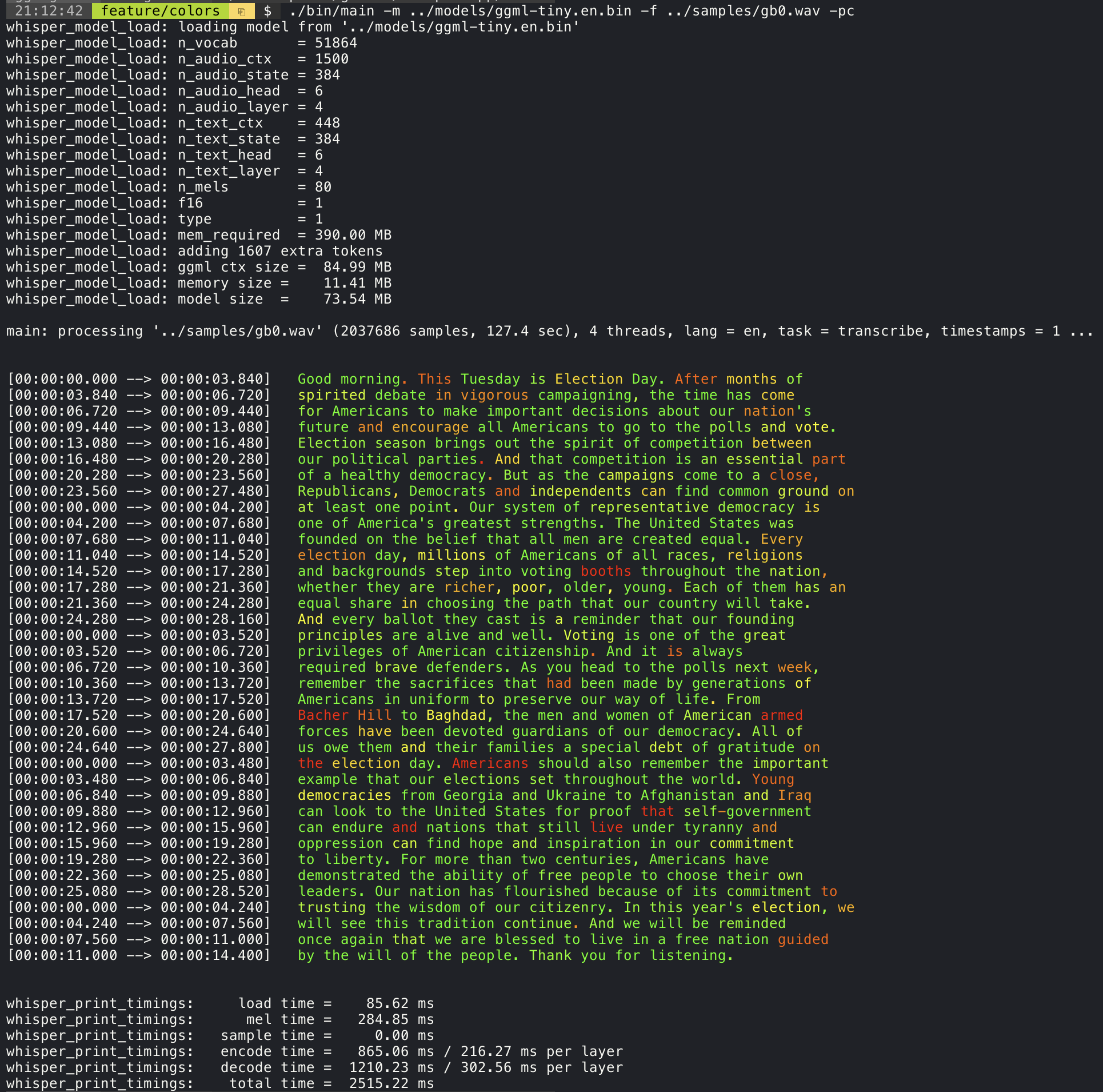
Adding the --print-colors argument will print the transcribed text using an experimental color coding strategy
to highlight words with high or low confidence:
./build/bin/whisper-cli -m models/ggml-base.en.bin -f samples/gb0.wav --print-colors
For example, to limit the line length to a maximum of 16 characters, simply add -ml 16:
$ ./build/bin/whisper-cli -m ./models/ggml-base.en.bin -f ./samples/jfk.wav -ml 16
whisper_model_load: loading model from './models/ggml-base.en.bin'
...
system_info: n_threads = 4 / 10 | AVX2 = 0 | AVX512 = 0 | NEON = 1 | FP16_VA = 1 | WASM_SIMD = 0 | BLAS = 1 |
main: processing './samples/jfk.wav' (176000 samples, 11.0 sec), 4 threads, 1 processors, lang = en, task = transcribe, timestamps = 1 ...
[00:00:00.000 --> 00:00:00.850]   And so my
[00:00:00.850 --> 00:00:01.590]   fellow
[00:00:01.590 --> 00:00:04.140]   Americans, ask
[00:00:04.140 --> 00:00:05.660]   not what your
[00:00:05.660 --> 00:00:06.840]   country can do
[00:00:06.840 --> 00:00:08.430]   for you, ask
[00:00:08.430 --> 00:00:09.440]   what you can do
[00:00:09.440 --> 00:00:10.020]   for your
[00:00:10.020 --> 00:00:11.000]   country.
The --max-len argument can be used to obtain word-level timestamps. Simply use -ml 1:
```text $ ./build/bin/whisper-cli -m ./models/ggml-base.en.bin -f ./samples/jfk.wav -ml 1
whisper_model_load: loading model from './models/ggml-base.en.bin' ... system_info: n_threads = 4 / 10 | AVX2 = 0 | AVX512 = 0 | NEON = 1 | FP16_VA = 1 | WASM_SIMD = 0 | BLAS = 1 |
main: processing './samples/jfk.wav' (176000 samples, 11.0 sec), 4 threads, 1 processors, lang = en, task = transcribe, timestamps = 1 ...
[00:00:00.000 --> 00:00:00.320] [00:00:00.320 --> 00:00:00.370] And [00:00:00.370 --> 00:00:00.690] so [00:00:00.690 --> 00:00:00.850] my [00:00:00.850 --> 00:00:01.590] fellow [00:00:01.590 --> 00:00:02.850] Americans [00:00:02.850 --> 00:00:03.300] , [00:00:03.300 --> 00:00:04.140] ask [00:00:04.140 --> 00:00:04.990] not [00:00:04.990 --> 00:00:05.410] what [00:00:05.410 --> 00:00:05.660] your [00:00:05.660 --> 00:00:06.260] country [00:00:06.260 --> 00:00:06.600] can [00:00:06.600 --> 00:00:06.840] do [00:00:06.840 --> 00:00:07.010] for [00:00
→ →
→ →
→ →
→ →
→ →
→