1
 →

AI-first external attack surface assessment with continuous discovery, evidence-based vulnerability validation, and developer-agent MCP integration.
hevnsnt/CVEngine is an open-source project on GitHub, mainly written in Python. AI-first external attack surface assessment with continuous discovery, evidence-based vulnerability validation, and developer-agent MCP integration. It currently holds 450 stars and 67 forks with 0 open issues, and was last pushed on an unknown date (repository created unknown).
Git Homed tracks it on the Today's Trending board.

Type in your domain. cvENGINE finds everything you expose, then tells you which of today's exploited CVEs can actually hit you, with proof.
No license fee. No per-asset pricing. No black box. 100% open source and self-hosted.
---
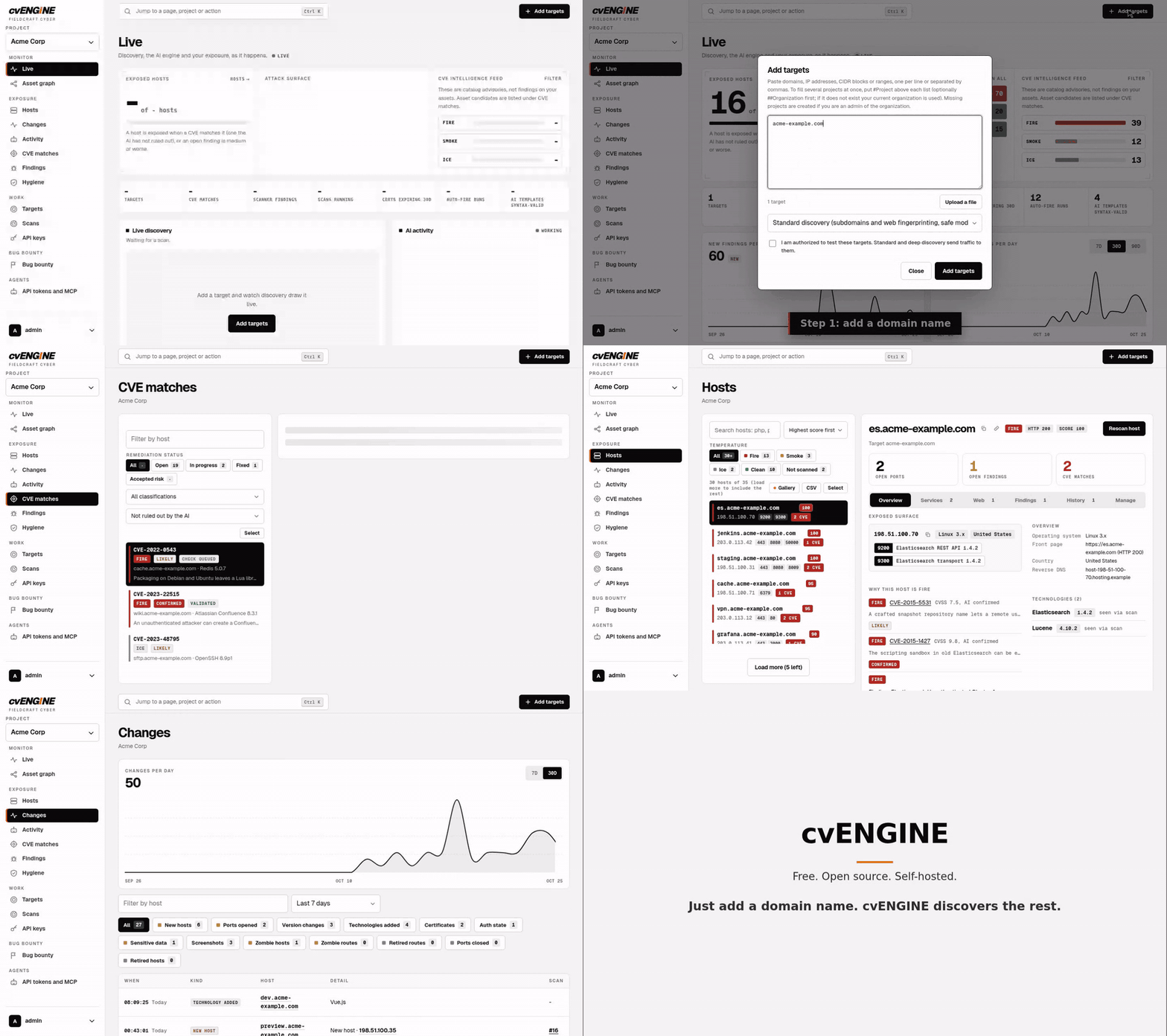
Attack surface tools find assets. Vulnerability scanners find flaws. Threat feeds find CVEs. cvENGINE runs all three as one continuous loop and hands you a verdict instead of a pile of alerts. It answers the question that matters: of everything exploited today, what do I have exposed?
| | |
| --- | --- |
| Discover | Subdomains, certificates, IPs, and ports with bbot and naabu, plus a certificate transparency watch and weekly deep sweeps |
| Understand | nmap service and OS fingerprints, web routes and their sign-in state, exposed databases, firewalls, WordPress, and email and DNS hygiene |
| Prioritize | Fire, smoke, and ice ratings, a 0 to 100 score per host, and AI triage into confirmed, likely, or needs validation |
| Verify | Read-only validation with Nuclei, nmap, and banner probes. Validate now on any match |
| Search | Shodan-style search over your own inventory: port:3389 -host:vpn, tech:"apache tomcat" sev:high |
| Operate | A live dashboard, a change timeline with screenshot diffs, organizations and roles, two-step sign-in, a REST API, an MCP server, and Slack, Discord, Telegram, and Lark alerts |
| Hunt | A bug bounty workbench: program scope from HackerOne, Bugcrowd, Intigriti, and YesWeHack, and report drafts |
| Bring your own AI | Anthropic, OpenAI, OpenRouter, Ollama, or vLLM. Without a model it still discovers, scans, matches, and validates |
example.com and www.example.com on the same servers are one host.flowchart LR
T(["Add a target
domain, IP, CIDR, URL"])
subgraph FIND["1 FIND"]
direction TB
D["Discovery
bbot"] --> I["Inventory
nmap, naabu"]
end
subgraph PROBE["2 PROBE"]
direction TB
X["Exposure checks
databases, RDP screenshot"] --> N1["nuclei
technology pass"] --> R["Firewall and web
route checks"] --> W["WPScan
node2shell, opt-in"]
end
subgraph MATCH["3 MATCH"]
direction TB
C["CVE correlation"] --> N2["nuclei
AI-targeted pass"]
end
subgraph DECIDE["4 DECIDE"]
direction TB
A["AI triage
and validation"] --> O["Changes, host score,
dashboard, API, alerts"]
end
H["Hygiene
TLS, SPF, DKIM, DMARC, CAA"]
T --> FIND --> PROBE --> MATCH --> DECIDE
DECIDE -.-> H
style FIND fill:#e8f1ff,stroke:#3b82f6,color:#0b3b8c
style PROBE fill:#f1eaff,stroke:#8b5cf6,color:#3b1d8c
style MATCH fill:#fff4e0,stroke:#f59e0b,color:#7a4a00
style DECIDE fill:#e6f7ec,stroke:#22c55e,color:#0b5a2a
linkStyle default stroke:#555,stroke-width:2px
classDef start fill:#111,stroke:#111,color:#fff
classDef step fill:#fff,stroke:#444,color:#111
classDef out fill:#fff,stroke:#16a34a,stroke-width:2px,color:#111
class T start
class D,I,X,N1,R,W,C,N2,A step
class O out
class H step
Each scanner runs once per host inside a time window, so repeat scans stay fast. See the pipeline for every stage.
cvENGINE stands on excellent open source work. Full credits and licenses are in THIRD-PARTY.md.
| | | | --- | --- | | Scanners | bbot, Nuclei and its templates, naabu, nmap, gowitness, wafw00f, WPScan, aardwolf, node2shell | | Exploitation intelligence | cve.now, CISA KEV, ENISA EUVD, FIRST EPSS, Exploit-DB, Metasploit, VulnCheck KEV, CVE List V5 | | Also | OSV, Debian security tracker, crt.sh, MailFail, bounty-targets-data, Bugcrowd VRT, Ollama, vLLM, Model Context Protocol |
On a Linux server (Debian or Ubuntu is easiest, with 4 GB of RAM or more):
git clone https://github.com/hevnsnt/CVEngine.git
cd CVEngine
sudo ./install.sh
It asks nothing: it installs what is missing, generates every secret, creates the HTTPS certificate, starts cvENGINE, and prints the address and your admin password. Open the address, sign in, and add a domain. The setup wizard does the rest. Your browser will warn about the private certificate until you trust secrets/certs/ca.crt.
Step-by-step install, a public name with a trusted certificate, and Mac and Windows are in Deployment and Hosting online.
Read-only checks, no password lists, and no scanning of loopback, link-local, or cloud metadata addresses. Each organization's data is isolated, stored secrets are encrypted, and access is protected by two-step sign-in, an IP allowlist, and an audit log. Only scan systems you own or are authorized to test.
| Doc | What it covers | | --- | --- | | Deployment and Hosting online | Install, HTTPS, proxies, backups, dev stack | | Updates and Upgrade | Staying current | | Configuration | Every setting | | Search | Shodan-style search, with examples | | Fire, smoke, and ice | How CVEs are rated and why | | Pipeline and Architecture | How it works | | Compare | cvENGINE and ProjectDiscovery, feature by feature | | Tenancy, Agent API, AI usage | Teams, the REST API and MCP, and AI cost | | Bug bounty and Front end | The bounty workbench and the interface |
cvENGINE is a fork of reNgine 2.x by Yogesh Ojha and its contributors, and builds on the projects above. See the changelog, contributors, and third-party software.
Released under the GPL-3.0. See LICENSE.
→ →
 →
 →
 →
 →
 →
 →