1
 →
→
Ultralytics YOLOv5 in PyTorch for object detection, instance segmentation, classification, training, and export.

中文 | 한국어 | 日本語 | Русский | Deutsch | Français | Español | Português | Türkçe | Tiếng Việt | العربية







Ultralytics YOLOv5 🚀 is a fast, accurate, and easy-to-use computer vision model developed by Ultralytics. Based on the PyTorch framework, YOLOv5 is renowned for its speed, accuracy, and simplicity. It incorporates insights and best practices from extensive research and development, making it a popular and reliable choice for a wide range of vision AI tasks, including object detection, image segmentation, and image classification.
We hope the resources here help you get the most out of YOLOv5. Please browse the YOLOv5 Docs for detailed information, raise an issue on GitHub for support, and join our Discord community for questions and discussions!
To request an Enterprise License, please complete the form at Ultralytics Licensing.


YOLOv5 is a mature, production-proven model that remains an excellent choice for fast and reliable object detection, instance segmentation, and image classification. If your project calls for the newest architectures, additional tasks such as pose estimation and oriented object detection (OBB), or a unified Python and CLI interface, the actively maintained ultralytics package brings the latest Ultralytics YOLO models together in one place. Explore the Ultralytics Docs to find the best fit for your use case.
# Install the ultralytics package for the latest Ultralytics YOLO models
pip install ultralytics

See the YOLOv5 Docs for full documentation on training, testing, and deployment. See below for quickstart examples.
Clone the repository and install dependencies in a Python>=3.8.0 environment. Ensure you have PyTorch>=1.8 installed.
# Clone the YOLOv5 repository
git clone https://github.com/ultralytics/yolov5
Navigate to the cloned directory
cd yolov5
Install required packages
pip install -r requirements.txt
Use YOLOv5 via PyTorch Hub for inference. Models are automatically downloaded from the latest YOLOv5 release.
import torch
Load a YOLOv5 model (options: yolov5n, yolov5s, yolov5m, yolov5l, yolov5x)
model = torch.hub.load("ultralytics/yolov5", "yolov5s")  # Default: yolov5s
Define the input image source (URL, local file, PIL image, OpenCV frame, numpy array, or list)
img = "https://ultralytics.com/images/zidane.jpg"  # Example image
Perform inference (handles batching, resizing, normalization automatically)
results = model(img)
Process the results (options: .print(), .show(), .save(), .crop(), .pandas())
results.print()  # Print results to console
results.show()  # Display results in a window
results.save()  # Save results to runs/detect/exp
The detect.py script runs inference on various sources. It automatically downloads models from the latest YOLOv5 release and saves the results to the runs/detect directory.
# Run inference using a webcam
python detect.py --weights yolov5s.pt --source 0
Run inference on a local image file
python detect.py --weights yolov5s.pt --source img.jpg
Run inference on a local video file
python detect.py --weights yolov5s.pt --source vid.mp4
Run inference on a screen capture
python detect.py --weights yolov5s.pt --source screen
Run inference on a directory of images
python detect.py --weights yolov5s.pt --source path/to/images/
Run inference on a text file listing image paths
python detect.py --weights yolov5s.pt --source list.txt
Run inference on a text file listing stream URLs
python detect.py --weights yolov5s.pt --source list.streams
Run inference using a glob pattern for images
python detect.py --weights yolov5s.pt --source 'path/to/*.jpg'
Run inference on a YouTube video URL
python detect.py --weights yolov5s.pt --source 'https://youtu.be/LNwODJXcvt4'
Run inference on an RTSP, RTMP, or HTTP stream
python detect.py --weights yolov5s.pt --source 'rtsp://example.com/media.mp4'
The commands below demonstrate how to reproduce YOLOv5 COCO dataset results. Both models and datasets are downloaded automatically from the latest YOLOv5 release. Training times for YOLOv5n/s/m/l/x are approximately 1/2/4/6/8 days on a single NVIDIA V100 GPU. Using Multi-GPU training can significantly reduce training time. Use the largest --batch-size your hardware allows, or use --batch-size -1 for YOLOv5 AutoBatch. The batch sizes shown below are for V100-16GB GPUs.
# Train YOLOv5n on COCO for 300 epochs
python train.py --data coco.yaml --epochs 300 --weights '' --cfg yolov5n.yaml --batch-size 128
Train YOLOv5s on COCO for 300 epochs
python train.py --data coco.yaml --epochs 300 --weights '' --cfg yolov5s.yaml --batch-size 64
Train YOLOv5m on COCO for 300 epochs
python train.py --data coco.yaml --epochs 300 --weights '' --cfg yolov5m.yaml --batch-size 40
Train YOLOv5l on COCO for 300 epochs
python train.py --data coco.yaml --epochs 300 --weights '' --cfg yolov5l.yaml --batch-size 24
Train YOLOv5x on COCO for 300 epochs
python train.py --data coco.yaml --epochs 300 --weights '' --cfg yolov5x.yaml --batch-size 16
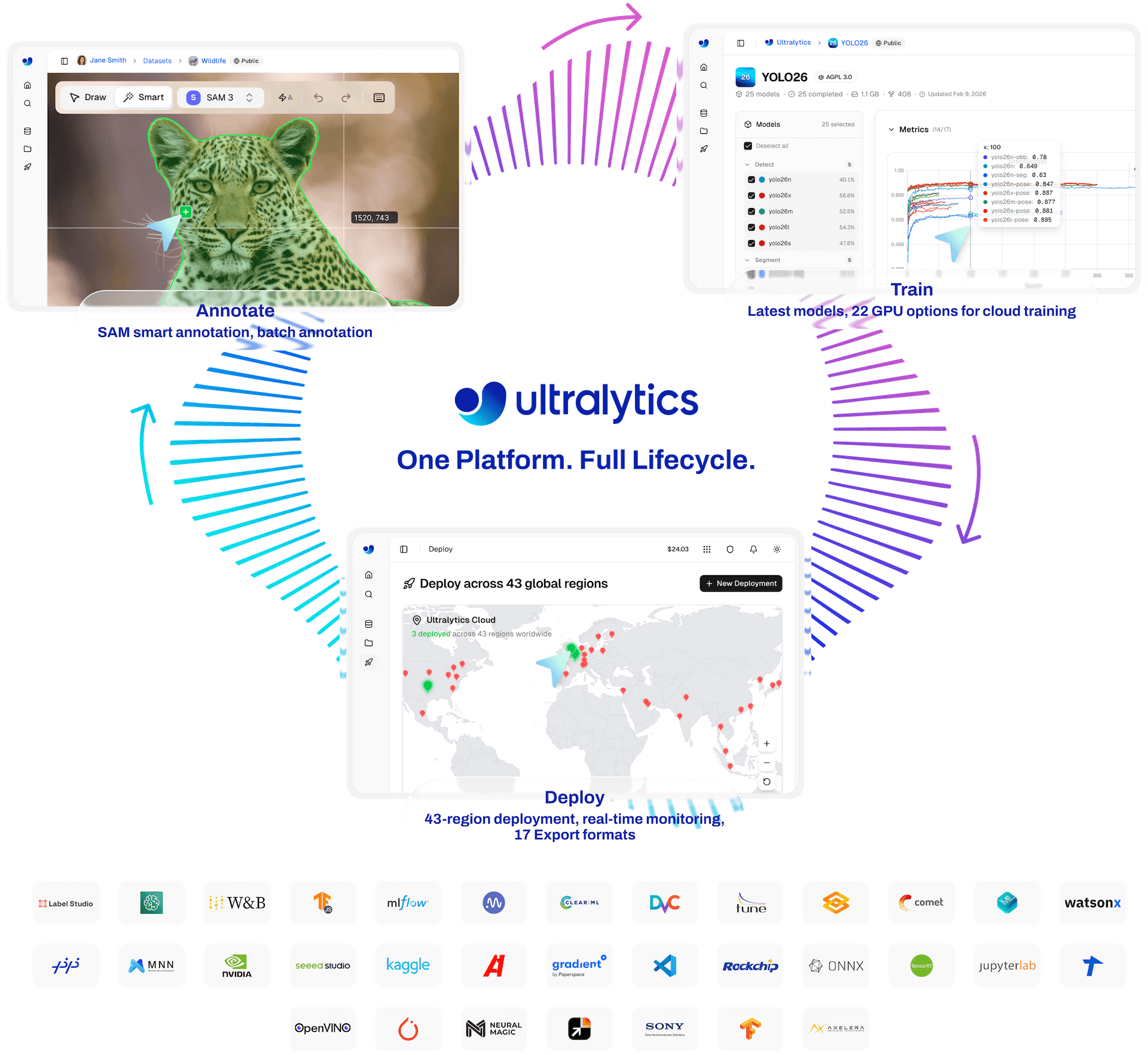
Our key integrations with leading AI platforms extend the functionality of Ultralytics' offerings, enhancing tasks like dataset labeling, training, visualization, and model management. Discover how Ultralytics, in collaboration with partners like Weights & Biases, Comet ML, Roboflow, and Intel OpenVINO, can optimize your AI workflow. Explore more at Ultralytics Integrations.
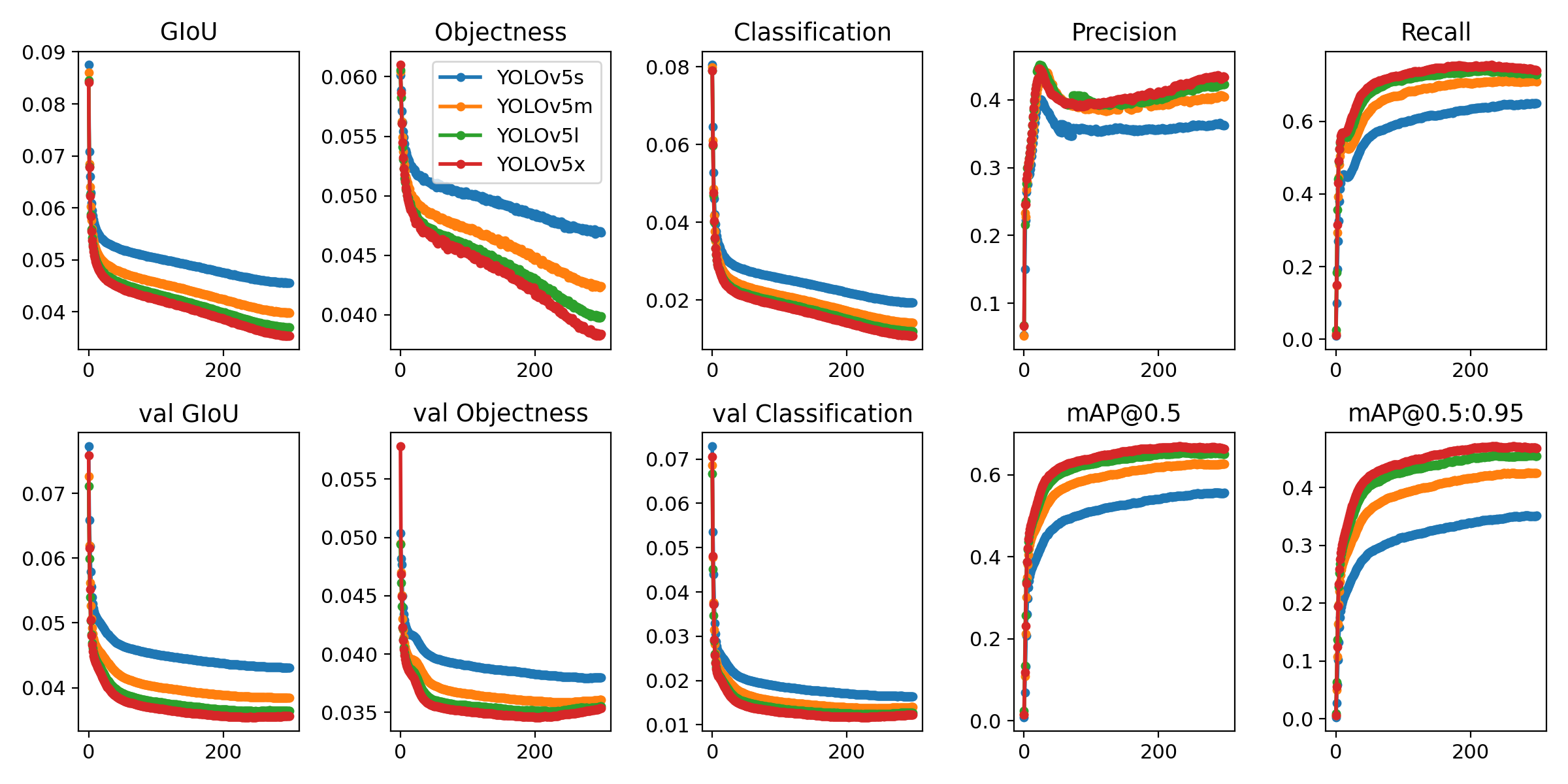
YOLOv5 is designed for simplicity and ease of use. We prioritize real-world performance and accessibility.
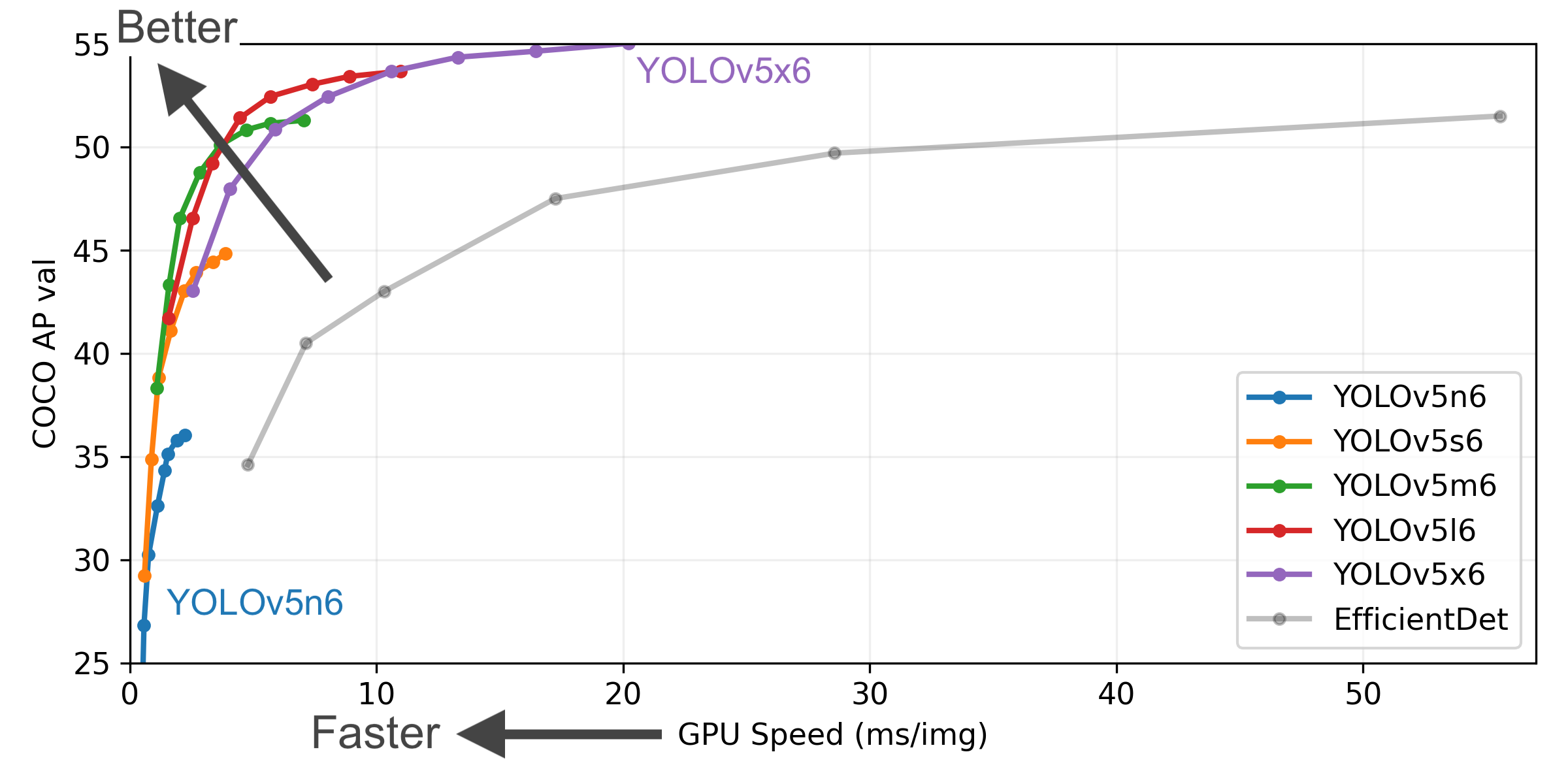
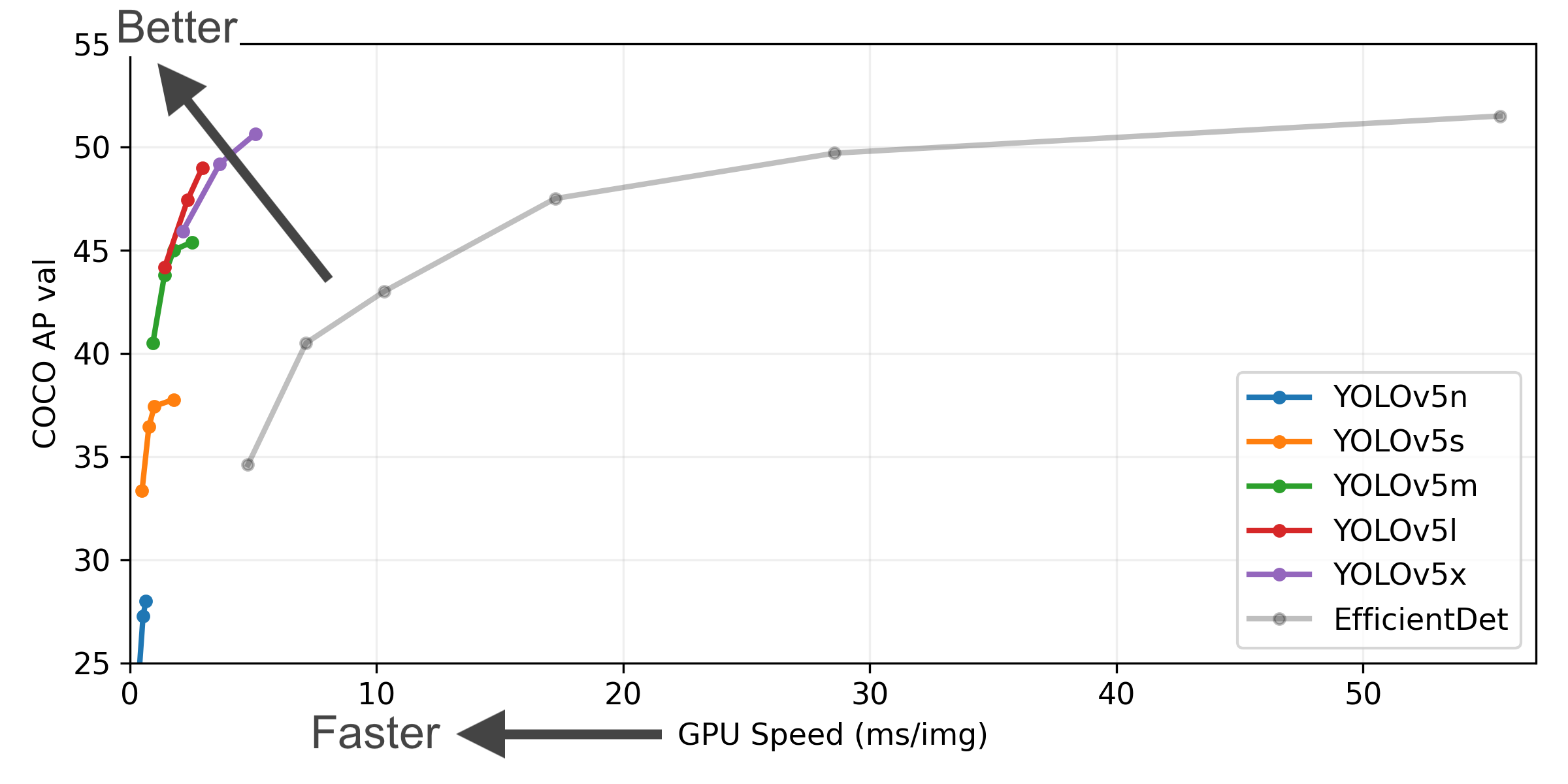
python val.py --task study --data coco.yaml --iou 0.7 --weights yolov5n6.pt yolov5s6.pt yolov5m6.pt yolov5l6.pt yolov5x6.ptThis table shows the performance metrics for various YOLOv5 models trained on the COCO dataset.
| Model | Size
(pixels) | mAPval
50-95 | mAPval
50 | Speed
CPU b1
(ms) | Speed
V100 b1
(ms) | Speed
V100 b32
(ms) | Params
(M) | FLOPs
@640 (B) |
| ----------------------------------------------------------------------------------------------------------------------------------------------------------------------- | --------------------- | -------------------- | ----------------- | ---------------------------- | ----------------------------- | ------------------------------ | ------------------ | ---------------------- |
| YOLOv5n | 640 | 28.0 | 45.7 | 45 | 6.3 | 0.6 | 1.9 | 4.5 |
| YOLOv5s | 640 | 37.4 | 56.8 | 98 | 6.4 | 0.9 | 7.2 | 16.5 |
| YOLOv5m | 640 | 45.4 | 64.1 | 224 | 8.2 | 1.7 | 21.2 | 49.0 |
| YOLOv5l | 640 | 49.0 | 67.3 | 430 | 10.1 | 2.7 | 46.5 | 109.1 |
| YOLOv5x | 640 | 50.7 | 68.9 | 766 | 12.1 | 4.8 | 86.7 | 205.7 |
| | | | | | | | | |
| YOLOv5n6 | 1280 | 36.0 | 54.4 | 153 | 8.1 | 2.1 | 3.2 | 4.6 |
| YOLOv5s6 | 1280 | 44.8 | 63.7 | 385 | 8.2 | 3.6 | 12.6 | 16.8 |
| YOLOv5m6 | 1280 | 51.3 | 69.3 | 887 | 11.1 | 6.8 | 35.7 | 50.0 |
| YOLOv5l6 | 1280 | 53.7 | 71.3 | 1784 | 15.8 | 10.5 | 76.8 | 111.4 |
| YOLOv5x6
+ [[TTA]](https://docs.ultralytics.com/yolov5/tutorials/test-time-augmentation) | 1280
1536 | 55.0
55.8 | 72.7
72.7 | 3136
- | 26.2
- | 19.4
- | 140.7
- | 209.8
- |
python val.py --data coco.yaml --img 640 --conf 0.001 --iou 0.65python val.py --data coco.yaml --img 640 --task speed --batch 1python val.py --data coco.yaml --img 1536 --iou 0.7 --augmentThe YOLOv5 release v7.0 introduced instance segmentation models designed for easy training, validation, and deployment. For full details, see the Release Notes and explore the YOLOv5 Segmentation Colab Notebook for quickstart examples.
→ →
→ →
→ →
→ →
→ →
→