1
 →
→
Turn any codebase, with its docs, SQL schemas, configs, and PDFs, into a queryable knowledge graph. A /graphify skill for Claude Code, Cursor, Codex, and Gemini CLI: local deterministic AST parsing
Graphify-Labs/graphify is an open-source project on GitHub, mainly written in Python. Turn any codebase, with its docs, SQL schemas, configs, and PDFs, into a queryable knowledge graph. It currently holds 125,254 stars and 0 forks with 0 open issues, and was last pushed on an unknown date (repository created unknown).
Git Homed tracks it on the AI Agent Skills Trending board and on the AI AI Agent Skills Trending list.

🇺🇸 English | 🇨🇳 简体中文 | 🇯🇵 日本語 | 🇰🇷 한국어 | 🇩🇪 Deutsch | 🇫🇷 Français | 🇪🇸 Español | 🇮🇳 हिन्दी | 🇧🇷 Português | 🇷🇺 Русский | 🇸🇦 العربية | 🇮🇷 فارسی | 🇮🇹 Italiano | 🇵🇱 Polski | 🇳🇱 Nederlands | 🇹🇷 Türkçe | 🇺🇦 Українська | 🇻🇳 Tiếng Việt | 🇮🇩 Bahasa Indonesia | 🇸🇪 Svenska | 🇬🇷 Ελληνικά | 🇷🇴 Română | 🇨🇿 Čeština | 🇫🇮 Suomi | 🇩🇰 Dansk | 🇳🇴 Norsk | 🇭🇺 Magyar | 🇹🇭 ภาษาไทย | 🇺🇿 Oʻzbekcha | 🇹🇼 繁體中文 | 🇵🇭 Filipino | 🇮🇱 עברית










Cut agent token spend by 80%. Graphify Cloud is always-on memory that governs your agents, keeps code quality high, and proves correctness with formal verification. Start a free 14-day trial →
Type /graphify in your AI coding assistant and it maps your entire project (code, docs, PDFs, images, videos) into a knowledge graph you can query instead of grepping through files.
EXTRACTED (explicit in the source) or INFERRED (resolved by graphify), so you can tell what was read directly from what was inferred.[!NOTE]
Want this always-on? Graphify Cloud keeps the graph live across your entire SDLC: monorepo and cross-repo support, formal verification, and code review with a bird's-eye view of your SDLC, plus connectors for Sentry, Jira, and more so incidents and tickets sit in the same graph as your code. Start a free 14-day trial at app.graphify.com.
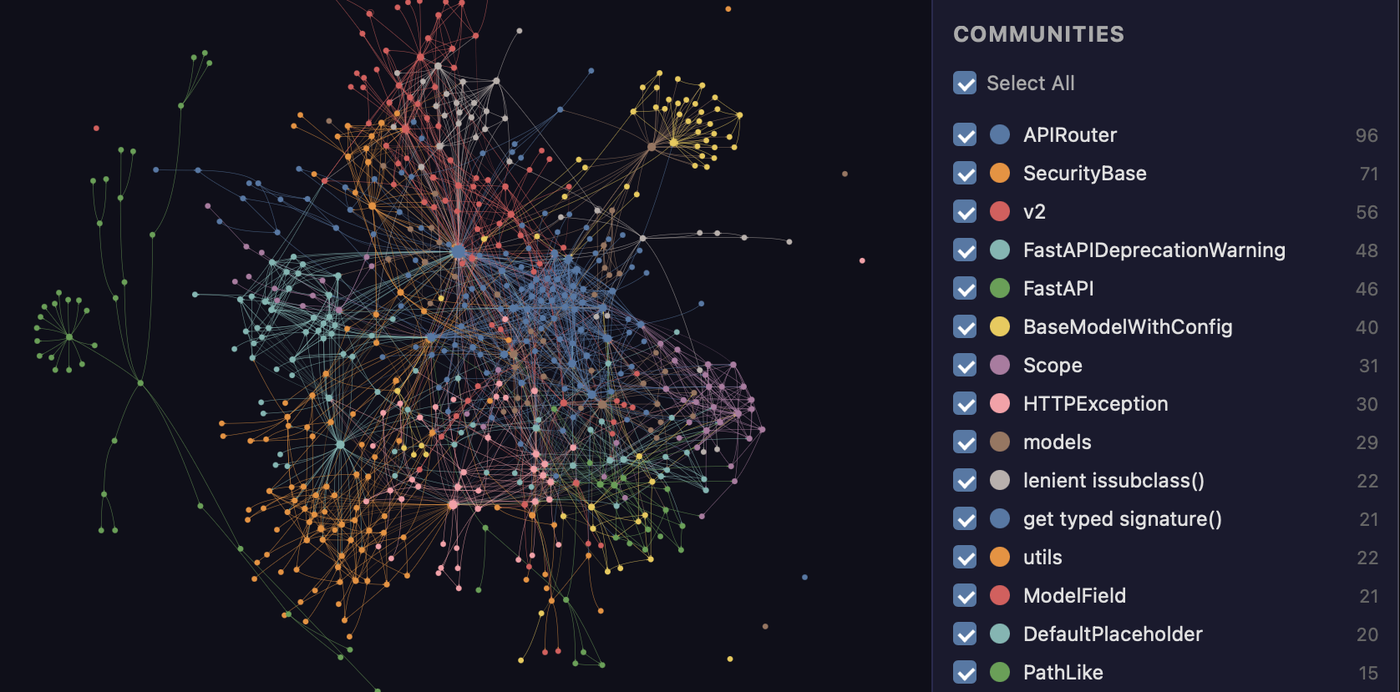
The FastAPI codebase mapped by graphify. Every node is a concept, colors are detected communities, and the whole thing is clickable in graph.html.
Get started (30 seconds):
uv tool install graphifyy      # install the CLI (or: pipx install graphifyy)
graphify install               # register the skill with your AI assistant
Then, in your AI assistant:
/graphify .
That's it. You get three files:
graphify-out/
├── graph.html       open in any browser — click nodes, filter, search
├── GRAPH_REPORT.md  the highlights: key concepts, surprising connections, suggested questions
└── graph.json       the full graph — query it anytime without re-reading your files
The persisted graph includes graph.schema_version so integrations can detect
incompatible format changes, plus graph.graphify_version identifying the
Graphify release that produced it.
Works in Claude Code, Cursor, Codex, Gemini CLI, GitHub Copilot, and 15+ more — pick your platform.
---
Full guides and reference live at docs.graphify.com:
Once the graph is built you query it instead of reading files. Real output, graphify run on the FastAPI codebase shown above:
$ graphify explain "APIRouter"
Node: APIRouter
  Source:    routing.py L2210
  Community: 2
  Degree:    47
Connections (47):
  --> RequestValidationError [uses] [INFERRED]
  --> Dependant [uses] [INFERRED]
  --> .get() [method] [EXTRACTED]
  <-- __init__.py [imports] [EXTRACTED]
  ...
$ graphify path "FastAPI" "ModelField"
Shortest path (3 hops):
  FastAPI --uses--> DefaultPlaceholder <--references-- get_request_handler() --references--> ModelField
Every edge carries a confidence tag (EXTRACTED = explicit in the source, INFERRED = derived by resolution), so you can tell what was read directly from what was inferred. graphify query "" returns a scoped subgraph for a plain-language question, and graphify path A B traces how any two things connect.
---
What you get out of the box:
| Capability | What you get |
|---|---|
| God nodes | The most-connected concepts, so you see what everything flows through |
| Communities | The graph split into subsystems (Leiden), with LLM-free labels |
| Cross-file links | calls / imports / inherits / mixes_in resolved across ~40 languages via tree-sitter AST |
| Query, path, explain | Ask a question, trace the path between two things, or explain one concept, all against graph.json |
| Rationale + doc refs | # NOTE: / # WHY: comments and ADR/RFC citations become first-class nodes linked to the code |
| Beyond code | Docs, PDFs, images, and video/audio all map into the same graph |
| Local-first | Code is parsed locally with tree-sitter (no LLM, nothing leaves your machine); only the semantic pass over docs/media calls a backend, and only if you configure one |
[!TIP]
Running this across many repos or a monorepo? Graphify Cloud does it continuously and cuts agent token spend by 80%, with cross-repo links, SDLC-wide code review, formal verification, and Sentry/Jira connectors. Start a free 14-day trial →
---
| Benchmark | Metric | graphify | Field | |---|---|---|---| | LOCOMO (n=300) | recall@10 | 0.497 | mem0 0.048, supermemory 0.149 | | LOCOMO (n=300) | QA accuracy | 45.3% | supermemory 49.7%, mem0 27.3% | | LongMemEval-S (n=50) | QA accuracy | 76% | tied with dense RAG | | ERPNext cross-tool (n=6) | key-fact coverage | 82.0% | grep/read baseline 70.8% | | Graph build | LLM credits | 0 | per-token for most systems |
Every system ran on the same harness with the same model and budgets, scored by a judge blind-validated against a second judge (90.6% agreement, Cohen's kappa 0.81). Full per-system tables, the code-intelligence result, and reproduction commands: BENCHMARKS.md.
---
| Requirement | Minimum | Check | Install |
|---|---|---|---|
| Python | 3.10+ | python --version | python.org |
| uv (recommended) | any | uv --version | curl -LsSf https://astral.sh/uv/install.sh \| sh |
| pipx (alternative) | any | pipx --version | pip install pipx |
macOS quick install (Homebrew):
brew install [email protected] uv
Windows quick install:
winget install astral-sh.uv
Ubuntu/Debian:
sudo apt install python3.12 python3-pip pipx
or install uv:
curl -LsSf https://astral.sh/uv/install.sh | sh
---
[!IMPORTANT]
Official package: The PyPI package isgraphifyy(double-y). Othergraphify*packages on PyPI are not affiliated. The CLI command is stillgraphify.
The official source repository is Graphify-Labs/graphify.
Step 1 — install the package:
# Recommended (isolated env; if 'graphify' isn't found after, run: uv tool update-shell):
uv tool install graphifyy
Alternatives:
pipx install graphifyy
pip install graphifyy  # may need PATH setup — see note below
Step 2 — register the skill with your AI assistant:
graphify install
That's it. Open your AI assistant and type /graphify .
To install the assistant skill into the current repository instead of your user
profile, add --project:
graphify install --project
graphify install --project --platform codex
Project-scoped installs write under the current directory, for example
.claude/skills/graphify/SKILL.md or .agents/skills/graphify/SKILL.md (plus a
references/ sidecar the skill loads on demand), and
print a git add hint for files that can be committed.
Per-platform commands that support project-scoped installs accept the same flag,
for example graphify claude install --project or graphify codex install --project.
[!TIP]
Hittingcommand not found, apip-on-Mac/Windows issue, PowerShell quoting,uvxusage, git-hook PATH quirks, or strict mode? See Installation and Troubleshooting.
| Platform | Install command |
|----------|----------------|
| Claude Code (Linux/Mac) | graphify install |
| Claude Code (Windows) | graphify install (auto-detected) or graphify install --platform windows |
| CodeBuddy | graphify install --platform codebuddy |
| Codex | graphify install --platform codex |
| OpenCode | graphify install --platform opencode |
| Kilo Code | graphify install --platform kilo |
| GitHub Copilot CLI | graphify install --platform copilot |
| VS Code Copilot Chat | graphify vscode install |
| Aider | graphify install --platform aider |
| OpenClaw | graphify install --platform claw |
| Factory Droid | graphify install --platform droid |
| Trae | graphify install --platform trae |
| Trae CN | graphify install --platform trae-cn |
| Gemini CLI | graphify install --platform gemini |
| Hermes | graphify install --platform hermes |
| Kimi Code | graphify install --platform kimi |
| Amp | graphify amp install |
| Agent Skills (cross-framework) | graphify install --platform agents (alias --platform skills) |
| Kiro IDE/CLI | graphify kiro install |
| Pi coding agent | graphify install --platform pi |
| Cursor | graphify cursor install |
| Devin CLI | graphify devin install |
| Google Antigravity | graphify antigravity install |
Codex users also need multi_agent = true under [features] in ~/.codex/config.toml for parallel extraction. CodeBuddy uses the same Agent tool and PreToolUse hook mechanism as Claude Code. Factory Droid uses the Task tool for parallel subagent dispatch. OpenClaw and Aider use sequential extraction (parallel agent support is still early on those platforms). Trae uses the Agent tool for parallel subagent dispatch and does not support PreToolUse hooks, so AGENTS.md is the always-on mechanism.
--platform agents (alias --platform skills) targets the generic cross-framework Agent-Skills locations: the spec's user-global ~/.agents/skills/ (read by npx skills and spec-compliant frameworks) for a global install, and ./.agents/skills/ for a project (--project) install. The bare graphify install stays single-platform (Claude Code) by design — use the named agents platform when you want the skill discoverable by any framework that reads .agents/skills.
Codex uses$graphifyinstead of/graphify.
| Extra | What it adds | Install |
|---|---|---|
| pdf | PDF extraction | uv tool install "graphifyy[pdf]" |
| office | .docx and .xlsx support | uv tool install "graphifyy[office]" |
| google | Google Sheets rendering | uv tool install "graphifyy[google]" |
| video | Video/audio transcription (faster-whisper + yt-dlp) | uv tool install "graphifyy[video]" |
| mcp | MCP stdio server | uv tool install "graphifyy[mcp]" |
| neo4j | Neo4j push support | uv tool install "graphifyy[neo4j]" |
| falkordb | FalkorDB push support | uv tool install "graphifyy[falkordb]" |
| svg | SVG graph export | uv tool install "graphifyy[svg]" |
| leiden | Leiden community detection (graspologic on Python < 3.13; native backend on 3.13+) | uv tool install "graphifyy[leiden]" |
| ollama | Ollama local inference | uv tool install "graphifyy[ollama]" |
| openai | OpenAI / OpenAI-compatible APIs | uv tool install "graphifyy[openai]" |
| gemini | Google Gemini API | uv tool install "graphifyy[gemini]" |
| anthropic | Anthropic Claude API (--backend claude, uses ANTHROPIC_API_KEY) | uv tool install "graphifyy[anthropic]" |
| bedrock | AWS Bedrock (uses IAM, no API key) | uv tool install "graphifyy[bedrock]" |
| azure | Azure OpenAI Service (--backend azure, uses AZURE_OPENAI_API_KEY + AZURE_OPENAI_ENDPOINT) | uv tool install "graphifyy[openai]" |
| sql | SQL schema extraction | uv tool install "graphifyy[sql]" |
| postgres | Live PostgreSQL introspection (--postgres DSN) | uv tool install "graphifyy[postgres]" |
| dm | BYOND DreamMaker .dm/.dme AST extraction (may need a C compiler + python3-dev if no wheel matches your platform) | uv tool install "graphifyy[dm]" |
| terraform | Terraform / HCL .tf/.tfvars/.hcl AST extraction | uv tool install "graphifyy[terraform]" |
| pascal | Pascal / Delphi .pas/.dpr/.dpk/.inc AST extraction (more accurate calls/inherits edges; falls back to a regex extractor when absent) | uv tool install "graphifyy[pascal]" |
| ocaml | OCaml .ml/.mli AST extraction | uv tool install "graphifyy[ocaml]" |
| commonlisp | Common Lisp .lisp/.cl/.lsp/.asd AST extraction | uv tool install "graphifyy[commonlisp]" |
| robot | Robot Framework .robot/.resource extraction (suites, test cases, keywords, keyword-call and resource/library import edges) | uv tool install "graphifyy[robot]" |
| chinese | Chinese query segmentation (jieba) | uv tool install "graphifyy[chinese]" |
| all | Everything above | uv tool install "graphifyy[all]" |
---
Run this once in your project after building a graph:
Run graphify install once in your project, for example graphify claude install or graphify codex install (or graphify install --platform ).
This writes a small config file that tells your assistant to consult the knowledge graph for codebase questions, preferring scoped queries like graphify query "" over reading the full report or grepping raw files.
AGENTS.md, .cursor/rules/, etc.) provide the same query-first guidance.GRAPH_REPORT.md is still available for broad architecture review.
CodeBuddy does the same two things as Claude Code: writes a CODEBUDDY.md section telling CodeBuddy to read graphify-out/GRAPH_REPORT.md before answering architecture questions, and installs PreToolUse hooks (.codebuddy/settings.json) that fire before Bash search commands and file reads, nudging toward graphify query instead.
Codex writes to AGENTS.md, which is what actually carries the always-on graph guidance on this platform. graphify codex install also registers a PreToolUse hook in .codex/hooks.json (graphify hook-check), but that entry is deliberately a no-op: Codex Desktop rejects hookSpecificOutput.additionalContext on PreToolUse, so emitting a nudge there would break Bash tool calls. Unlike Claude Code, where the hook (graphify hook-guard) does the nudging, on Codex the hook fires and intentionally does nothing, and AGENTS.md is the always-on mechanism.
Kilo Code installs the Graphify skill to ~/.config/kilo/skills/graphify/SKILL.md and a native /graphify command to ~/.config/kilo/command/graphify.md. graphify kilo install also writes AGENTS.md plus a native tool.execute.before plugin (.kilo/plugins/graphify.js + .kilo/kilo.json or .kilo/kilo.jsonc registration) so Kilo gets the same always-on graph reminder behavior through native .kilo config.
Cursor writes .cursor/rules/graphify.mdc with alwaysApply: true, so Cursor includes it in every conversation automatically, no hook needed.
To remove graphify from all platforms at once: graphify uninstall (add --purge to also delete graphify-out/). Or use the per-platform command (e.g. graphify claude uninstall).
---
GRAPH_REPORT.md summarizes the god nodes, communities, and key paths for broad architecture review. How the graph is built and what it contains: How graphify works.
---
graphify parses ~40 programming languages locally with tree-sitter AST, and maps docs, PDFs, images, and audio/video through an optional semantic pass. Full list: Supported inputs.
---
/graphify .                        # build graph for current folder
/graphify ./docs --update          # re-extract only changed files
/graphify . --cluster-only         # rerun clustering without re-extracting
/graphify . --cluster-only --resolution 1.5      # more granular communities
/graphify . --cluster-only --exclude-hubs 99     # suppress utility super-hubs from god-node rankings
/graphify . --no-viz               # skip the HTML, just the report + JSON
/graphify . --wiki                 # build a markdown wiki from the graph
graphify export callflow-html      # Mermaid architecture/call-flow HTML (auto-regenerates on every git commit if hook is installed)
/graphify query "what connects auth to the database?"
/graphify path "UserService" "DatabasePool"
/graphify explain "RateLimiter"
/graphify add https://arxiv.org/abs/1706.03762   # fetch a paper and add it
/graphify add                        # transcribe and add a video
graphify hook install              # auto-rebuild on commit + branch checkout (run graphify update . after git pull — see "Recommended workflow" below)
graphify merge-graphs a.json b.json              # combine two graphs
graphify prs                       # PR dashboard: CI state, review status, worktree mapping
graphify prs 42                    # deep dive on PR #42 with graph impact
graphify prs --triage              # AI ranks your review queue (uses whatever backend is configured)
graphify prs --conflicts           # PRs sharing graph communities — merge-order risk
See the full command reference below.
---
graphify honors .gitignore and supports --exclude patterns and a project .graphifyignore. Details: Configuration.
---
Commit or share the graph so your whole team queries the same context, and review pull requests with graph context. See Share context with your team and Review pull requests.
---
Beyond your AI assistant, query `graph.js
→ →
→ →
→ →
→ →
→ →
→ →
→ →
→