1
 →
→
Autonomous penetration testing using a swarm of AI agents. Orchestrates recon, classification, exploitation, and reporting specialists with ReAct reasoning — supports bug bounty
Armur-Ai/Pentest-Swarm-AI is an open-source project on GitHub, mainly written in Go. Autonomous penetration testing using a swarm of AI agents. Orchestrates recon, classification, exploitation It currently holds 2,614 stars and 479 forks with 15 open issues, and was last pushed on 2026-09-25 (repository created 2024-03-26).
Git Homed tracks it on the Today's Trending board, currently at rank #78 with 35 new stars today.
Dozens of AI agents don't just scan — they exploit. They chain attacks (BOLA/IDOR, JWT forgery, mass assignment, SSRF, injection), build and score attack paths, and prove real vulnerabilities at machine speed.
Built for pentesters · bug bounty hunters · red teamers · security researchers

📖 Documentation · Quick Start · vs. XBOW · Swarm vs. Multi-Agent · How It Works · Roadmap







📖 New here? Start with the documentation — quickstart, provider setup, CLI reference, and troubleshooting. (Or run pentestswarm docs to open it.)
XBOW proved a point: AI can top the bug-bounty leaderboards. But XBOW is a closed, hosted SaaS — one agent, on their cloud, on their model, at their price. We think the future of offense is open, self-hosted, and a swarm — so we built it.
| | Pentest Swarm AI | XBOW | |---|:---:|:---:| | Open source | ✅ AGPL, fork it | ❌ closed | | Self-hosted | ✅ your infra, your model, $0 floor | ❌ their cloud, their bill | | A real swarm | ✅ dozens of agents, concurrent | ❌ single agent |
Three structural wins — and the swarm is the one that compounds. This isn't a single planner LLM walking recon → classify → exploit → report down a fixed line. Dozens of agents work your surface at once, coordinating through a shared stigmergic blackboard: the instant a finding lands it wakes whichever agent it's relevant to, so a 1,000-subdomain target gets hit in parallel — attacking at machine speed. And unlike a scanner that spits out unverified "maybes," the swarm exploits what it finds, proves it with captured evidence, then writes the report.
Who it's for: pentesters covering a whole scope overnight · bug bounty hunters racing to first-blood on a fresh target · red teamers who need breadth fast · researchers pushing autonomous offense.
Run it on any model — Claude, anything OpenAI-compatible (incl. Together AI's hosted Llama/Qwen/DeepSeek), the new security-tuned open models (Pentest-R1 and the wave behind it), or fully local Ollama / LM Studio. We don't compete with those models — we're the harness that gives them hands: real tools, swarm coordination, scope safety, and evidence-backed reports. Air-gapped, zero API cost, and not one byte of your data leaving your box.
For authorized testing only — see the disclaimer below.
---
### Credits & Inspiration
This project stands on the shoulders of giants. We credit and thank these projects for pioneering AI-powered offensive security:
> - PentestGPT — the OG that proved LLMs can pentest
- PentAGI — fully autonomous agent architecture
- Strix — AI hackers that find and fix vulns
- CAI — cybersecurity AI framework, 3600x faster than humans
- HackingBuddyGPT — LLM hacking in 50 lines of code
- Shannon — white-box AI pentester
- BlacksmithAI — multi-agent pentest framework
- PentestAgent — black-box AI security testing
> Their open-source contributions made tools like this possible.
Legal Disclaimer: Pentest Swarm AI is designed exclusively for authorized security testing, bug bounty programs, CTF competitions, and educational research. You must obtain explicit written permission from the target system owner before running any scan. Unauthorized access to computer systems is illegal under the Computer Fraud and Abuse Act (CFAA), the Computer Misuse Act, and equivalent laws worldwide. The authors and contributors of this project accept no liability for misuse, damage, or any illegal activity conducted with this tool. By using this software, you agree that you are solely responsible for ensuring your use complies with all applicable laws and regulations. Do not use this tool against systems you do not own or have explicit authorization to test.
---
Most "multi-agent" pentesting tools are a single planner LLM dispatching to specialist agents in a fixed order — recon → classify → exploit → report. That's a pipeline, not a swarm.
Pentest Swarm AI is built around three swarm-intelligence primitives:
📖 Full write-up: Architecture — Swarm vs. Pipeline (the blackboard, pheromone decay, emergent chains, and why concurrency stays cheap). Diagrams also live in docs/.
We built this because the category was empty. Every tool marketed as "swarm" was actually a pipeline. If you find a counter-example, open an issue — we'll add them to the comparison table.
---
One command to install. One command to run. No API key, no cloud, no bill to start.
npm install -g @armurai/pentestswarm                                       # npm (Node ≥16)
curl -fsSL https://raw.githubusercontent.com/Armur-Ai/Pentest-Swarm-AI/main/scripts/install.sh | sh   # any macOS/Linux
brew install Armur-Ai/tap/pentestswarm                                     # Homebrew
go install github.com/Armur-Ai/Pentest-Swarm-AI/cmd/pentestswarm@latest    # Go toolchain
docker run --rm ghcr.io/armur-ai/pentestswarm:latest --help                # Docker
pentestswarm run
That's it. run opens the interactive TUI launcher — no flags to memorize:
localhost:7777 and a full-screen terminal TUI with live charts, a swarm-topology diagram, and a graded findings stream. Both, by default.run just wraps scan, so everything is scriptable too:
# watch it find a real vuln in ~2 min — bundled lab, local model, no key
pentestswarm scan --lab --lab-target crapi --provider ollama --swarm --tui
a real target, cloud model for max quality
export PENTESTSWARM_ORCHESTRATOR_API_KEY=your-key-here
pentestswarm scan  --scope  --swarm --follow
New here? pentestswarm demo plays the whole campaign offline — that's the GIF above. Running inside GitHub Actions? See deploy/github-action/example-workflow.yml.
---
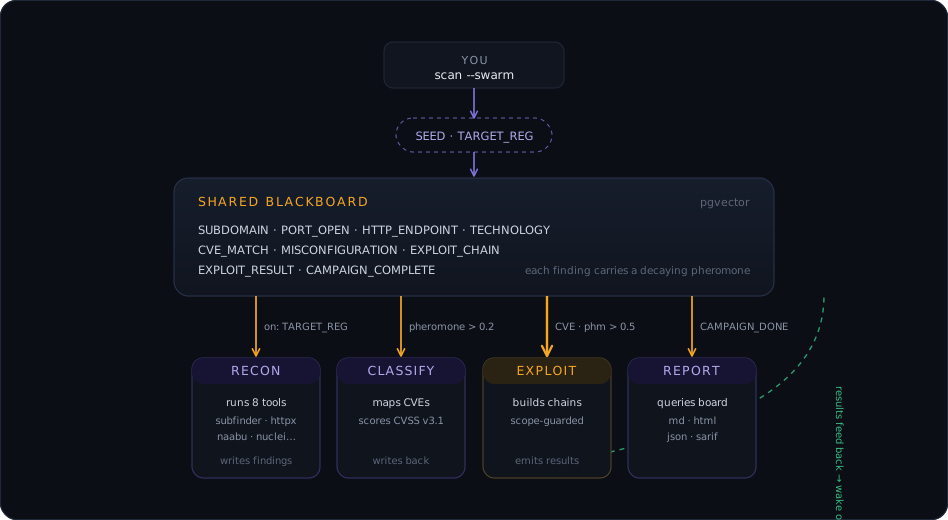
Key behaviours:
1. Agents are independent. Any one of them can be removed, replaced, or added without rewiring the others.
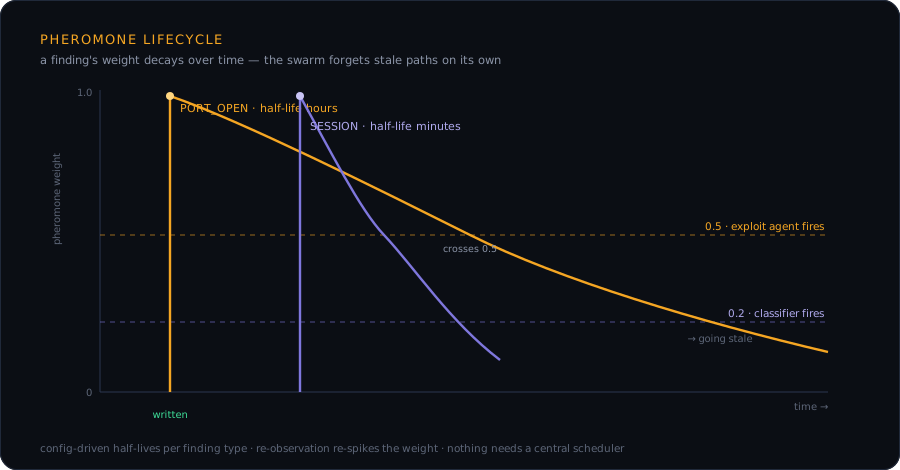
2. Pheromones decay per-finding-type. A PORT_OPEN stays hot for hours; a SESSION for minutes. Config-driven half-lives.
3. Scope is enforced at the tool layer and again at the executor. Defence in depth — --scope is not bypassable.
4. Cleanup is always registered before execution. SIGINT, crashes, and budget exhaustion all trigger reverse-order cleanup. See internal/pipeline/cleanup_memory.go and cleanup.go.
5. Prompt caching on Claude cuts cost and latency on repeated system prompts (enabled by default for recon + classifier).
---
How we position vs. the rest of the ecosystem. We'll ship real benchmark numbers in a future release (see the benchmarks roadmap).
| Tool | Open / self-host | Architecture | Executes vs. suggests | Memory | Tools wired | MCP | Swarm? | |---|---|---|---|---|---|---|---| | Pentest Swarm AI | ✅ open, self-hosted | Stigmergic blackboard | Executes | pgvector + pheromones | 8 ProjectDiscovery + nmap; sqlmap / Burp MCP / Metasploit in roadmap | Yes | ✅ real | | XBOW | ❌ closed SaaS | Autonomous agent (hosted) | Executes | Hosted | Managed | No public API | No | | PentestGPT | ✅ open | Single-agent ReAct | Suggests | None | None native | No | No | | HackingBuddyGPT | ✅ open | Single-agent | Executes | Run logs | Shell passthrough | No | No | | PentAGI | ✅ open | 4 agents + planner | Executes | pgvector | 40+ via MCP/shell | Partial | Pipeline | | Shannon | ✅ open | White-box + browser | Executes | Session state | Browser DOM | No | Pipeline | | HexStrike | ✅ open | MCP tool wrapper | Delegates to client LLM | None (stateless) | 150+ via MCP | Yes | No | | Pentest-R1 | ✅ open (model) | RL-tuned LLM | Executes | Trajectory | CTF-scope | No | No |
If any entry here is wrong or out of date, please open a PR — we want this table to stay honest.
---
Honesty labels: stable means shipped + tested, beta means works but rough edges, alpha means experimental, planned means in the roadmap.
| Feature | Status | Notes |
|---|---|---|
| Sequential 5-phase runner | stable | Default mode; battle-tested core |
| Stigmergic swarm scheduler | alpha | --swarm flag; memory-backed blackboard wired |
| ProjectDiscovery toolchain | stable | subfinder, httpx, nuclei, naabu, katana, dnsx, gau |
| nmap adapter | stable | XML parsed; scope-validated |
| Cleanup registry | stable | Always runs on SIGINT / exit / budget-cancel |
| Claude prompt caching | stable | Enabled for recon + classifier by default |
| --strict LLM mode | stable | Promotes LLM errors to fatal |
| CVSS v3.1 scoring | stable | FIRST spec |
| Jev false-positive filter | beta | --jev; optional second-opinion pass via TypeSafe's Jev — off by default, fails open. Docs |
| Jev adaptive attack-path scoring | beta | --jev-adaptive; the swarm scores its candidate attack strategies with Jev in real time and pursues the best first (graded pheromone). Off by default, fails open. |
| Exploit chains | beta | chain run/list/update; a growing library of named, CVE-tied exploit chains (SSRF→RCE, auth-bypass→RCE…) — fingerprint + safe verify + report. Lean binary + on-demand updates. Docs |
| Postgres blackboard backend | beta | Migration shipped; runner uses memory-board for now |
| MCP server | beta | pentestswarm mcp serve |
| VS Code extension | beta | deploy/vscode/ |
| GitHub Action | beta | deploy/github-action/action.yml with SARIF |
| Swarm playbooks (5) | beta | playbooks/{bug-bounty,external-asm,ci-cd,internal-network,ctf-solver}.yaml |
| Live dashboard | alpha | web/; UI built, wiring to live campaigns in progress |
| Burp MCP bridge | planned | Wave 2 |
| Metasploit / ZAP / sqlmap adapters | planned | Wave 2 |
| Fine-tuned Pentest-Swarm model | planned | Wave 3 (Pentest-R1 recipe) |
| Cybench / AutoPenBench benchmarks | planned | Wave 3 |
---
pentestswarm run                                        # ⭐ Interactive TUI — pick options + target, no flags
pentestswarm scan  --scope  --swarm      # Scriptable: stigmergic swarm scheduler
pentestswarm scan  --scope  --tui        # Full-screen live TUI (charts + swarm topology)
pentestswarm scan --lab --lab-target crapi              # Attack a bundled vulnerable lab, no setup
pentestswarm playbook run  --target            # Run a community playbook
pentestswarm doctor                                     # System health check
pentestswarm install-tools                              # Fetch the recon/exploit toolchain
pentestswarm mcp serve                                  # MCP server for Claude/Cursor
pentestswarm serve                                      # Start API server + dashboard
pentestswarm run is the front door — an interactive launcher (provider + key entry, target or bundled lab, live-view choice, readiness checks) so you never have to remember flags. The scan form stays fully scriptable for CI.
---
All agents inherit from a single provider config. Set one key, the entire swarm works.
Bring your own model — we're the harness, not the model. A new wave of open models is topping the cyber-offense benchmarks — GLM (5.3), Qwen (3.x), DeepSeek, and security-tuned fine-tunes like Pentest-R1. Pentest Swarm turns any of them — or a frontier model, or a fully-local one — into an operating pentester: real tools, swarm coordination, scope enforcement, and evidence-backed reports. The model does the reasoning; the swarm does the work.
Together AI is first-class — pick together (in pentestswarm run or --provider together) and just add your key; the endpoint is handled for you. Any other OpenAI-API-compatible endpoint (OpenAI, DeepSeek, Groq, …) works via openai + a base-URL, plus first-party Gemini. The only hard requirement is native tool/function calling, which GLM, Qwen, and DeepSeek all support.
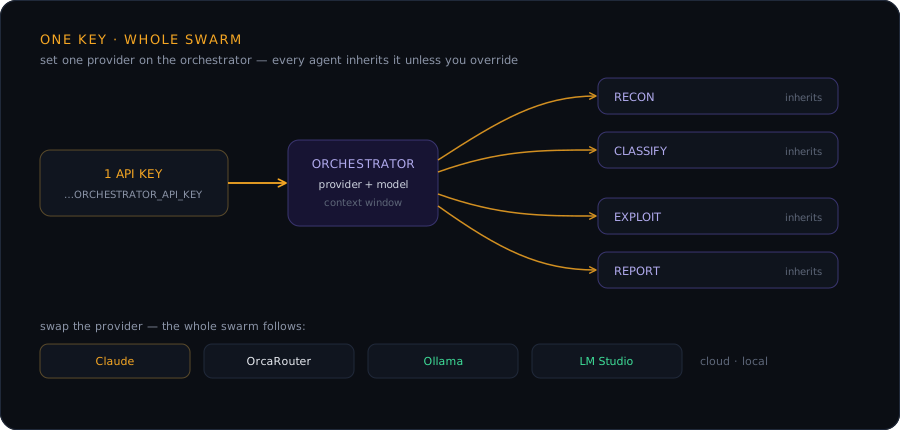
| Provider | provider: | Setup | Privacy | Best for |
|----------|-------------|-------|---------|----------|
| Claude (default) | claude | export PENTESTSWARM_ORCHESTRATOR_API_KEY=... | Cloud | Best quality, zero setup, prompt caching |
| Together AI | together | Just set the key — endpoint auto-configured | Cloud | Open cyber-benchmark leaders: GLM zai-org/GLM-5.3, Qwen Qwen/..., DeepSeek, Kimi |
| OpenAI-compatible | openai | Set key + the vendor's /v1 endpoint | Cloud | OpenAI, DeepSeek, Groq, or any Chat-Completions API |
| Gemini | gemini | export PENTESTSWARM_ORCHESTRATOR_API_KEY=AIza... | Cloud | Large context, free tier |
| Ollama | ollama | Install Ollama + pull models | 100% local | Full privacy, air-gapped (GLM / Qwen builds available) |
| LM Studio | lmstudio | Load model, enable server | 100% local | GUI model management |
| OrcaRouter | orcarouter | export PENTESTSWARM_ORCHESTRATOR_API_KEY=sk-orca-... | Cloud | One endpoint for Claude/GPT + other frontier models, gateway-level security |
Together AI example — run the whole swarm on GLM 5.3:
orchestrator:
  provider: "together"             # first-class — endpoint defaults to Together's API
  model: "zai-org/GLM-5.3"        # or Qwen/..., deepseek-ai/..., etc. — see together.ai/models
  api_key: ""                      # or export PENTESTSWARM_ORCHESTRATOR_API_KEY
  context_window: 128000
---
| Component | Technology | Why | |-----------|-----------|-----| | Platform | Go 1.24 | Single binary, goroutine concurrency, native security tools | | CLI | Cobra + bubbletea | Beautiful TUI with multi-panel agent view | | LLM | Claude / Together AI (GLM · Qwen · DeepSeek) / Gemini / OrcaRouter / Ollama / LM Studio | Best quality cloud + open cyber-bench leaders + full privacy local | | Security Tools | subfinder · httpx · nuclei · naabu · katana · dnsx · gau · nmap | ProjectDiscovery Go libs + nmap subprocess | | Blackboard | Postgres 16 + pgvector | Transactional writes, vector similarity, pheromone decay in SQL | | Cache | Redis 7 | Rate limiting, session state | | Dashboard | Next.js 15 + shadcn/ui + tremor | Dark-first, chart-heavy | | MCP | JSON-RPC stdio | Claude Desktop + Cursor integration |
---
git clone https://github.com/Armur-Ai/Pentest-Swarm-AI.git
cd Pentest-Swarm-AI
./scripts/setup.sh    # Install tools, start Postgres/Redis/Ollama
make build            # Compile binary
make test             # Run tests
make dev              # Hot-reload development
Regenerate the demo GIF after any CLI change:
brew install vhs      # one-off
vhs docs/demo-flashy.tape
---
Today the swarm reacts to findings and runs verified attack playbooks (BOLA/IDOR, mass assignment, NoSQL injection, excessive data exposure) end-to-end. Next, we make it think — three major capabilities, each shipping as its own release:
Follow the GitHub Project board for live status.
---
Single agents are tools. Pipelines dressed up as agents are slightly fancier tools. A swarm is different: agents share an environment, each agent's writes influence other agents' behaviour, and the useful work is emergent rather than prescribed. That's what lets a swarm handle a 1,000-subdomain target without anyone writing a plan for it.
One agent is a tool. A swarm is a platform.
---
We're building the first real open-source pentest swarm in the open — come build it with us. In Discord you can share findings, request a tool adapter, argue about stigmergy and pheromone decay, get help running your first scan, or grab a good first issue and ship a PR. Researchers, red-teamers, and the AI-security-curious all welcome.
⭐ If a real open-source swarm is something you want to exist, drop a star. Star velocity is the fuel that keeps this shipping — it's the single biggest thing you can do in ten seconds.
---
Running Pentest Swarm — internally, on client engagements, in CI, or embedded in your own workflow? Add your org to ADOPTERS.md with a quick PR — it helps others trust the project and helps us prioritize what to build. Not ready to be listed publicly? A hello in [Disco
→ →
→ →
→ →
→ →
→ →
→ →→
→→