1
 →
→
SeaweedFS is a distributed storage system for object storage (S3), file systems, and Iceberg tables, designed to handle billions of files with O(1) disk access and effortless horizontal scaling.






SeaweedFS is a simple and highly scalable distributed file system. There are two objectives:
1. to store billions of files! 2. to serve the files fast!
One weed binary serves an S3 object store, a POSIX file system, and a lakehouse with S3 Tables, all over the same data. Each blob is one disk read away, capacity grows by starting another volume server, and cloud storage can be cached or tiered transparently.
Download the latest binary from the releases page and unzip the single weed (or weed.exe) file, or let the install script put it in /usr/local/bin:
curl -fsSL https://raw.githubusercontent.com/seaweedfs/seaweedfs/master/install.sh | bash
Then start a ready-to-use S3 object store:
AWS_ACCESS_KEY_ID=admin \
AWS_SECRET_ACCESS_KEY=secret \
S3_BUCKET=my-bucket \
./weed mini -dir=./data
That's it. The S3 endpoint is at http://localhost:8333, my-bucket exists, and admin/secret are valid credentials:
AWS_ACCESS_KEY_ID=admin AWS_SECRET_ACCESS_KEY=secret \
  aws --endpoint-url http://localhost:8333 s3 cp README.md s3://my-bucket/
The same process also runs the master, a volume server, the filer, WebDAV, the Iceberg REST catalog, and the Admin UI. Add S3_TABLE_BUCKET=warehouse to also create an Iceberg table bucket, or warehouse:LANCE for a Lance one. Drop the AWS keys to run without authentication for development.
macOS: if the binary is quarantined, run xattr -d com.apple.quarantine ./weed first.
weed mini is auto-tuned for one node and is fine for single-node production, such as an S3 gateway that issues presigned URLs. See [Quick Start with weed mini][WeedMini].
docker run -p 8333:8333 -v weed-data:/data \
  -e AWS_ACCESS_KEY_ID=admin \
  -e AWS_SECRET_ACCESS_KEY=secret \
  -e S3_BUCKET=my-bucket \
  chrislusf/seaweedfs
Same behavior as the weed mini command above.
To run master, volume server, filer, S3, and WebDAV as separate services:
wget https://raw.githubusercontent.com/seaweedfs/seaweedfs/master/docker/seaweedfs-compose.yml
wget -P prometheus https://raw.githubusercontent.com/seaweedfs/seaweedfs/master/docker/prometheus/prometheus.yml
docker compose -f seaweedfs-compose.yml -p seaweedfs up
[Docker Compose for S3][DockerComposeS3] adds credentials, and the docker/compose folder has variants for replication, mounts, message queues, and more.
helm repo add seaweedfs https://seaweedfs.github.io/seaweedfs/helm
helm install seaweedfs seaweedfs/seaweedfs -n seaweedfs --create-namespace -f values.yaml
A production-shaped values.yaml for a three-node cluster: two copies of every write, three masters, and an S3 endpoint with credentials and a bucket.
global:
seaweedfs:
enableReplication: true
replicationPlacement: "001" # one extra copy on another server; "002" for two
master:
replicas: 3
data:
type: persistentVolumeClaim # the cluster's default storage class; add storageClass to pick one
size: 1Gi
volume:
replicas: 3 # at least 1 + the sum of the replication digits
dataDirs:
- name: data
type: persistentVolumeClaim
size: 500Gi
maxVolumes: 0 # size the volume count from the disk
filer:
replicas: 2
data:
type: persistentVolumeClaim
size: 20Gi
s3:
enabled: true
replicas: 2
enableAuth: true
credentials:
admin:
accessKey: admin
secretKey: change-me
createBuckets:
- name: app-storage
The S3 endpoint is the seaweedfs-s3 service on port 8333. [Helm Chart Recipes][HelmRecipes] has values for a development cluster, a lakehouse with the Iceberg catalog exposed, filer metadata on PostgreSQL, and node-local disks. The [SeaweedFS Operator][Operator] and the [CSI driver][SeaweedFsCsiDriver] are the other Kubernetes paths.
git clone https://github.com/seaweedfs/seaweedfs.git
cd seaweedfs/weed && make install
weed lands in $GOPATH/bin. [Getting Started][GettingStarted] covers running master, volume, filer, and S3 as separate processes.
Capacity is a volume server. Start one on any machine with disk and point it at the master:
weed volume -dir=/data -master=<master_host>:9333
Nothing rebalances until you ask it to. Throughput is a filer or S3 gateway; they are stateless, so run as many as you need behind a load balancer. [Production Setup][ProductionSetup] walks through a multi-node cluster.
weed benchmark][Benchmarks] writes 1KB files at 15,700 per second and reads them back at 47,000 per second, and a mixed S3 [warp][S3Benchmark] run totals 3.2 GiB/s. Numbers are in the Benchmark section; throughput grows with volume servers and gateways.
weed shell][WeedShell] or the [maintenance worker][Worker].The S3 gateway implements the object, bucket, S3 Tables, IAM, and STS APIs on one endpoint, so the AWS SDKs and CLI, rclone, restic, Spark, and Trino work unchanged.
| API | Operations | | --- | --- | | S3 bucket and object | 73 | | S3 Tables | 36 | | IAM | 39 | | STS | 5 |
SeaweedFS is a lakehouse in one system. [S3 Table Buckets][S3TableBucket] hold Apache Iceberg tables by default, or [Lance][LanceCatalog] tables for vectors and multimodal data, and the built-in [Iceberg REST Catalog][IcebergCatalog] and Lance namespace serve them directly. There is no Hive Metastore, Glue, or separate catalog service to deploy, secure, and back up.
S3_TABLE_BUCKET=warehouse ./weed mini -dir=./data brings the whole stack up on a laptop.
[Cloud Drive][CloudDrive] mounts a bucket from S3, Google Cloud Storage, Azure, Backblaze B2, Wasabi, Storj, or any S3-compatible store into SeaweedFS and serves it at local speed:
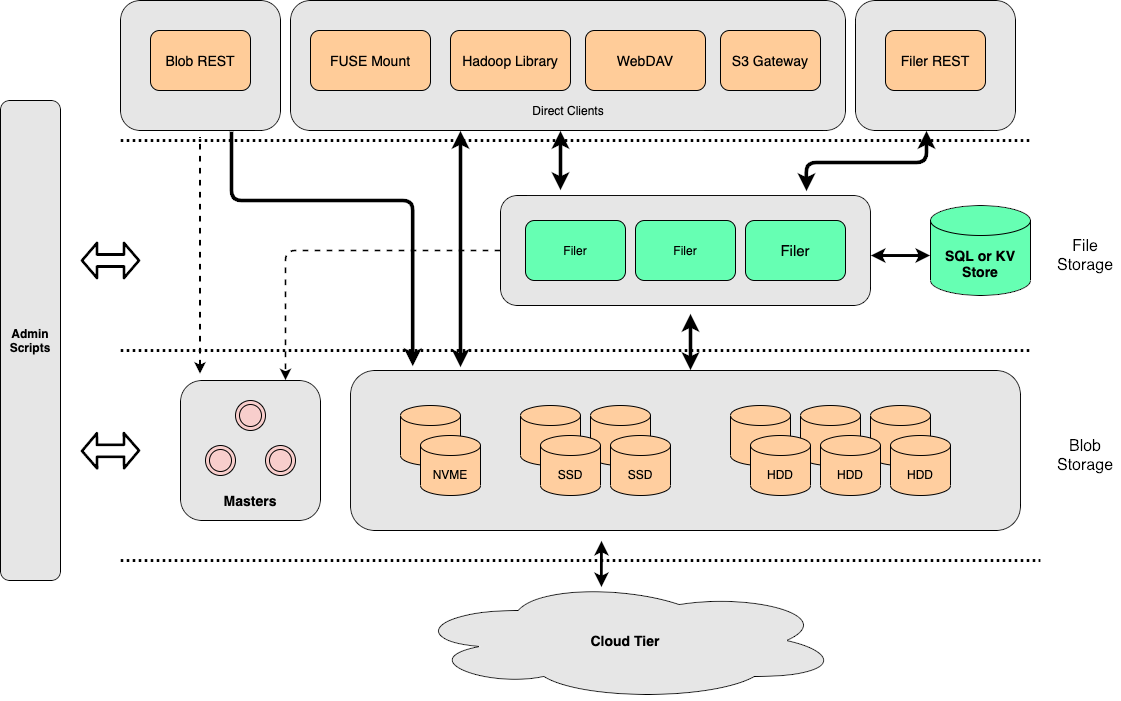
Most other distributed file systems seem more complicated than necessary.
SeaweedFS is meant to be fast and simple, in both setup and operation. If you do not understand how it works when you reach here, we've failed! Please raise an issue with any questions or update this file with clarifications.
SeaweedFS is constantly moving forward. Same with other systems. These comparisons can be outdated quickly. Please help to keep them updated.
HDFS uses the chunk approach for each file, and is ideal for storing large files.
SeaweedFS is ideal for serving relatively smaller files quickly and concurrently.
SeaweedFS can also store extra large files by splitting them into manageable data chunks, and store the file ids of the data chunks into a meta chunk. This is managed by "weed upload/download" tool, and the weed master or volume servers are agnostic about it.
The architectures are mostly the same. SeaweedFS aims to store and read files fast, with a simple and flat architecture. The main differences are
GlusterFS stores files, both directories and content, in configurable volumes called "bricks". It hashes the path and filename into ids, and assigned to virtual volumes, and then mapped to "bricks".
MooseFS chooses to neglect small file issue. From moosefs 3.0 manual, "even a small file will occupy 64KiB plus additionally 4KiB of checksums and 1KiB for the header", because it "was initially designed for keeping large amounts (like several thousands) of very big files"
MooseFS Master Server keeps all meta data in memory. Same issue as HDFS namenode.
Ceph can be setup similar to SeaweedFS as a key->blob store. It is much more complicated, with the need to support layers on top of it. Here is a more detailed comparison
SeaweedFS has a centralized master group to look up free volumes, while Ceph uses hashing and metadata servers to locate its objects. Having a centralized master makes it easy to code and manage.
Ceph, like SeaweedFS, is based on the object store RADOS. Ceph is rather complicated with mixed reviews.
Ceph uses CRUSH hashing to automatically manage data placement, which is efficient to locate the data. But the data has to be placed according to the CRUSH algorithm. Any wrong configuration would cause data loss. Topology changes, such as adding new servers to increase capacity, will cause data migration with high IO cost to fit the CRUSH algorithm. SeaweedFS places data by assigning them to any writable volumes. If writes to one volume failed, just pick another volume to write. Adding more volumes is also as simple as it can be.
SeaweedFS is optimized for small files. Small files are stored as one continuous block of content, with at most 8 unused bytes between files. Small file access is O(1) disk read.
SeaweedFS Filer uses off-the-shelf stores, such as MySql, Postgres, Sqlite, Mongodb, Redis, Elastic Search, Cassandra, HBase, MemSql, TiDB, CockroachCB, Etcd, YDB, to manage file directories. These stores are proven, scalable, and easier to manage.
| SeaweedFS | comparable to Ceph | advantage | | ------------- | ------------- | ---------------- | | Master | MDS | simpler | | Volume | OSD | optimized for small files | | Filer | Ceph FS | linearly scalable, Customizable, O(1) or O(logN) |
Please note, as Apr 25, 2026 MinIO ceased development. It's strongly discouraged to use that unmaintained software with multiple security bugs. RustFS is a MinIO reimplementation in Rust, Apache 2.0 licensed and still developed, keeping MinIO's storage model down to a byte-compatible on-disk format. So the points below apply to both.
MinIO followed AWS S3 closely and was ideal for testing for S3 API. It had good UI, policies, versionings, etc. SeaweedFS is trying to catch up here.
The metadata are in simple files. Each file write incurs extra writes to the corresponding meta file, on every drive of the erasure set. Changing only tags or retention rewrites that meta file on all of them, so the write amplification does not shrink with object size.
There is no optimization for lots of small files. The files are simply stored as is to local disks. Plus the extra meta file and shards for erasure coding, it only amplifies the LOSF problem.
Multiple disk IO are needed to read one file. SeaweedFS has O(1) disk reads, even for erasure coded files.
Erasure coding is full-time. SeaweedFS uses replication on hot data for faster speed and optionally applies erasure coding on warm data.
No POSIX-like API support.
There are specific requirements on storage layout, which makes it hard to scale out and to maintain. An erasure set must be 2 to 16 drives and must divide the drive list symmetrically, and capacity grows or shrinks a whole pool at a time. In SeaweedFS, just start one volume server pointing to the master. That's all.
Unscientific single-machine numbers from a MacBook with an SSD. [weed benchmark][Benchmarks], 1 million 1KB files, concurrency 16:
| | Requests per second | p50 | p99 | | --- | --- | --- | --- | | Write | 15,708 | 0.8 ms | 2.6 ms | | Random read | 47,019 | 0.3 ms | 0.7 ms |
make benchmark runs [warp][S3Benchmark] mixed S3 traffic against a local weed server:
``` Mixed operations. Operation: DELETE, 10%, Concurrency: 20, Ran 42s.
→ →
→ →
→ →
→ →
→ →
→