1
 →
→
Local-first AI coding agent desktop: Electron + Rust host core + pi Agent Harness + user-installable plugins
vastsa/PI-Desktop is an open-source project on GitHub, mainly written in TypeScript. Local-first AI coding agent desktop: Electron + Rust host core + pi Agent Harness + user-installable plugins It currently holds 4,666 stars and 394 forks with 0 open issues, and was last pushed on an unknown date (repository created unknown).
Git Homed tracks it on the Today's Trending board.

Bring projects, agents, models, plugins, and workflows into one persistent desktop environment.
Local-first · Model-agnostic · Plugin-powered · macOS / Windows / Linux





Download · Documentation · Build a Plugin · Screenshots · 简体中文
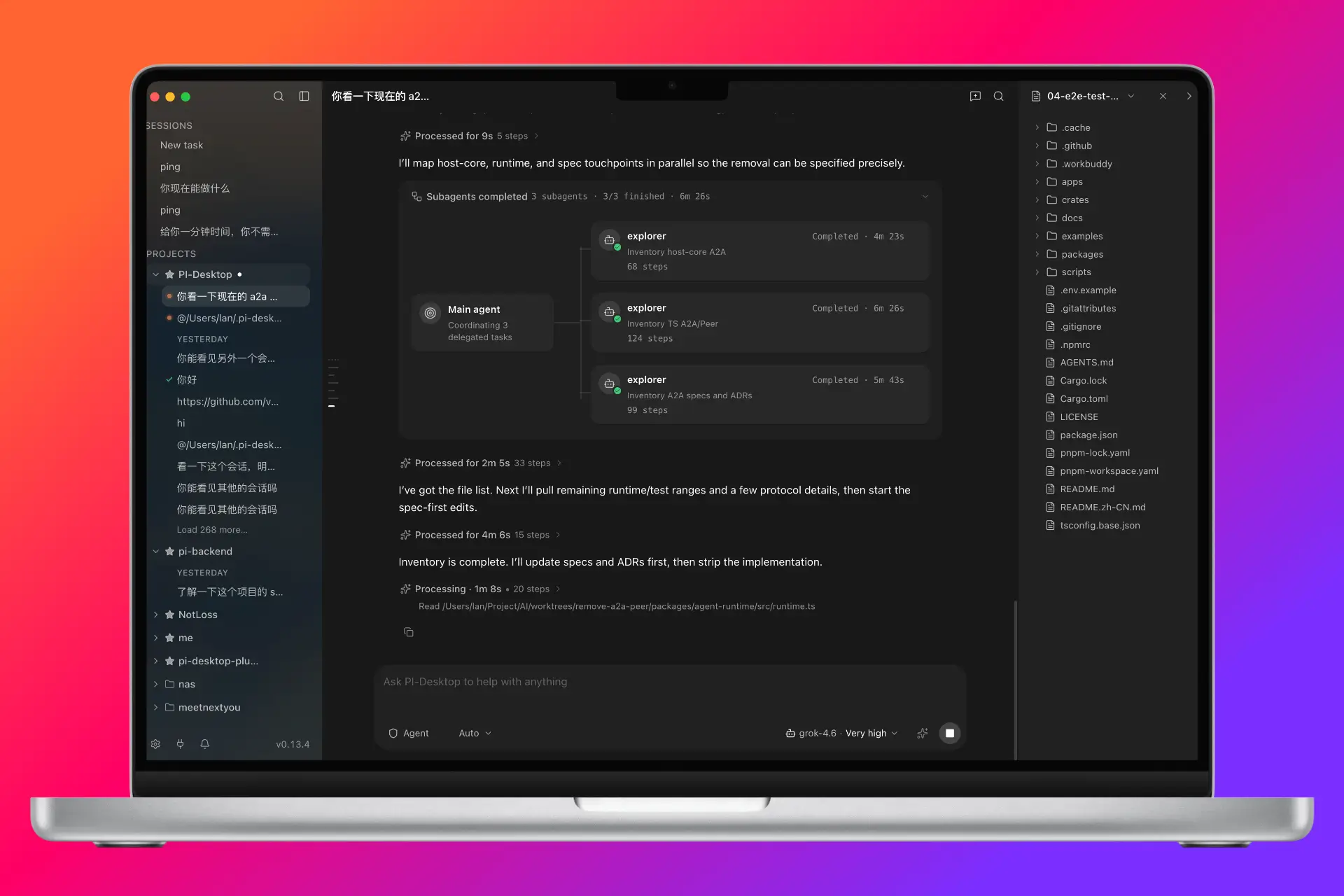
Your projects stay local · Your models stay replaceable · Your workspace stays yours
---
Terminal agents are great at execution. IDE agents are great at living inside an editor.
PI-Desktop goes one step further:
Give AI agents a persistent, independent, and extensible desktop workspace of their own.
Independent WorkspaceNo dependency on a specific IDE or terminal. Projects, sessions, reviews, previews, and agents all live in their own workspace. |
Plugin-PoweredPlugins extend more than the agent. Add panels, views, widgets, tools, MCP servers, themes, and background services. |
Agent OrchestrationOne agent is not always enough. Delegate to Subagents or coordinate full Worker Sessions in parallel. |
Model FreedomCloud models, local models, custom gateways, compatible APIs. Switch models without rebuilding your workflow. |
It is not a wrapper around one model. It is not another IDE extension.
---
PI-Desktop keeps the Core focused.
Your actual workflow is assembled through extensions.
AgentExtend what the agent can do Agent Tools Skills Completion pi Extensions |
WorkspaceExtend the desktop itself Commands Panels Work Panel Views Floating Widgets Themes |
PlatformExtend the runtime MCP Servers Resident Services Plugin Message Bus |
A plugin does not have to be “just another tool.”
It can be an entire product:
Voice Agent
├── Floating Widget
├── Speech Service
├── Agent Tool
└── Commands
GitHub Workspace
├── Work Panel
├── MCP Server
├── Agent Tools
└── Background Service
Session Analytics
├── Dashboard
├── Commands
└── Workspace View
| Capability | What it enables | | ------------------- | -------------------------------------------------------------- | | Command | Add actions to the global command system | | Panel | Open a standalone plugin interface | | Floating Widget | Build voice orbs, status lights, timers, and other floating UI | | Work Panel View | Add new views to the right-side workspace | | Agent Tool | Register tools callable by the agent | | Completion | Use the models already configured by the user | | Skill | Add reusable agent capabilities and workflows | | Theme | Customize workspace appearance | | MCP Server | Connect local or remote MCP servers | | Service | Run persistent background work | | Message Bus | Let plugins communicate with each other |
Plugins can be distributed as .piplug packages or installed through the marketplace.
---
                         PI-Desktop
                             │
          ┌──────────────────┼──────────────────┐
          │                  │                  │
        Agent            Workspace           Platform
          │                  │                  │
     Agent Tools           Panels              MCP
       Skills             Widgets            Services
     Subagents             Views            Message Bus
   pi Extensions          Themes
          │                  │                  │
          └──────────────────┼──────────────────┘
                             │
                       Your Workflow
PI-Desktop can simply be your coding agent.
Or you can turn it into:
AI Development Workspace · Voice Agent · DevOps Console · GitHub Workspace · Data Assistant · Multi-Agent Control Center · Automation Platform
The Core provides the foundation. Plugins decide what your workspace becomes.
---
AgentGive it a task. Let it work. Read code, edit files, run commands, test, and iterate. Best for day-to-day development. |
PlanReview the approach before execution. The agent studies the project first and produces an implementation plan. Best for refactors and high-risk changes. |
GoalDefine the outcome. Let the agent choose the path. Lock the objective and acceptance criteria, then let the agent drive execution. Best for complex and long-running tasks. |
Privileged operations still pass through PI-Desktop's permission layer.
---
Complex work should not be forced into one context window.
PI-Desktop provides two levels of delegation.
Delegate independent work to background agents:
Code exploration · Implementation · Test analysis · Research · Review
Each Subagent gets its own context and reports the result back to the parent agent.
For longer-lived work, delegate to full Worker Sessions.
Main Session
│
├── Worker A
│   └── Frontend
│
├── Worker B
│   └── Backend
│
├── Worker C
│   └── Tests
│
└── Worker D
    └── Review
Workers are full PI-Desktop sessions:
Independent context · Independent execution · Directly inspectable · Reusable · Full transcript
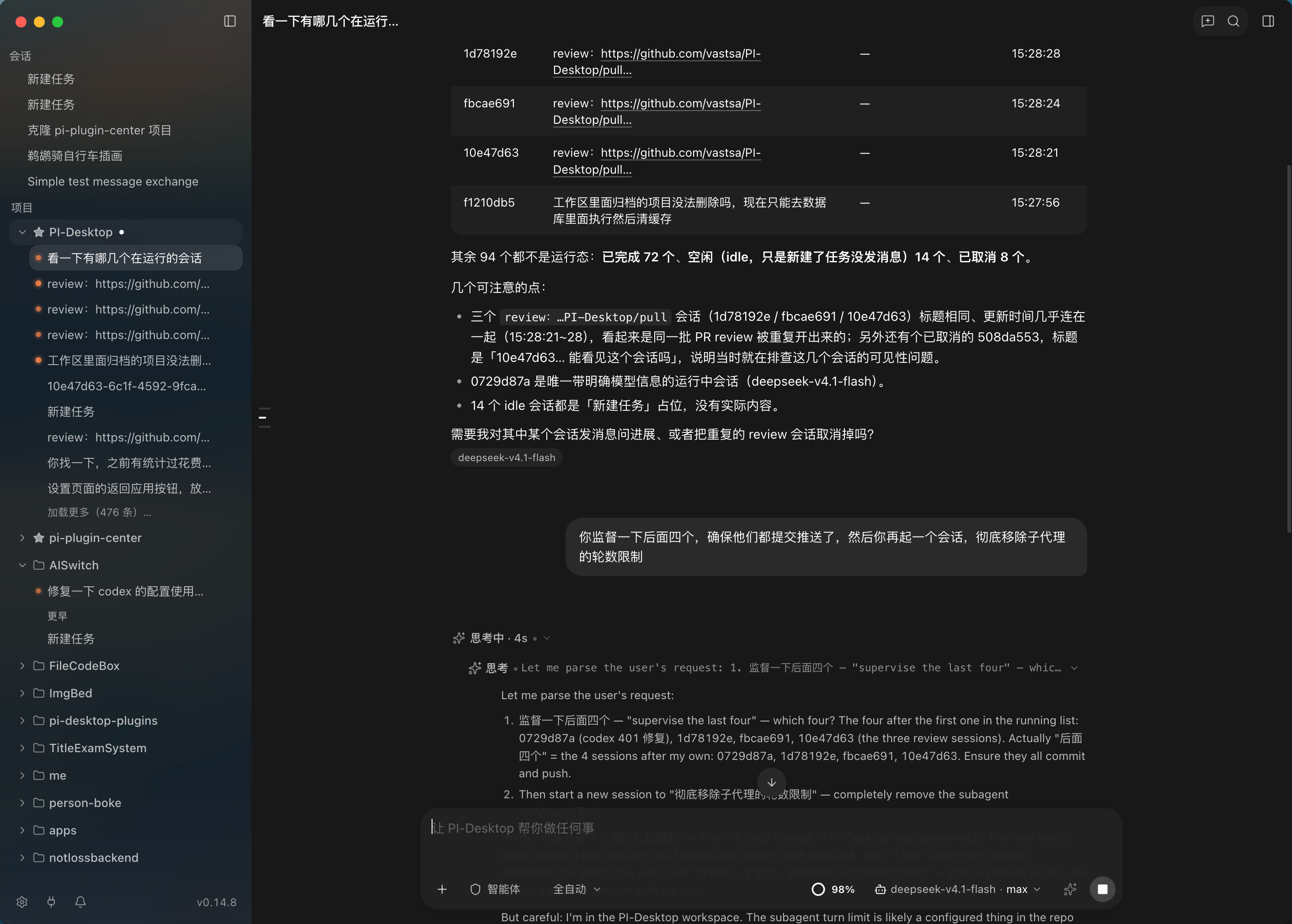
Coordinate multiple Worker Sessions from one parent Session |
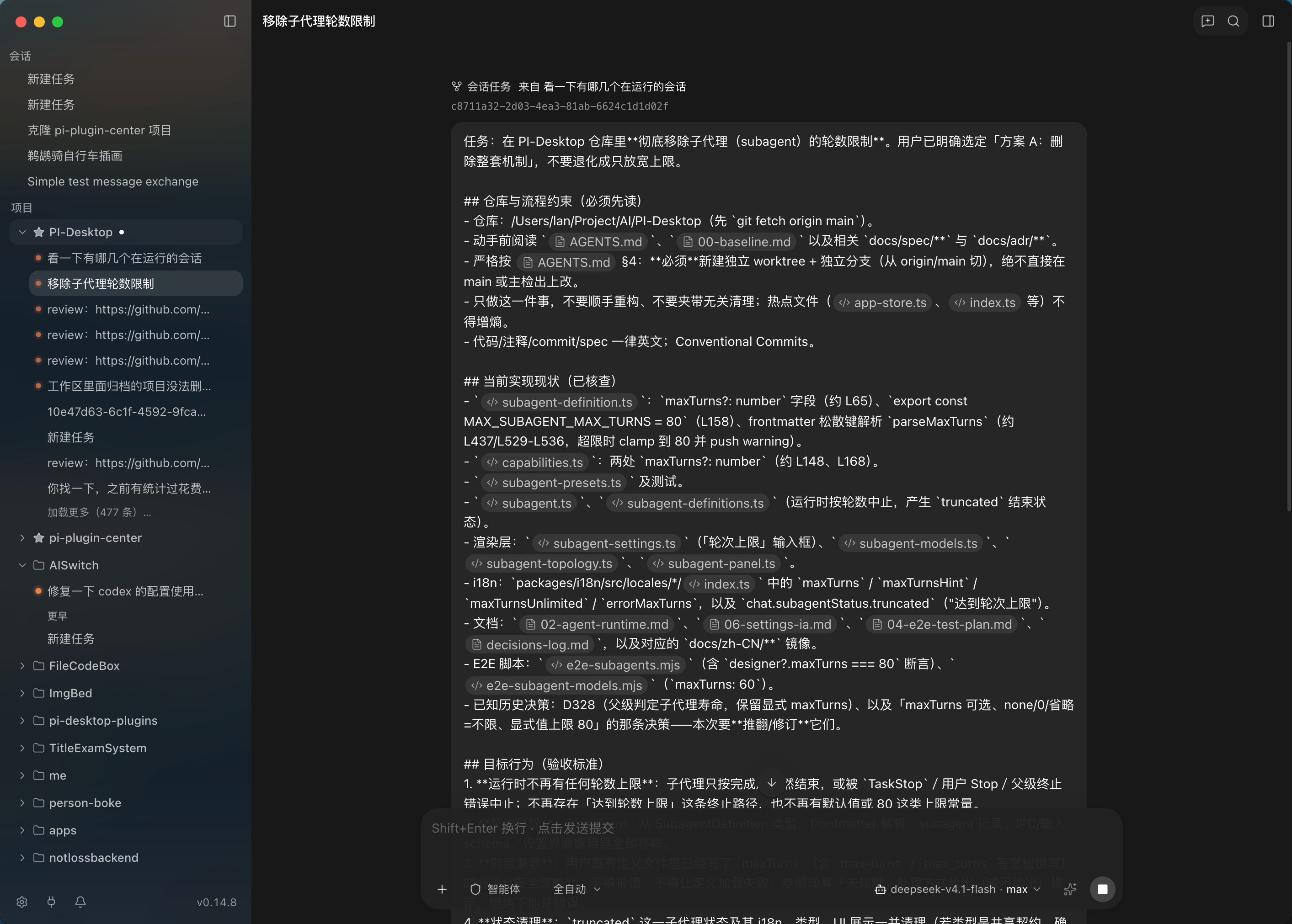
Each Worker remains a full, inspectable Session |
Move from “one agent helps me code” to “multiple agents divide and complete the work.”
---
PI-Desktop is organized around:
—not around disposable chat threads.
You can:
@---
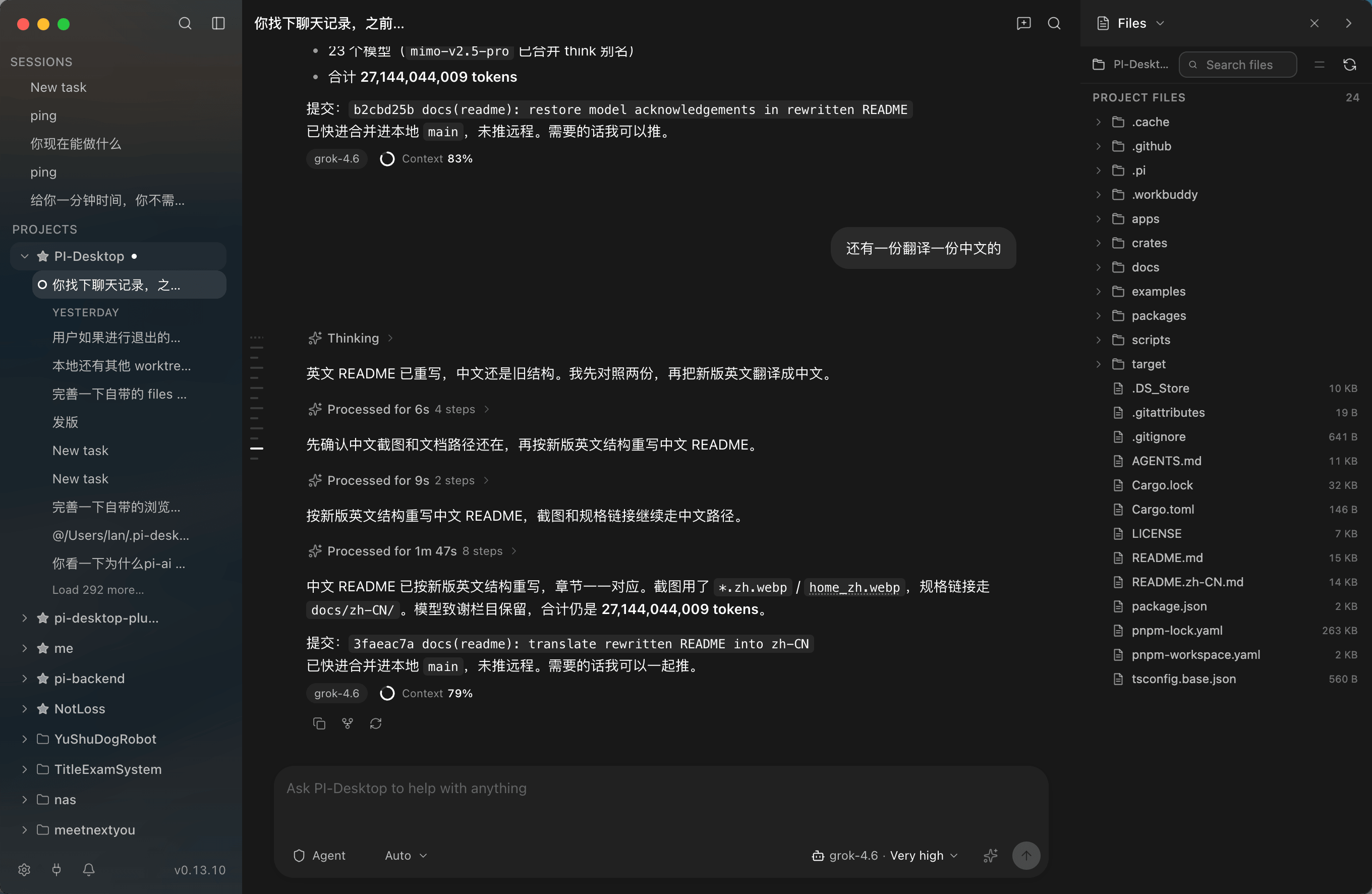
Persistent Sessions instead of disposable chats |
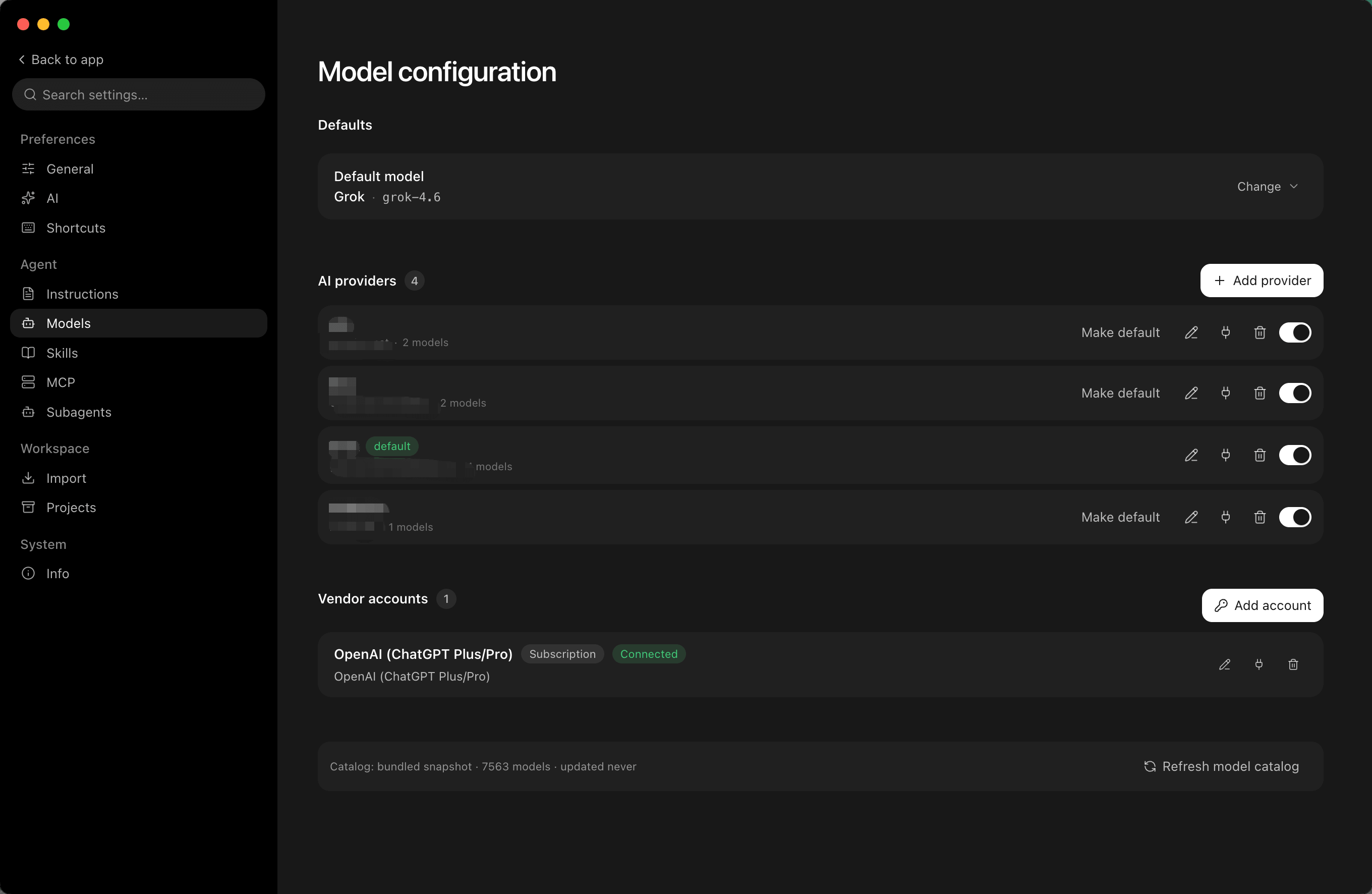
Switch models and reasoning levels inside the Session |
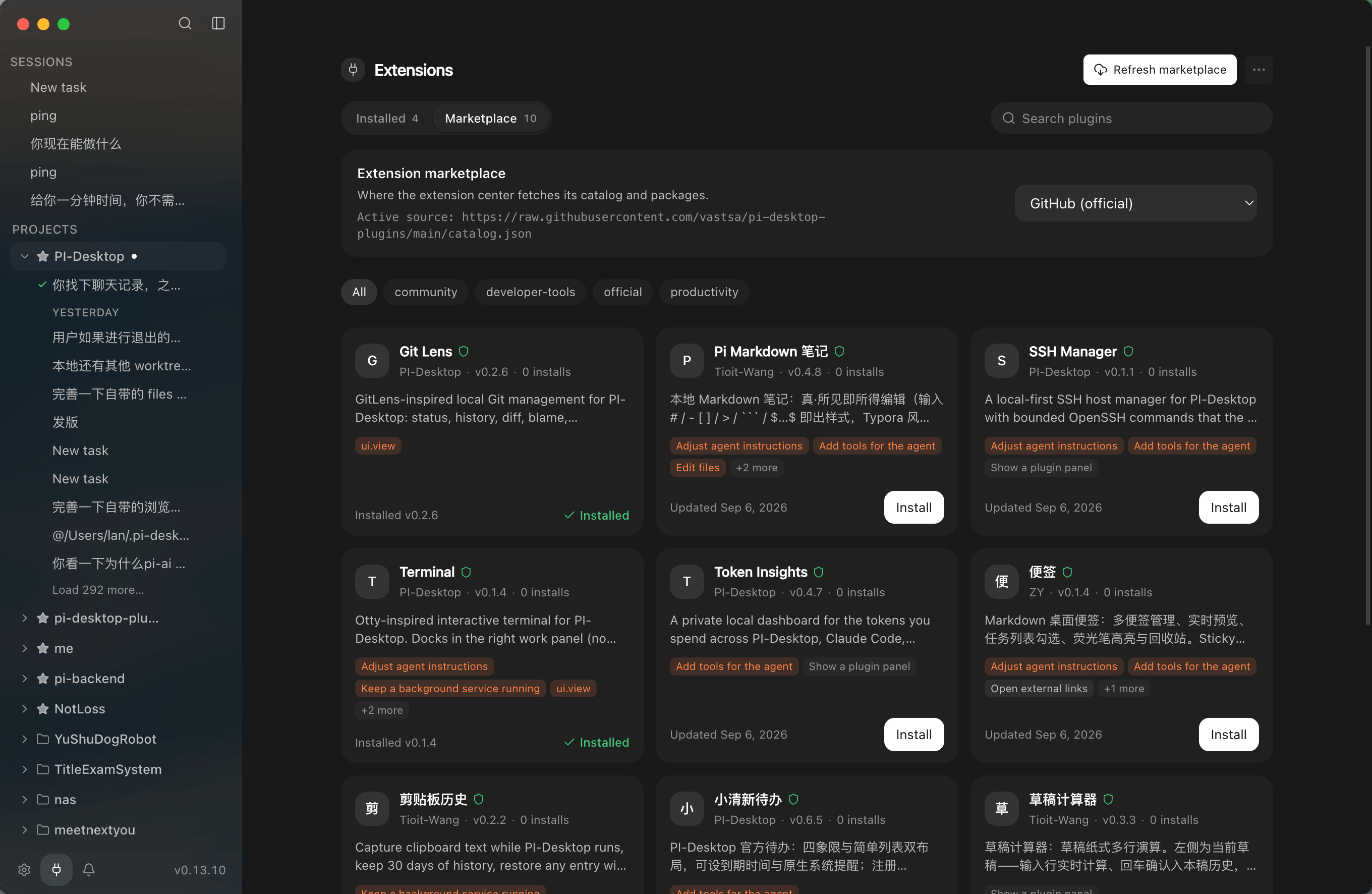
A plugin marketplace that extends both the agent and the desktop |
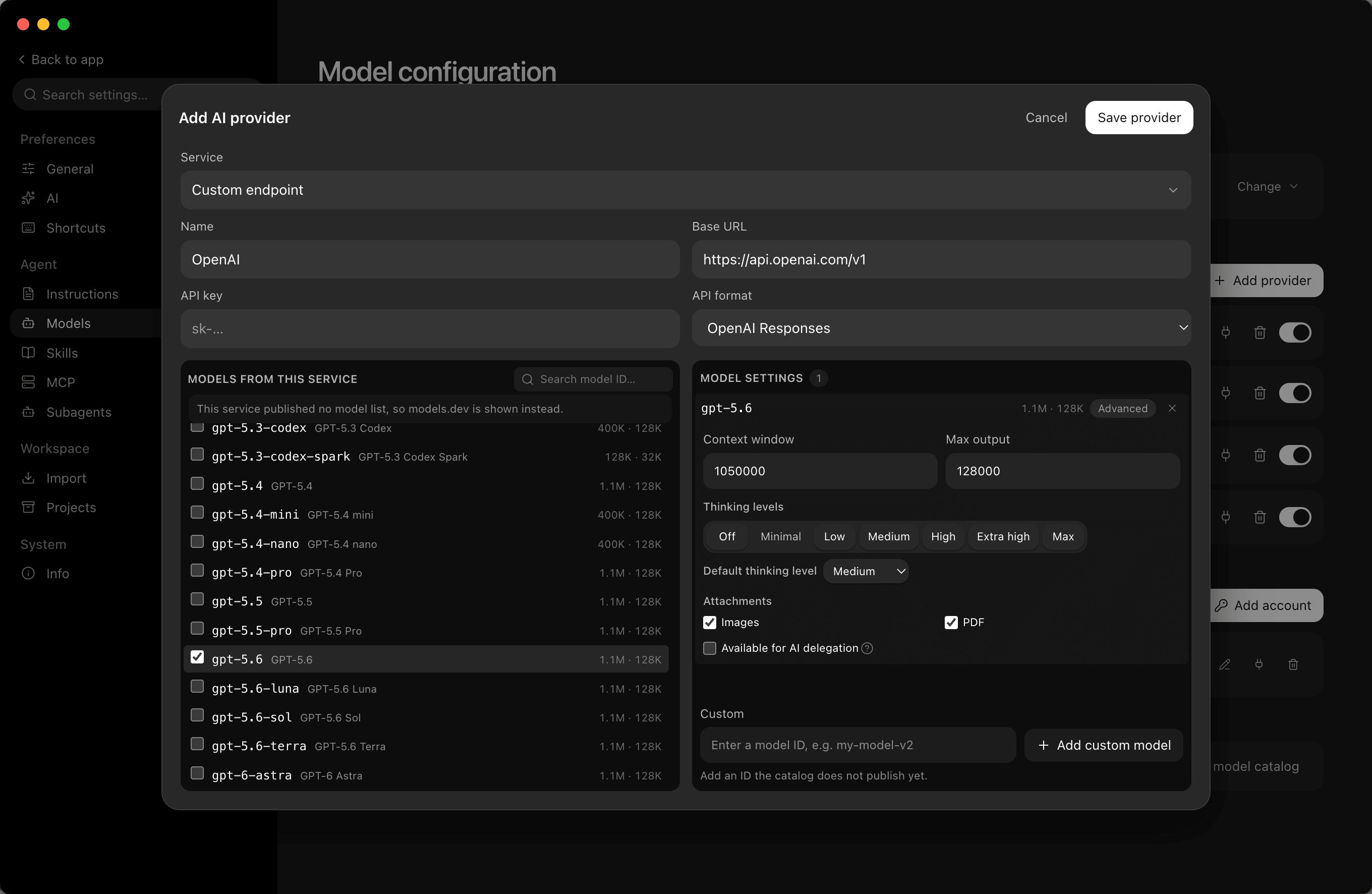
Connect your own provider, gateway, or local model |
---
PI-Desktop does not tie your workflow to a single model vendor.
Use:
OpenAI · Anthropic · OpenAI-Compatible APIs · Custom Gateways · Ollama · LM Studio · Local Models
Configure each model independently:
Provider · Model ID · Context Window · Output Limit · Reasoning / Thinking · Temperature · OAuth · API Key · Endpoint
Different Sessions can use different models.
The same Session can switch models at any time.
Planning     → Model A
Coding       → Model B
Review       → Model C
Private Task → Local Model
The model is a replaceable component of the workflow — not the workflow itself.
---
Keep your existing work.
PI-Desktop can import local sessions from:
Claude Code · Codex · OpenCode · Pi
---
PI-Desktop does not require you to move your development environment into our cloud.
| Data | Default behavior | | -------------------- | ----------------------------------------- | | Projects | Local | | Sessions | Local | | Settings | Local | | Logs | Local | | API credentials | OS Keychain | | PI-Desktop telemetry | None | | Model requests | Sent directly to your configured provider |
No mandatory PI-Desktop account.
No mandatory PI-Desktop relay.
When using a remote model, the context required for the request is sent directly to that provider.
---
Agents can read files, edit code, run commands, call tools, use extensions, and delegate work.
Privileged operations still pass through the permission layer:
Agent
  ↓
Tool Request
  ↓
Permission Layer
  ↓
Allow / Ask / Deny
  ↓
Execution
You decide how much autonomy each Session gets.
---
01Download Install PI-Desktop |
02Connect a model Configure a Provider |
03Open a project Choose a local repository |
04Start working Agent / Plan / Goal |
macOS · Windows · Linux
| Platform | Architecture | Package |
| -------- | ------------- | --------------------------------------- |
| macOS | Apple Silicon | .dmg / .zip |
| macOS | Intel | .dmg / .zip |
| Windows | x64 | Installer / Portable |
| Linux | x64 | .AppImage / .deb / .rpm / .asar |
macOS releases are signed with a Developer ID certificate and notarized by Apple.
Linux x64 packages require glibc 2.35+.
Common supported distributions include:
ldd --version
---
PI-Desktop is built on the pi ecosystem.
The Agent Runtime uses:
pi-aipi-agent-corePi provides the Agent Engine. PI-Desktop builds the persistent desktop workspace, sessions, permissions, plugins, and agent orchestration around it.
---
PI-Desktop can also serve as a host platform for building agent products.
You can build:
Plugins · MCP Servers · Skills · Agent Tools · pi Extensions · Themes · Panels · Floating Widgets · Background Services
Built-in templates include:
panel-basicagent-tool-basicskill-packfull-demo>=22.19>=10git clone https://github.com/vastsa/PI-Desktop.git
cd PI-Desktop
pnpm install
cargo build -p host-core
pnpm build:js
pnpm dev
pnpm typecheck
pnpm lint
pnpm test
Documentation · Architecture · Specification · Plugin Development · E2E Test Plan · Release Runbook · AGENTS.md
---
Contributions are welcome:
Issues · Pull Requests · Plugins · Skills · MCP Integrations · Documentation · Translations
For standalone capabilities, consider one question first:
Would this be better as a Plugin?
Keep the Core focused. Let the ecosystem grow.
Report an Issue · Open Issues · Build a Plugin
---

---
Linux.Do — A new ideal community
---
Not by a lone genius, but by a token-powered construction crew.
PI-Desktop has been built with the help of models from multiple providers.
More than 27 billion tokens have been used across development, refactoring, review, design, and debugging.
Thanks to every human contributor — and every model that helped us build it.
---
PI-Desktop is licensed under the GNU Lesser General Public License v3.0.
See LICENSE for details.
---
Your models · Your agents · Your plugins · Your workspace
Download · Documentation · Build a Plugin
Local-first · Model-agnostic · Plugin-powered
→ →
→ →
→ →
→ →
→ →
→ →
→ →
→