1
 →

QuickJS with durable execution: suspend running JS, snapshot the whole heap, resume it in another process. Native TypeScript, a REPL that survives restarts, Rust bindings.
stencil-hq/dquickts is an open-source project on GitHub, mainly written in C. QuickJS with durable execution: suspend running JS, snapshot the whole heap, resume it in another process. It currently holds 447 stars and 6 forks with 0 open issues, and was last pushed on an unknown date (repository created unknown).
Git Homed tracks it on the Today's Trending board.
A fork of QuickJS, Fabrice Bellard's small embeddable JavaScript engine, that adds two things:
for loop,.ts files run directly. The parser erases the types as it reads them,It also includes Rust bindings (a port of rquickjs) that expose both features.
git clone https://github.com/stencil-hq/dquickts
cd dquickts
make                 # builds qjs, qjsc and libquickjs.a
./qjs hello.ts
./qjs --drepl session.snap   # a REPL whose state survives restarts
make test-snapshot   # builds and runs the suspension and snapshot test hosts
This fork tracks upstream QuickJS 2026-06-04 (see VERSION). Everything upstream ships,
including the experimental Temporal and Intl support (qjs --experimental), is still here. The
fork adds:
| Feature | API |
| --- | --- |
| In-process suspension of running code | JS_RequestSuspend(), JS_IsSuspended(), JS_Resume() |
| Durable host calls: a C function parks its JS caller until the host supplies a result | JS_SuspendCall(), JS_ResumeWith() |
| Heap snapshots of a whole runtime, including a suspended call stack | JS_WriteSnapshot(), JS_ReadSnapshot() |
| Incremental snapshots: a delta holds only what changed since a base | JS_SNAPSHOT_BASE, JS_SNAPSHOT_DELTA, JS_DropSnapshotBase() |
| TypeScript: types erased at parse time; enums, namespaces and parameter properties compiled to bytecode | JS_EVAL_FLAG_TYPESCRIPT, qjs --typescript, .ts/.mts/.cts |
| Standard decorators (2023-05), auto-accessors, Symbol.metadata; TypeScript legacy decorators and decorator metadata | JS_EVAL_FLAG_TS_LEGACY_DECORATORS, JS_EVAL_FLAG_TS_DECORATOR_METADATA |
| Explicit resource management (ES2026) | using, await using, DisposableStack, AsyncDisposableStack |
| Ports from quickjs-ng | queueMicrotask(), atob()/btoa(), DOMException, the V8 stack trace API, promise hooks, immutable ArrayBuffers, performance, os.setInterval(), std.writeFile(), the bjson module, a re-entrant event loop, C closures, private symbols, runtime dump flags, and bug fixes |
| Embedder helpers | JS_IsEqual(), JS_NewProxy(), JS_GetProxyTarget(), JS_PromiseMarkAsHandled(), and others |
| A REPL whose functions and variables survive restarts | qjs --drepl FILE |
| Rust bindings built on this engine | rquickjs/ |
The full list is under unreleased in Changelog.
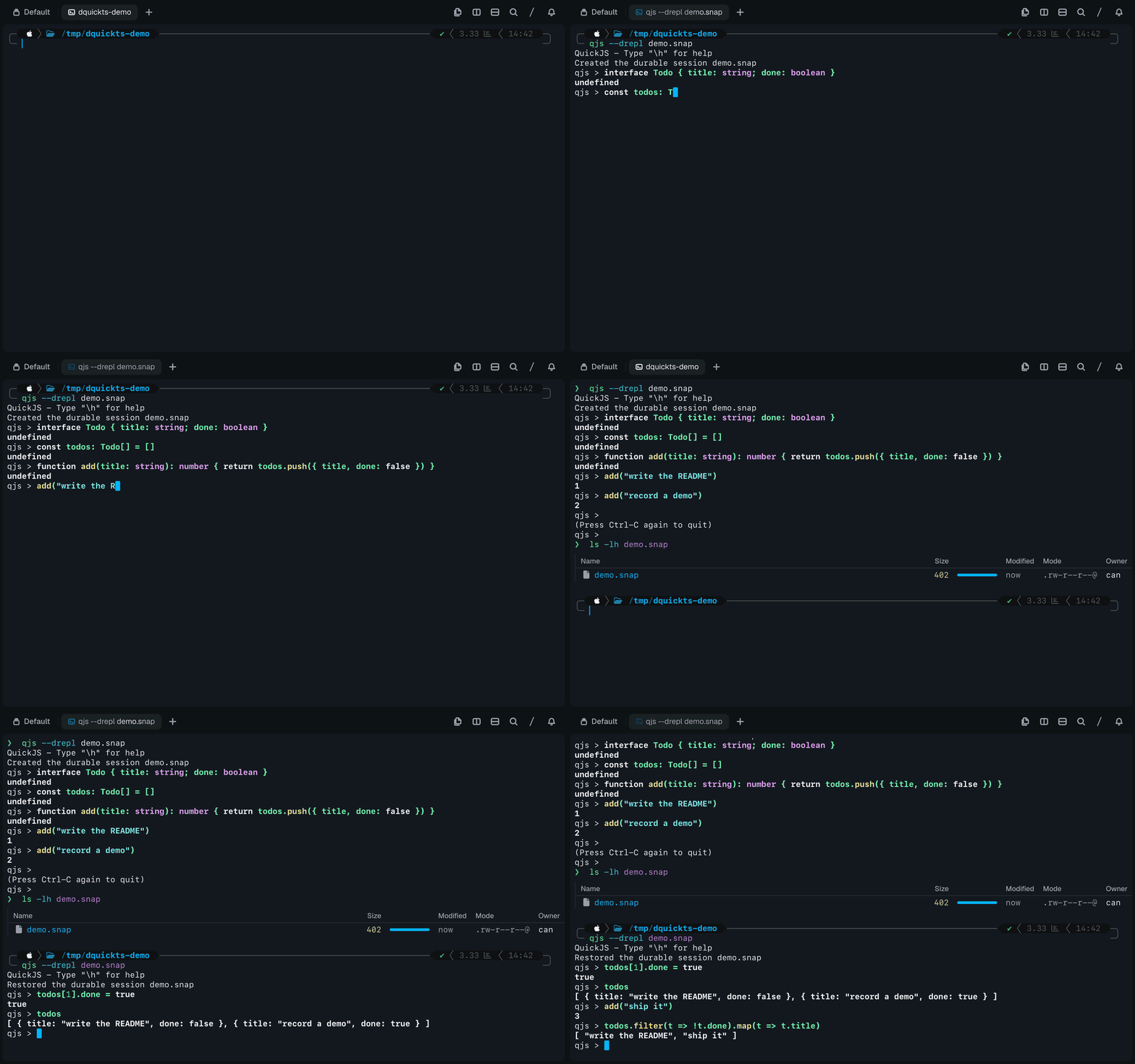
qjs --drepl FILE starts the usual REPL, with highlighting, history and tab completion, and
input is TypeScript. After every command, the whole session is saved to FILE. When you start
qjs --drepl FILE again, the session comes back with the same functions, variables, objects and
closures:
$ ./qjs --drepl session.snap
QuickJS - Type "\h" for help
Created the durable session session.snap
qjs> function add(a: number, b: number): number { return a + b }
undefined
qjs> let total: number = add(2, 3)
undefined
qjs> class Counter { constructor(private n = 0) {} inc(): number { return ++this.n } }
undefined
qjs> const c = new Counter()
undefined
qjs> c.inc()
1
qjs> ^C
(Press Ctrl-C again to quit)
qjs> ^C
$ ./qjs --drepl session.snap
QuickJS - Type "\h" for help
Restored the durable session session.snap
qjs> add(total, 10)
15
qjs> c.inc()
2
The commands don't run in the REPL's own runtime. They run in a separate runtime that holds only
the standard objects plus print() and console.log():
repl.js) stays in the main runtime and passes each command to the durableawait works,
and sends back the rendered result.
JS_WriteSnapshot() as a delta of aFILE, so the file always
holds a complete delta. The session in the transcript above takes about 400 bytes.
qjs rebuilds the base, which is a new session with every lazily created builtinJS_ReadSnapshot() then applies
FILE on top of it. If the file is missing, a new session starts.
Limits:
std and os modules are not available. Their files, timers and handlers are host state\load file evaluates a file inside the session.qjs build that wrote it.let, const and class names, but it does complete their members (c.in →
c.inc()).
A snapshot is the entire state of a JavaScript runtime, written out as one byte buffer. It includes:
await,await),
Some things you can do with this:
You can only take a snapshot when no JavaScript is running on the C stack. There are two ways to get to that point.
1. Between jobs. The script has returned, and the host is not running any job. Async code
reaches this state on its own at every await. A waiting async function, a yielded
generator and a pending promise are all ordinary heap objects at that point, so you can
snapshot right away.
2. While suspended. This covers synchronous code. A long loop never yields, so you ask the
engine to stop it:
1. Call JS_RequestSuspend(), usually from the interrupt handler.
2. At the next safepoint (described under How it works), the engine moves
the running frames to the heap and unwinds the C stack.
3. The call that started the execution, such as JS_Eval() or JS_Call(), returns
JS_EXCEPTION, and JS_IsSuspended() returns true.
4. Take the snapshot now. Later, in the same runtime or in a restored one, JS_Resume()
continues from the exact instruction where the code stopped.
#include
include
include "quickjs.h"
static JSValue js_print(JSContext *ctx, JSValueConst this_val,
                        int argc, JSValueConst *argv)
{
    const char *str = JS_ToCString(ctx, argv[0]);
    if (!str)
        return JS_EXCEPTION;
    puts(str);
    JS_FreeCString(ctx, str);
    return JS_UNDEFINED;
}
/ Every C pointer the heap can hold. Same list, same order, when reading. /
static const void  const natives[] = { (const void )js_print };
static const JSSnapshotHost host = { .natives = natives, .native_count = 1 };
static int on_interrupt(JSRuntime *rt, void *opaque)
{
    JS_RequestSuspend(rt); / suspend at the next safepoint /
    return 0;
}
int main(void)
{
    const char *src =
        "let sum = 0;\n"
        "for (let i = 0; i < 1e6; i++) sum += i;\n"
        "print(sum = ${sum});\n"
        "sum\n";
    JSRuntime *rt = JS_NewRuntime();
    JSContext *ctx = JS_NewContext(rt);
    JSValue global = JS_GetGlobalObject(ctx), val;
    JS_SetPropertyStr(ctx, global, "print",
                      JS_NewCFunction(ctx, js_print, "print", 1));
    JS_FreeValue(ctx, global);
JS_SetInterruptHandler(rt, on_interrupt, NULL);
    val = JS_Eval(ctx, src, strlen(src), "", JS_EVAL_TYPE_GLOBAL);
    if (JS_IsException(val) && JS_IsSuspended(rt)) {
        / Stopped in the middle of the loop: save the whole runtime. /
        size_t len;
        uint8_t *snap = JS_WriteSnapshot(ctx, &len, &host, NULL, 0, 0);
        printf("suspended, snapshot = %zu bytes\n", len);
/ Rebuild it in a fresh runtime (could be another process, later). /
        JSRuntime *rt2 = JS_NewRuntime();
        JSSnapshotResult res;
        char err[128];
        if (JS_ReadSnapshot(rt2, snap, len, NULL, 0, &host, &res,
                            err, sizeof(err))) {
            fprintf(stderr, "restore failed: %s\n", err);
            return 1;
        }
        js_free(ctx, snap);
        JS_FreeContext(ctx);
        JS_FreeRuntime(rt); / the original runtime is gone /
rt = rt2;
        ctx = res.contexts[0];
        JS_FreeSnapshotResult(rt, &res);
        val = JS_Resume(ctx); / continues inside the for loop /
    }
    / prints "sum = 499999500000" /
    JS_FreeValue(ctx, val);
    JS_FreeContext(ctx);
    JS_FreeRuntime(rt);
    return 0;
}
$ cc -I. example.c libquickjs.a -lm -lpthread -o example && ./example
suspended, snapshot = 13185 bytes
sum = 499999500000
The restored runtime has no interrupt handler, so the loop runs to the end. For a version where
each slice runs in a new process, see
tests/snapshot/hibernate.c and
tests/snapshot/cross_process.sh.
A C function can suspend the JavaScript code that called it. The function returns
JS_SuspendCall(). The JS call then stays open until the host completes it with
JS_ResumeWith(), which can happen after a snapshot and in another process:
/ fetch(url): the script waits; the host completes the call later. /
static JSValue js_fetch(JSContext *ctx, JSValueConst this_val,
                        int argc, JSValueConst *argv)
{
    / record argv[0] somewhere durable, e.g. pass it as a snapshot root /
    return JS_SuspendCall(ctx);
}
/ ...snapshot, exit, restore in another process, then: /
val = JS_ResumeWith(ctx, JS_NewString(ctx, body), / throw_flag / 0);
From the script's side, const body = fetch(url) is an ordinary synchronous call. If you pass
throw_flag = 1, the call throws the value instead of returning it. The caller has to call the
C function directly, from a stack that can be suspended. If it doesn't, JS_SuspendCall()
throws a TypeError.
A full snapshot of even an empty runtime is about 13 KB, because the realm's intrinsics are part of the heap. Incremental snapshots avoid writing those bytes over and over:
1. Write one snapshot with JS_SNAPSHOT_BASE. A good moment is after the host natives are
installed and the application script has run. This full snapshot becomes the runtime's
base.
2. Write later snapshots with JS_SNAPSHOT_DELTA. A delta holds only the cells (objects, closure
variables, frames, and so on) that were created or modified since the base, plus their new
strings and atoms, plus the roots. A modified object is saved as a patch of its base version,
so adding or setting a property costs a few bytes.
3. To restore, call JS_ReadSnapshot(rt, base, base_len, delta, delta_len, ...).
Deltas are not chained: each delta needs only the base. A runtime restored from a base has that base attached, so the deltas it writes are relative to the same base. Many runtimes can share one base.
Bases are reproducible. Runtimes of the same engine build that are set up the same way (same host
natives, same code run) write byte-identical bases, in any process. So a host doesn't have to
store the base: it can rebuild it and keep only the deltas. qjs --drepl works this way. The
Math.random() state is not part of a base. Full snapshots and deltas save it, and a base read
without a delta starts with a fresh seed.
sequenceDiagram
    participant A as Process 1
    participant S as Storage
    participant B as Process 2..N
    A->>A: install natives, run setup
    A->>S: JS_WriteSnapshot(BASE) → base
    A->>A: JS_Eval() … suspended
    A->>S: JS_WriteSnapshot(DELTA) → state
    Note over A: exit
    loop until done
        S->>B: base + state
        B->>B: JS_ReadSnapshot(base, state), JS_Resume()
        B->>S: JS_WriteSnapshot(DELTA) → state
    end
These sizes come from tests/snapshot/cross_process.sh. Each slice runs in a new process. The
base (12,931 bytes) is taken before the script runs, so every delta also carries the script's
compiled code and all of its data:
| Script | Processes | Largest delta (bytes) |
| --- | ---: | ---: |
| hibernate-sync.js | 365 | 19,915 |
| control-async.js | 92 | 18,722 |
| control-generators.js | 82 | 17,696 |
| data-map.js | 5 | 14,715 |
| control-using.js | 66 | 7,536 |
If you take the base after setup instead, the deltas shrink to the size of the change. In the Rust example, the base is 13,403 bytes and the delta after one function call is 128 bytes.
While a base is attached, the runtime keeps every cell, string and atom of the base alive, so
that they keep their identity. They are not garbage collected, and weak references to them never
become empty. JS_DropSnapshotBase() releases them. After that, the next delta needs a new base.
The implementation is in quickjs-snapshot.c (format, writer, reader, frames),
quickjs-snapshot-data.c (collections, weak containers, buffers, typed arrays) and
quickjs-snapshot-control.c (generators, promises, iterators, Proxy, disposable stacks,
modules). quickjs.c #includes all three, so embedders compile nothing extra.
Suspension. QuickJS already polls an interrupt counter at backward and conditional branches.
The counter fires every 10,000 branches by default (JS_INTERRUPT_COUNTER_INIT). When a
suspension is pending and the counter fires, the engine checks whether the whole call stack is
suspendable. That holds when:
JS_Eval(), JS_Call() or a similar entrynew,If the check passes, each frame (its bytecode position, operand stack, arguments and locals) is
moved into a heap frame object. That is the same structure an async function uses to survive an
await. The C stack then unwinds. Closures that captured a frame's variables keep pointing at
the moved frame.
If any frame was entered on behalf of native code, the request stays pending until a later
safepoint. That includes getters and setters, valueOf/toString conversions, Proxy traps,
forEach/JSON.stringify callbacks, eval code and promise jobs. Because of this rule, the
engine never has to save a C stack.
Writing. The writer walks the heap from the roots:
roots[],| Section | Contents |
| --- | --- |
| Header | magic QJSSNAP\n, format version, full/delta, base id (FNV-1a-64 of the base), build signature, host class names |
| Cell headers | type and allocation size of every cell |
| Changed cells | delta only: indexes of base cells whose body changed |
| Atoms, strings | the ones the base does not already have |
| Roots | contexts, jobs, host roots, suspended frame |
| Bodies | one length-prefixed body per cell (index-prefixed in a delta) |
Native code pointers. The heap holds C pointers: builtin functions, job functions, lazily
created builtins, and host functions. Each one is written as an index into a registry. The
registry is built in a fixed order: the engine's builtin function lists and natives first, then
the host's natives[] and func_lists[]. A pointer that is not in the registry fails the write
with snapshot: unregistered native code pointer.
The header also carries a hash of the registry's layout: engine version, format and bytecode
versions, sizeof(JSValue), builtin names, and the native counts. JS_ReadSnapshot() rejects a
snapshot when the hash differs.
Reading.
1. The reader allocates an empty shell for every cell from the cell headers, before it reads any body. Because every cell already exists, bodies can refer to each other in any order, and cycles need no special handling. 2. It fills the bodies:
JS_ReadFunctionHeader() /JS_ReadFunctionBody()).
load_opaque() for each host
object.
The reader rejects bad magic, wrong versions, a delta from a different base, a registry or class mismatch, truncation, duplicate or missing bodies, and trailing bytes. If it fails partway, it turns half-built objects back into plain ones so that no finalizer runs on garbage. You then free the runtime.
Deltas. Deltas use byte comparison, not dirty bits. While a base is attached, the runtime keeps the encoded body of every base cell. A delta write serializes every reachable cell and every base cell, then compares each base cell's bytes with the stored body. Only bodies that differ, and new cells, go into the delta.
A changed body is written as a patch whenever that is shorter. The patch records how long a prefix and suffix the body shares with its base body, plus the bytes in between. An object body ends its property list with a terminator instead of starting it with a count. So adding, setting or deleting one property changes only a few bytes in the middle. A change to a global object with a hundred properties costs about twenty bytes.
The Math.random() state lives in the roots of full snapshots and deltas, not in the context
cell. That is why a base doesn't depend on the seed.
Base cells are walked even when nothing reaches them anymore, because a reachable object can
still change them, for example by detaching an ArrayBuffer they share. Base cells keep their
indexes, and new cells are numbered after them. To apply a delta, the reader loads the base,
skips the bodies of changed cells, and reads those bodies from the delta.
Weak references. A WeakRef or WeakMap entry whose target has already been collected is
written as dead and restored as dead. A FinalizationRegistry entry whose target is dead still
gets its cleanup callback after the restore. Objects that are only weakly reachable are freed by
the restored runtime.
JS_NewCFunction*(), JSCFunctionData callbacks, job functions and C module init functions.
Also list the function lists you gave to JS_SetPropertyFunctionList(). Use the same list in
the same order when writing and when reading. A change in the number of natives is detected,
but swapping two natives is not.
save_opaque() hook (to describe the data as a JS value) and
the load_opaque() hook (to rebuild it with JS_SetOpaque()).
roots. JS_ReadSnapshot() returns them in the same order.
ArrayBuffer data is always restored into memory the engine owns. Host buffersJS_WriteSnapshot() throws a TypeError for:SharedArrayBuffers whose memory may be shared with another thread,save_opaque() hook,JS_NewCClosure()), whose opaque pointer is host state,catch/finally blocks or using
disposals. The error is thrown at the frame's call site.
Date.now() reflects the time spent hibernated, and local-time methodsperformance.now() does not: it
continues from its value when the snapshot was written.
You don't need tsc, esbuild or a bundler. The parser recognizes TypeScript syntax and erases
the types while parsing, so it generates no bytecode for them.
→ →
 →
 →
 →
 →
 →
 →