1
 →
→
Local-first privacy guard: anonymize your documents before sharing with LLMs.
Rizzo-AI-Academy/rizzo-pii is an open-source project on GitHub, mainly written in Python. Local-first privacy guard: anonymize your documents before sharing with LLMs. It currently holds 1,094 stars and 80 forks with 77 open issues, and was last pushed on 2026-09-25 (repository created 2026-06-28).
Git Homed tracks it on the Today's Trending board, currently at rank #88 with 26 new stars today.

_Use frontier models without giving up your data._








📄 Read the full technical report (PDF) — model, dataset, method and experiments in detail



🪟 Windows installer · 🍎 macOS (Apple Silicon) · 🐧 Linux AppImage — all available now
rizzo-pii:0.3B is a lightweight, CPU-friendly, Italian-first token-classification
model (≈0.3B parameters, mmBERT / ModernBERT
backbone) that detects 22 categories of personal data — including the Italian-legal
identifiers (codice fiscale, partita IVA, dati catastali) that no other open model
covers — and drives a fully reversible anonymization workflow:
🔒 anonymize locally → 🏷️ placeholder + reversible local dictionary → ☁️ frontier LLM → 🔓 restore locally
It is built for law firms, accountants, notaries and anyone bound by the GDPR who wants to keep using ChatGPT / Claude / Gemini on sensitive documents without ever sending the real data out.

|
| ≈0.3B | ~0.5 GB | 22 | 0.989 | |:---:|:---:|:---:|:---:| | parameters (mmBERT-base) | RAM footprint, CPU | PII categories | micro-F1 (real IT validation) | The hedgehog mascot does one job: it grabs your document, blacks out every identifier, and stays inside the EU while doing it. |
---
People summarize contracts, draft replies and ask legal questions simply by pasting the document in. It is fast and useful — and it quietly moves enormous amounts of personal and confidential data off the user's device. Names, addresses, tax codes, IBANs, health details, unsigned-contract clauses: all of it crosses the network to servers the user does not control, where it may be logged, cached, retained or exposed in a breach. For a law firm or a hospital this is not hypothetical; under the GDPR it can be a direct compliance failure.
The intuitive fix is to stop sending data out and run an open model locally — but a frontier-grade open model is large and expensive to serve (€9,000–€10,000 of hardware), and the small models that fit a normal laptop are not in the same league on the hard tasks (legal reasoning, dense contracts, long official documents) — exactly where Italian professionals need the most help.
The trade-off we actually want: keep the frontier model and *remove the data from the equation*. Anonymize the document locally on a CPU, send only placeholders to the cloud, and restore the real values locally from the answer. The sensitive content never leaves the machine.
---
The workflow has three local steps and one remote step. Locally, rizzo-pii tags every span of
personal data and replaces each one with a stable, type-aware placeholder
([FULLNAME_1], [IBAN_1], [CF_1]), recording the mapping placeholder → real value in a
dictionary that stays on disk. Identical values share the same placeholder, so the frontier
model still sees a coherent text and can reason about it. The anonymized text is sent to
ChatGPT / Claude / Gemini; when the answer comes back, a local pass swaps the placeholders for the
true values. The cloud provider never receives a single real name, code or number.
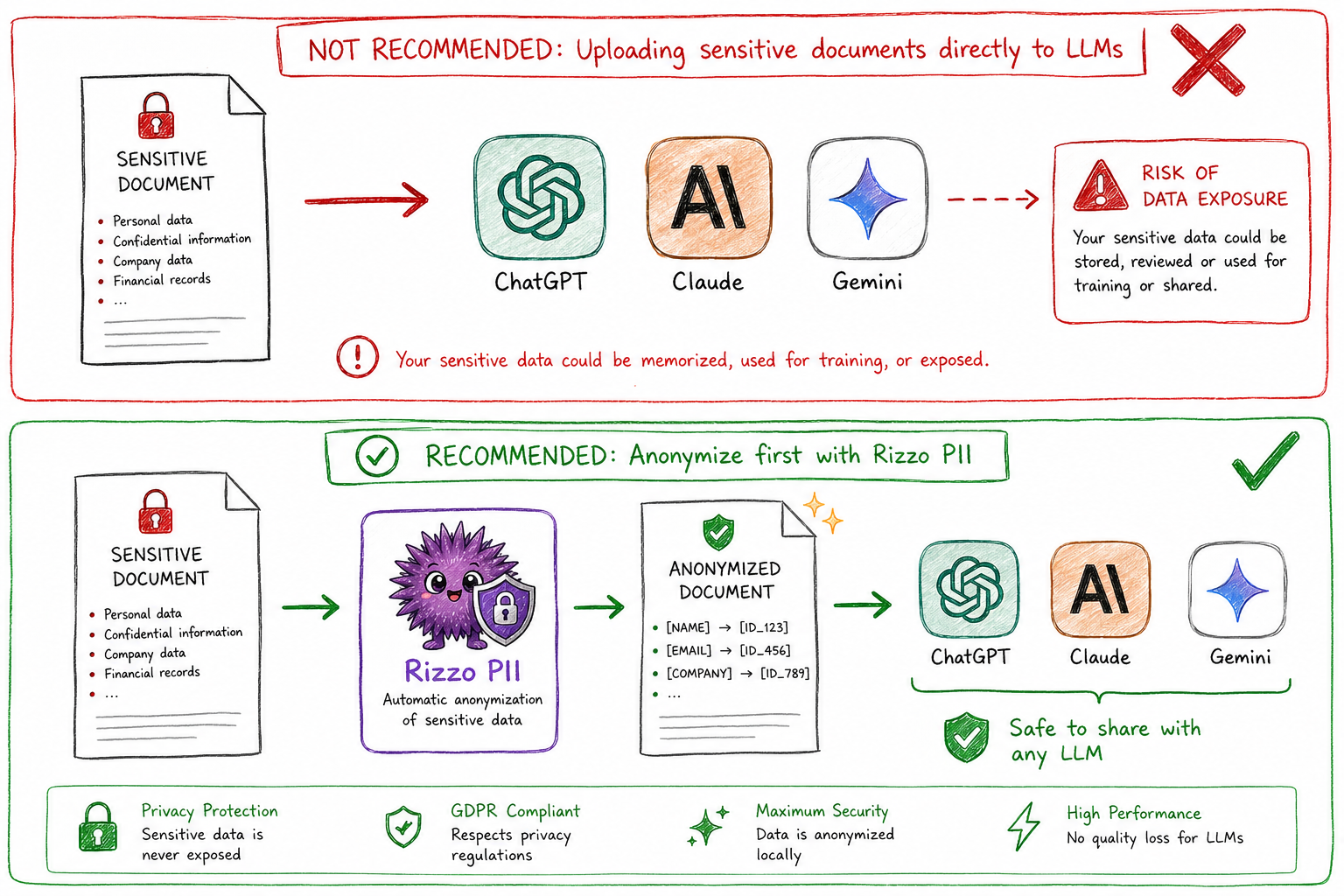
Everything except the frontier query happens on the user's CPU; only placeholder text crosses the boundary, and the answer is re-identified locally.
---
This is not "yet another PII detector". It is an architecture for using powerful models without surrendering data, built so the privacy guarantee is structural rather than a promise:
| Property | rizzo-pii:0.3B | OpenAI Privacy Filter | MS Presidio | |---|---|---|---| | Type | Dense encoder (mmBERT / ModernBERT) | Sparse MoE encoder | NER + rules pipeline | | Parameters | ≈0.3B dense (all active) | 1.5B total / ≈50M active | spaCy model + rules | | Memory to load | 0.5–1.2 GB | 1.5B params resident | Varies (spaCy) | | Runs on | CPU, under 1 GB RAM | On-device | CPU | | Categories | 22 (incl. IT-legal) | 8 generic | Configurable; EN defaults | | Italian CF / PIVA / catasto | Yes | No | Not by default | | Primary language | Italian (+7 more) | English | English | | Checksum validation | Yes (IBAN/CF/PIVA/card) | No | Some recognizers | | Reversible mapping | Yes (local dict) | Masking | Anonymization |
The differentiators are Italian-legal coverage, a smaller memory footprint, and a checksum-backed safety net (mod-97 for IBAN, Luhn for cards, the official CF/PIVA algorithms) that the larger generic models do not provide.
Concrete example. Take *"Il Sig. Mario Rossi, C.F. RSSMRA85H12F205Y, P.IVA 12345678903, è
titolare dell'immobile al Foglio 12, particella 345, sub. 6."* rizzo-pii tagsFULLNAME,CF,
PIVAandCATASTOand rewrites it as *"Il Sig. [FULLNAME_1], C.F. [CF_1], P.IVA [PIVA_1], è
titolare dell'immobile al [CATASTO_1]."* A generic English-first model has no label for the
fiscal code, the VAT number or the cadastral reference — the three most sensitive identifiers in
the sentence — and would leave them in the clear.
---
rizzo-pii predicts 22 entity types in BIO format (a B-/I- label per tag, plus O). The
raw datasets are left untouched; the mapping to these 22 tags is applied at load time through a
single TAG_MAP in train_pii.py, so the taxonomy can be changed in one place without
re-annotating anything. Details in docs/TASSONOMIA_TAG.md.
| Tag | Meaning | Example | Source |
|---|---|---|---|
| FULLNAME | Person name (incl. legal roles: judge, lawyer, parties, witness) | Mario Rossi | real+synth |
| AGE | Age | 45 anni | real |
| GENDER | Sex / gender | Femmina | real |
| DATE | Calendar date | 12/06/1985 | real+synth |
| TIME | Time of day | ore 15:30 | real |
| STREET | Street / square | Via Garibaldi | real+synth |
| BUILDINGNUM | Street number | 24 | real+synth |
| ZIPCODE | Postal code (CAP) | 00185 | real+synth |
| CITY | City | Milano | real+synth |
| PROVINCE | Province abbreviation | MI | synth |
| EMAIL | E-mail (incl. PEC) | [email protected] | real+synth |
| TELEPHONENUM | Phone number | +39 333 1234567 | real+synth |
| CF | Codice fiscale (personal tax code) | RSSMRA85H12F205Y | synth |
| PIVA | Partita IVA (VAT number) | 12345678903 | real+synth |
| ID_DOC | ID / passport / licence / social number | CA12345AB | real+synth |
| IBAN | IBAN / bank account | IT60X05428… | synth |
| CREDITCARDNUMBER | Credit-card number | 4111 1111 1111 1111 | real |
| AMOUNT | Money amount | € 12.500,00 | synth |
| TARGA | Vehicle plate | AB 123 CD | synth |
| ORG | Private company / firm / bank | Edilnord S.r.l. | synth |
| DOCID | Act identifier (RG, protocol, repertory, ruling) | 1234/2024 | synth |
| CATASTO | Cadastral data (sheet, parcel, sub.) | Foglio 12, part. 345 | synth |
Two design decisions stand out. First, legal roles collapse into FULLNAME — whether
"Mario Rossi" is the judge, the lawyer or a witness is not a property of the string; the role, if
needed, is recovered downstream as metadata. Second, raw types that mean the same thing are
merged: names + surnames → FULLNAME; PEC → EMAIL; TAXNUM → PIVA; ID card / passport /
licence / social number → ID_DOC; account number → IBAN. Honorifics (Dott., Avv.) and the
name of the court itself are dropped to O because they are not identifiers to mask.
The five Italian-legal tags (CF, PIVA, CATASTO, DOCID, PROVINCE) are the reason
rizzo-pii exists: they do not appear as labeled data in any public corpus, so they are created
through synthesis with mathematically valid checksums.
The app adds a 23rd tag, URL, handled by the regex net alone — the model is not trained on it.
It matches http(s)://…, www.… and bare domains on a closed TLD list; the closed list is what
keeps Italian legalese (p.iva, n.ro, S.r.l.) from being read as a domain, at the price of
letting an exotic TLD through.
---
The model is fine-tuned on a multilingual pool of ≈745k labeled rows (Italian reinforced to
~45%) assembled from four sources — real (Ai4Privacy, DeepMount) and synthetic — all remapped to the
22 tags at load time. The synthetic part follows the "LLM author, code labeler" principle: an
LLM writes only Italian legal prose with placeholders ({SLOT}) and our code injects the real
values (CF/PIVA/IBAN with valid checksums), so BIO labels are exact, identifiers are valid by
construction, and no real personal data is ever produced by the LLM. The backbone is
mmBERT-base (ModernBERT architecture, native 8192-token context) and training runs in a single
epoch on one 16 GB consumer GPU.
📄 The full dataset composition, the synthesis method, the training recipe and the
experiments are described in the technical report. See also
docs/DATASET.md and CLAUDE.md for the operational details.
---
Training was a single epoch (~26.6k steps over 744,912 rows). The loss fell from ≈6.2 to below 0.1 within the first few hundred steps, then settled into a clean, monotone, low regime; the validation loss decreased monotonically and was still falling when the epoch ended. Final training loss ≈0.003 and validation loss ≈0.006 are both very low and very close, so the model is not over-fitting — a second epoch would very likely push it lower still.
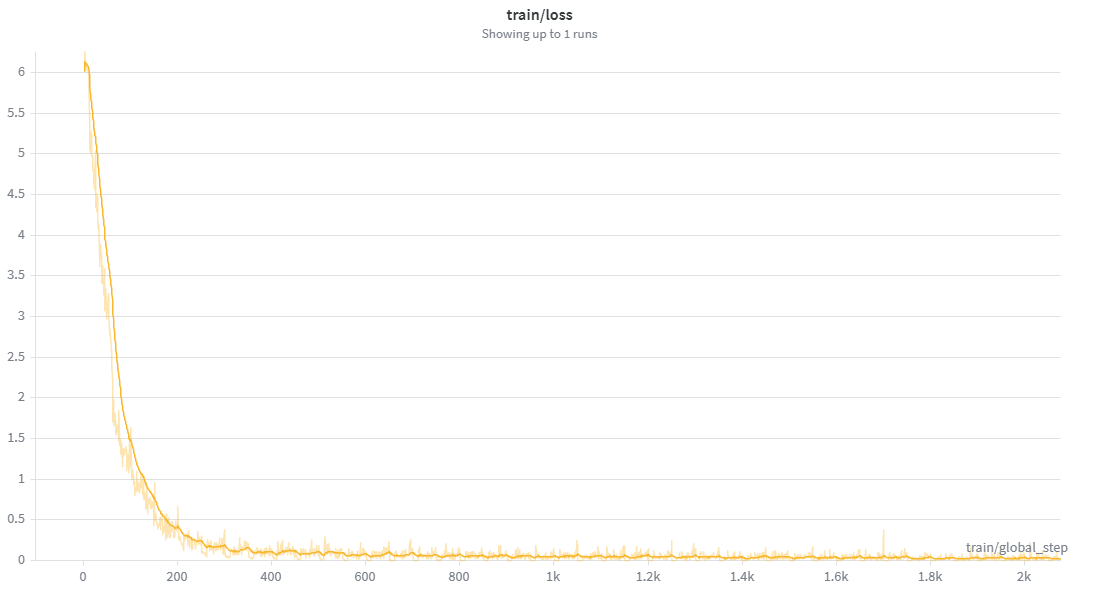
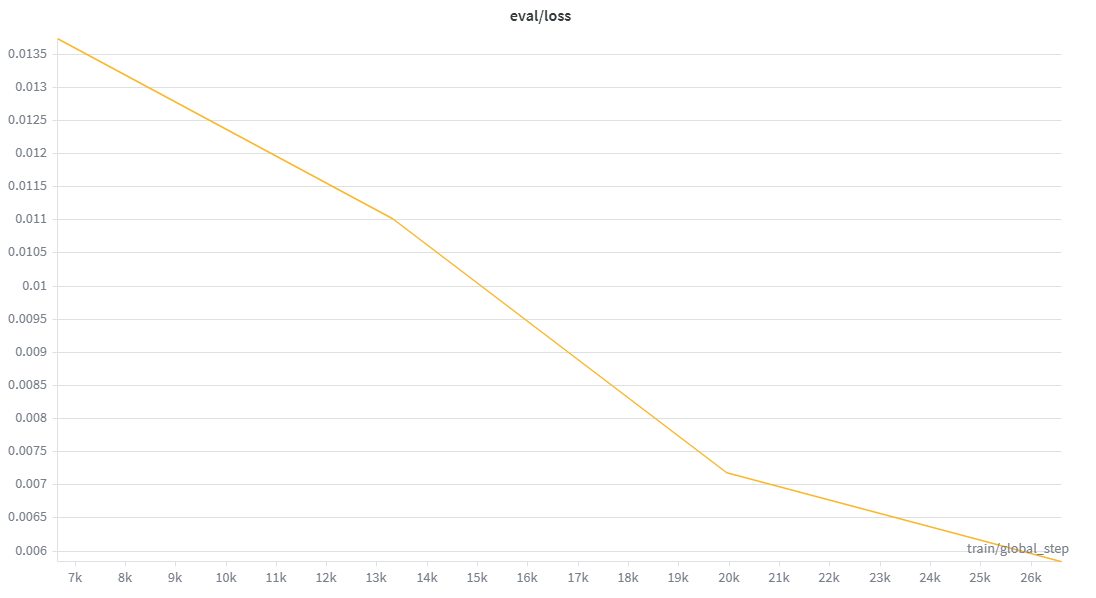
Left: training loss (smoothed zoom) — fast drop, then low and stable. Right: validation loss — monotone, still decreasing when training stopped.
On the 7,000-row held-out real Italian benchmark (validation_real.jsonl):
| 0.987 | 0.990 | 0.989 | 0.998 | |:---:|:---:|:---:|:---:| | micro precision | micro recall | micro F1 | token accuracy |
The unweighted per-tag mean (macro-F1) across all 22 tags is 0.987, and every one of the five Italian-legal identifiers scores a perfect 1.000.
| Tag | Sup. | P | R | F1 | | Tag | Sup. | P | R | F1 | |---|---:|---:|---:|---:|---|---|---:|---:|---:|---:| | FULLNAME | 4390 | .989 | .990 | .990 | | GENDER | 472 | 1.00 | 1.00 | 1.00 | | CATASTO | 1200 | 1.00 | 1.00 | 1.00 | | PROVINCE | 400 | 1.00 | 1.00 | 1.00 | | CITY | 953 | .961 | .963 | .962 | | DOCID | 400 | 1.00 | 1.00 | 1.00 | | DATE | 922 | 1.00 | 1.00 | 1.00 | | CF | 400 | 1.00 | 1.00 | 1.00 | | TELEPHONENUM | 874 | 1.00 | 1.00 | 1.00 | | AGE | 385 | .979 | .977 | .978 | | ID_DOC | 800 | 1.00 | 1.00 | 1.00 | | ZIPCODE | 299 | .938 | .967 | .952 | | EMAIL | 748 | .999 | .999 | .999 | | IBAN | 278 | .996 | .996 | .996 | | TIME | 637 | .991 | .992 | .991 | | CREDITCARD | 257 | .919 | .973 | .945 | | STREET | 617 | .951 | .969 | .960 | | AMOUNT | 146 | 1.00 | .993 | .997 | | BUILDINGNUM | 594 | .969 | .958 | .964 | | ORG | 145 | .967 | 1.00 | .983 | | PIVA | 514 | 1.00 | 1.00 | 1.00 | | TARGA | 43 | 1.00 | 1.00 | 1.00 |
All five Italian-legal identifiers (CF, PIVA, CATASTO, DOCID, PROVINCE) score a perfect
1.000, as do ID_DOC, DATE, TELEPHONENUM, GENDER and TARGA. The remaining soft spots are
the open, high-variability classes (ZIPCODE, CREDITCARDNUMBER, STREET, CITY) and ORG,
which is exactly where a larger, better-balanced dataset would help.
---
The released checkpoint is ~1.2 GB on disk in fp32 and runs comfortably on a CPU: quantized, its memory footprint is on the order of 0.5 GB, with no GPU required. That is the whole point — the privacy layer is cheap enough to run on the laptop the user already owns.
In production the neural model is never used alone. It is paired with a deterministic regex + checksum network for the structured identifiers (EMAIL, phone, IBAN, CF, PIVA, credit card, amount, plate), where IBAN/PIVA/card must pass their checksum (mod-97 / Luhn) to be accepted, and a valid checksum overrides the model. This eliminates the classic failure mode of a neural tagger fragmenting a long code, and gives mathematically certain detection for exactly the identifiers whose leakage is most damaging. The app adds the reversible layer (stable placeholders, downloadable local dictionary, a "restore" tab tolerant to markdown/format drift), chunking with overlap for long PDFs, and a colored per-tag UI.
| To use the model (inference) | To retrain the model |
|---|---|
| Any 64-bit CPU (no GPU) | A single 16 GB GPU is enough |
| 0.5–1.2 GB RAM for the model | Reference run: RTX 5060 Ti, ~2 h |
| Windows (installer) / Linux / macOS | PyTorch cu128 for Blackwell |
| Fully offline; no API key | ~745k rows, regenerable from scripts |
The desktop app Rizzo PII (Tauri) launches the Python/Flask backend as a bundled CPU "sidecar"; a CPU-only PyTorch build keeps it fully offline on Windows (WebView2), macOS and Linux. Packaging instructions in docs/BUILD.md.
⬇️ Download. Grab the ready-to-use build from the
Releases page — no Python or
setup required: a Windows installer (double-click), a macOS .dmg (Apple Silicon /
arm64 — signed & notarized by Apple, just open it), and a Linux AppImage (chmod +x then
run) are all available now.
---
Just want to anonymize documents? You do not need the dataset, the training scripts or a GPU — only the model. Three ways, all of them fully local. (Regenerating the data and retraining is a different flow: Quickstart, further down.)
Nothing to install but Docker; the image carries the CPU dependencies and the model.
git clone https://github.com/Rizzo-AI-Academy/rizzo-pii
cd rizzo-pii
docker build -t rizzo-pii .                          # ~10 min, 2.65 GB image
docker run -d --name rizzo-pii \
  -p 127.0.0.1:5005:5005 rizzo-pii                   # -> http://127.0.0.1:5005
docker logs -f rizzo-pii                             # startup / gunicorn logs
docker rm -f rizzo-pii                               # stop and remove
The image is self-contained: the CPU-only PyTorch stack and the model
(rizzoaiacademy/rizzo-pii-0.3B) are baked
in at build time, so docker build needs the network but docker run never does —
HF_HUB_OFFLINE=1 makes sure of it. Same deal as the desktop app: the documents never leave the
machine. Inside the container the server is gunicorn with 1 worker (the model is loaded once,
~1.2 GB) and 4 threads; /health answers 503 until the model is ready, which is what the
HEALTHCHECK polls — the first request is served when docker ps says healthy.
Publish the port as 127.0.0.1:5005:5005, not 5005:5005, unless you actually mean to expose the
service to your LAN — inside the container the bind is 0.0.0.0 on purpose, and the network
boundary is Docker's job.
Useful knobs (all optional):
# a different port, tags left in the clear, irreversible anonymization
docker run -d -p 127.0.0.1:8080:8080 -e PII_PORT=8080 \
  -e PII_EXCLUDE_TAGS=AGE,GENDER -e PII_MAPPING=0 rizzo-pii
The image is CPU-only, which is the intended deployment (see the table above); torch and
transformersare pinned to the versions it was verified with. A GPU build would need thecu128
wheels and the NVIDIA container runtime. Note that Dockerfile.linux is a different thing: it is
the reproducible build environment for the Linux .deb/AppImage bundles, described in
docs/BUILD.md.
Same server, without Docker — this is what the desktop app runs internally.
git clone https://github.com/Rizzo-AI-Academy/rizzo-pii
cd rizzo-pii
python -m venv .venv && source .venv/bin/activate     # Windows: .\.venv\Scripts\Activate.ps1
pip install -r requirements.txt                       # CPU torch is fine, no GPU needed
the model (~1.2 GB) into the folder the app looks for. The folder name carries the
version: app.py pins it in APP_MODEL_VERSION, so revision and directory must match.
hf download rizzoaiacademy/rizzo-pii-0.3B --revision v1.5.0 \
  --local-dir models/rizzo-pii-0.3B-v1.5.0
python src/app/app.py                                 # -> http://127.0.0.1:5005
python src/app/app.py --port 8080 --exclude-tags AGE,GENDER --no-mapping   # same knobs as above
No server at all: entities and anonymized text printed to stdout.
PII_MODEL_DIR=models/rizzo-pii-0.3B-v1.5.0 \
  python src/training/test_pii.py "Mi chiamo Mario Rossi, IBAN IT60X0542811101000000123456"
Whichever way you started it, the process is a plain HTTP service — see
The local HTTP API below for /analyze, /pdf, /preview and the rest.
curl localhost:5005/health                      # 200 = model loaded and ready
curl -X POST localhost:5005/analyze -H 'Content-Type: application/json' \
     -d '{"text": "Mario Rossi, CF RSSMRA85M01H501Q"}'
---
Prerequisites and critical environment constraints (Blackwell GPU, torch cu128, etc.) are in
CLAUDE.md. The dataset/raw/ sources are downloaded from Hugging Face (see the
hf download commands in CLAUDE.md). All scripts force UTF-8 and resolve their paths from__file__, so they run from any working directory.💡 Just want to use the app? You don't need any of this — download the ready-to-use build
(Windows / macOS / Linux) from the
Releases page, or run the web app
with Docker / from source: Inference quickstart. The steps
below are for developers who want to regenerate the data and retrain the model.
git clone https://github.com/Rizzo-AI-Academy/rizzo-pii
cd rizzo-pii
python -m venv .venv; .\.venv\Scripts\Activate.ps1
pip install -r requirements.txt          # NVIDIA Blackwell? install torch cu128 first — see requirements.txt
copy .env.example .env                    # optional: add W&B / Gemini keys
python src/data_pipeline/llm_template_bank.py --per-type 5 --append          # (opt.) legal templates via Gemini
python src/data_pipeline/generate_synthetic_pii.py -n 200000 --out dataset/synthetic/synthetic_pii_it_200k.jsonl
python src/data_pipeline/augment_real_pii.py     -n 40000  --out dataset/synthetic/synthetic_pii_it_realaug.jsonl
python src/data_pipeline/prepare_deepmount.py                                 # requires HF login
python src/data_pipeline/build_validation.py                                 # real validation (7k, it)
python src/data_pipeline/build_subset.py                                     # 10k/5k subsets for smoke tests
# fast smoke test / tuning on the subset (~3 min)  -> experiments/subset_smoke/
python src/training/train_pii.py --type subset
full run on the whole dataset  -> models/rizzo-pii-0.3B-v{VERSION}/ + experiments/full_run_v{VERSION}/
python src/training/train_pii.py --type full
python src/training/train_pii.py --type full --version 1.2.0   # or an explicit version
python src/training/test_pii.py "Mi chiamo Mario Rossi, IBAN IT60X0542811101000000123456"
python src/app/app.py            # http://127.0.0.1:5005  (paste text or upload a PDF)
The web app assigns every PII a reversible ID ([FULLNAME_1], [IBAN_1]…) plus a local
dictionary, pairing the model with the regex/checksum net. You copy the anonymized text into an LLM
and restore the real values from the response. Input: pasted text, a PDF, or a
.md / .txt file.
The same process is a plain HTTP service, so you can use it as a sidecar in a fail-closed pipeline:
```bash curl localhost:5005/health
→ →
→ →
→ →
→ →
→ →
→ →
→ →
→