
1
 →
→oblien/openship is an open-source project on GitHub, mainly written in TypeScript. Self-hosted deployment platform It currently holds 13,741 stars and 1,229 forks with 121 open issues, and was last pushed on 2026-09-29 (repository created 2026-03-05).
Git Homed tracks it on the Today's Trending board, currently at rank #42 with 147 new stars today.
Open-source, self-hostable deployment platform with built-in CI/CD.
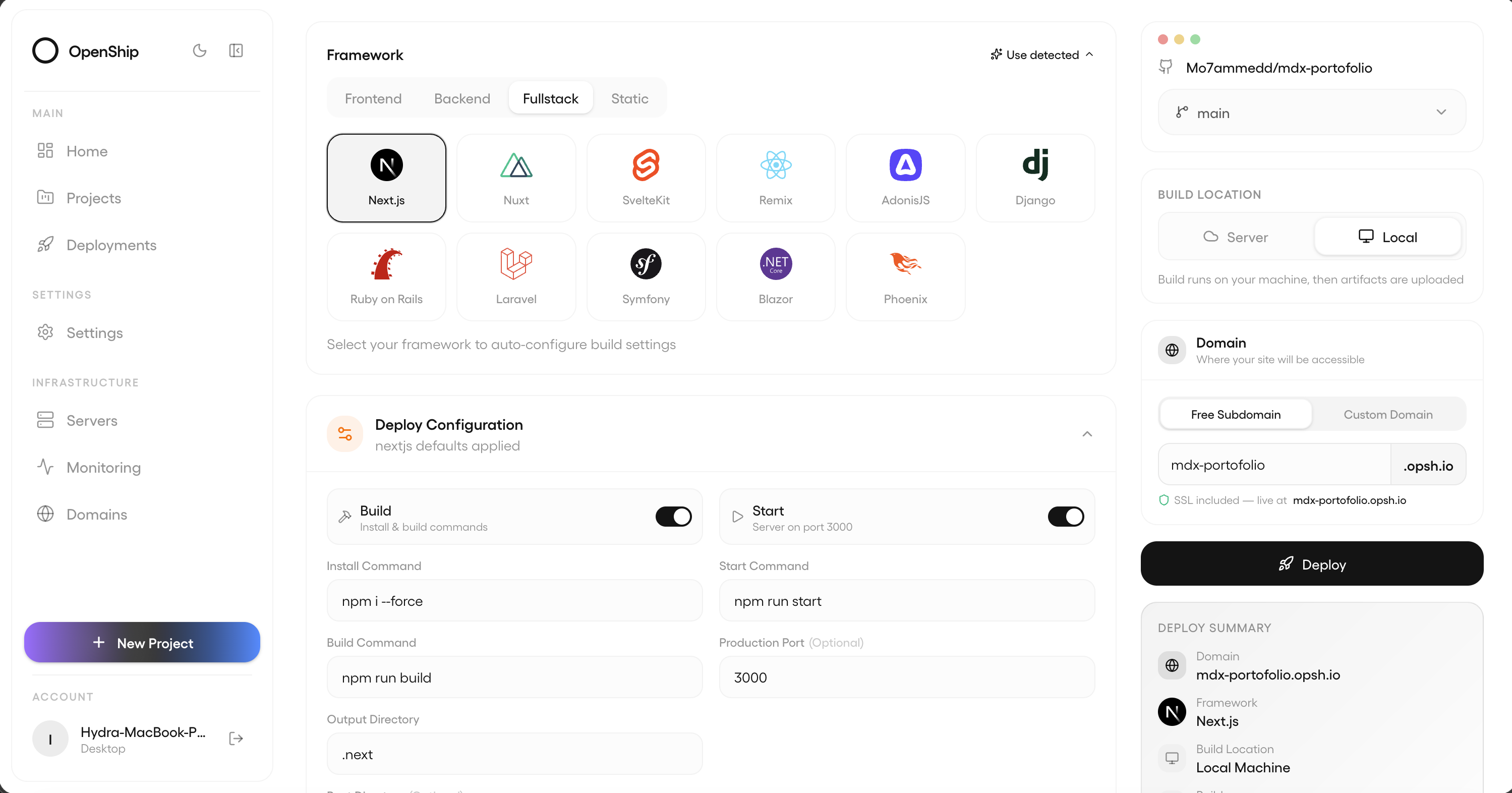
Point it at a repo — it builds, ships, routes, and TLS-terminates your app. Drive it from a desktop app, web dashboard, or CLI.




Quick Start · How It Works · Interfaces · Docs · Contributing




---
There's one decision to make first: how you run Openship itself (the control plane). Everything else is the same afterwards.
| If you're… | Run Openship as | Where your apps run |
|---|---|---|
| Solo, one machine, no ops | Desktop app | A server you connect over SSH, or Openship Cloud |
| A team — or you want push-to-deploy / to host apps on your own box | Self-hosted server (openship up) | On that box (Compose mode) — or out to another server / Cloud (bare mode) |
| Not interested in running anything | Openship Cloud | Managed sandboxes, zero setup |
[!TIP]
Solo? Use the desktop app. It runs Openship's control plane on your own machine only while the app is open — nothing is left running on an always-on server, nothing is exposed publicly. You only need an always-on server install once you want push-to-deploy (CI/CD), team access, or to host apps on that box — the things that need a public, always-on endpoint.
The control plane runs locally and drives your servers over SSH. No login, no terminal, no public surface — download, open, done:
| Platform | Download | |---|---| | macOS (Apple Silicon) | Openship-arm64.dmg | | macOS (Intel) | Openship-x64.dmg | | Windows | Openship-win32-x64.zip | | Linux | Openship.AppImage |
Linux: chmod +x Openship.AppImage && ./Openship.AppImage. Already have the CLI? openship install fetches and launches it. Links always point at the newest release.
From the desktop app you connect a server (SSH) or Openship Cloud and deploy to it — the app itself doesn't host public apps on your laptop.
Install the CLI (it bundles the API + dashboard), then run openship — an interactive wizard creates the first admin, wires your domain, and installs Openship as a boot service. Run it again anytime to manage the instance.
curl -fsSL https://get.openship.io | sh          # install  (or: npm i -g openship — needs Node 22+)
openship                                          # guided setup, then control panel
The install script brings its own Node when your system one is older than 22; a package-manager install runs on the Node you already have.
For CI / headless boxes, skip the wizard and drive openship up directly:
openship up                                       # install + start as a background service (boots + auto-restarts)
openship up --public-url https://openship.example.com   # + serve the dashboard on your domain (edge + TLS handled)
openship up picks how it runs for you:
--compose.--bare.openship open opens the dashboard · openship stop stops it · openship update upgrades · openship up --foreground runs attached.
Preview an unreleased build (dev). To run the CLI built straight from source — a branch, tag, or main ahead of the next release — install the from-source build:
>> curl -fsSL https://get.openship.io/dev | sh # main (default)
curl -fsSL https://get.openship.io/dev | OPENSHIP_REF=dev sh # a branch/tag (var goes on sh, not curl)
openship-dev # same CLI, built from source
openship-dev update # pull latest source + rebuild (no release needed)
> It installs as a separateopenship-devcommand with its own isolated home (~/.openship-dev) and boot service, so your productionopenshipand its data are never touched. Needs Bun + git; it's an unverified dev build (the dashboard compile wants real RAM/CPU) — not a production path.
Deploy a project:
cd your-project
openship init            # link this directory to a project
openship deploy
Full server guide + complete CLI reference: openship.io/docs.
Two ways to enable Tab-completion for openship:
| | Setup | Trade-off |
|---|---|---|
| Static file (recommended) | openship completion > | Instant shell startup. Regenerate after upgrading to pick up newly added commands. |
| Live-sourced | add source <(openship completion ) to your shell config | Always reflects the currently installed version. Adds a small delay to every new shell session. |
Static file:
openship completion bash > /etc/bash_completion.d/openship
openship completion zsh  > ~/.zsh/completions/_openship
openship completion fish > ~/.config/fish/completions/openship.fish
Live-sourced (zsh example):
echo 'source <(openship completion zsh)' >> ~/.zshrc
The self-hosted stack lives in docker/docker-compose.yml and pulls published images from GitHub Container Registry (ghcr.io/oblien/*) — no build tooling, no monorepo compile. Run it from the repo root:
git clone https://github.com/oblien/openship.git && cd openship
cp .env.example .env          # then edit
docker compose --env-file .env -f docker/docker-compose.yml up -d
The stack is postgres + redis + api + dashboard + edge. The edge is OpenResty on :80/:443 as a container (network_mode: host) — routing + Let's Encrypt, no bare host install. Linux only (host networking); on mac/win use openship up (bare). The api container mounts the host Docker socket so the control plane can build + run your apps as host containers — it's host-privileged through the socket, so run it only on a trusted host.
Upgrade: pin OPENSHIP_VERSION in .env for reproducible pulls, then docker compose --env-file .env -f docker/docker-compose.yml pull && … up -d. openship update only reconciles a stack the CLI installed, and openship up would adopt this one — don't reach for either here. Build from source instead: add -f docker/docker-compose.build.yml … up -d --build.
Host operations (:80/:443 takeover, the mail engine, host terminal/port scans) need the container→host SSH channel, which openship up provisions and this path does not — the five manual steps are in .env.example under Host operations from the container, and the failure it produces is Troubleshooting → Host control channel. Everything else, including deploys, works without it.
The rootdocker-compose.ymlis a different file: it's the SaaS / from-source control plane (builds from source, ships the marketing site, no edge/socket). It does not self-host your apps — usedocker/docker-compose.ymlabove oropenship up.
---
Point Openship at a source — a GitHub repo, a local folder, or a prebuilt artifact — and it runs one pipeline end to end:
1. Detect. It reads your package.json, framework config, lockfiles, and any docker-compose.yml / openship.json to work out the stack, package manager, build/start commands, and port. Zero config files required; an openship.json overrides the guesses if you want control.
2. Build. On the target server or locally on the orchestrator, into a Docker image or a bare release. The resolved config is frozen into a snapshot, so redeploys and rollbacks re-run exactly what shipped.
3. Run. As a container (published on loopback only — never a public port) or a supervised host process.
4. Route + secure. The OpenResty edge writes a reverse-proxy vhost to your domain and issues a Let's Encrypt certificate (HTTP-01). Because routing and TLS happen after the app is up, a DNS or cert hiccup surfaces as "action required" — it never fails the deploy or takes your app down.
5. Push-to-deploy. A GitHub webhook re-runs the pipeline on every push to the tracked branch — rebuilding only the services a monorepo push actually touched.
Databases, domains, SSL, CDN, mail, and backups are managed from the same place. (Push-to-deploy and public domains need an always-on server or Cloud — a desktop/loopback instance has no public endpoint to receive webhooks.)
---
Choose how to work with OpenShip:
OpenshipClient, or embed the engine with createShip. Install with npm install openship (0.8.0+, Node.js 22+) and follow the SDK guide.[!NOTE]
The docs are actively being filled out. If something's missing or unclear, contributions are hugely welcome.
---
| | | |---|---| | Built-in CI/CD | Push-to-deploy, preview environments, staging/prod flows, rollbacks | | Any stack | Node, Python, Go, Rust, PHP, Ruby, Java, .NET, Docker, monorepos | | Full backend | Postgres, MySQL, MongoDB, Redis, workers, WebSockets, storage | | Domains & SSL | Automatic Let's Encrypt, wildcards, unlimited domains, auto-renewal | | CDN | Edge caching, HTTP/3, Brotli compression, instant purge | | Mail server | Built-in SMTP with DKIM/SPF/DMARC — no Mailgun or SES needed | | Backups | Scheduled, databases + volumes, one-click restore, export anytime | | Real-time monitoring | Live build logs, container metrics, visitor geography and per-code response mix — ~1.4 µs per request, zero DB writes per request | | Scaling | Auto-scaling on cloud, multi-node ready on self-hosted | | Portability | Standard Docker containers — move between providers freely | | Docker Compose | Deploy existing compose files as-is |
---
---
Production-ready core, actively developed. Self-hosting is free (no billing).
Coming next: multi-node clusters, load-balancing UI, private networking, advanced monitoring, and visual CI/CD pipelines.
---
See CONTRIBUTING.md.
---
Found a vulnerability? We welcome your report — please disclose it privately, never in a public issue, PR, or discussion.
Openship-authored code is licensed under the Apache License 2.0. Bundled third-party components retain their own licenses. In particular, the iRedMail engine is GPL-licensed and is included in several control-plane distributions even when mail setup is not used. See the component and packaging inventory for the recorded license boundaries and outstanding upstream notice review.
→ →
→ →
→ →
→ →
→ →
→ →
→ →
→