1
 →
→
Fast and modern interactive financial charts with their own native renderer powered by WebGL2 or Canvas2D.
LuxAlgo/Vela is an open-source project on GitHub, mainly written in TypeScript. Fast and modern interactive financial charts with their own native renderer powered by WebGL2 or Canvas2D. It currently holds 636 stars and 140 forks with 18 open issues, and was last pushed on 2026-10-01 (repository created 2026-07-13).
Git Homed tracks it on the Today's Trending board, currently at rank #76 with 36 new stars today.

Fast, extensible financial charts for the web.
Headless core · native WebGL2 renderer · batteries-included workspace · plugin SDK
[![npm version][npm-version-img]][npm-link] [![Downloads][npm-downloads-img]][npm-link] [![License][license-img]][license-link]
Homepage · Quick start · Documentation · Plugin SDK · Changelog · License
Vela™ renders interactive financial charts with its own native renderer (WebGL2, with a canvas2d fallback) and keeps the chart itself headless: drive it entirely from code, or drop in the workspace for a complete chart app in one call. Every layer (data providers, scripting engines, renderers) plugs in behind a public port and can be swapped without touching the rest.
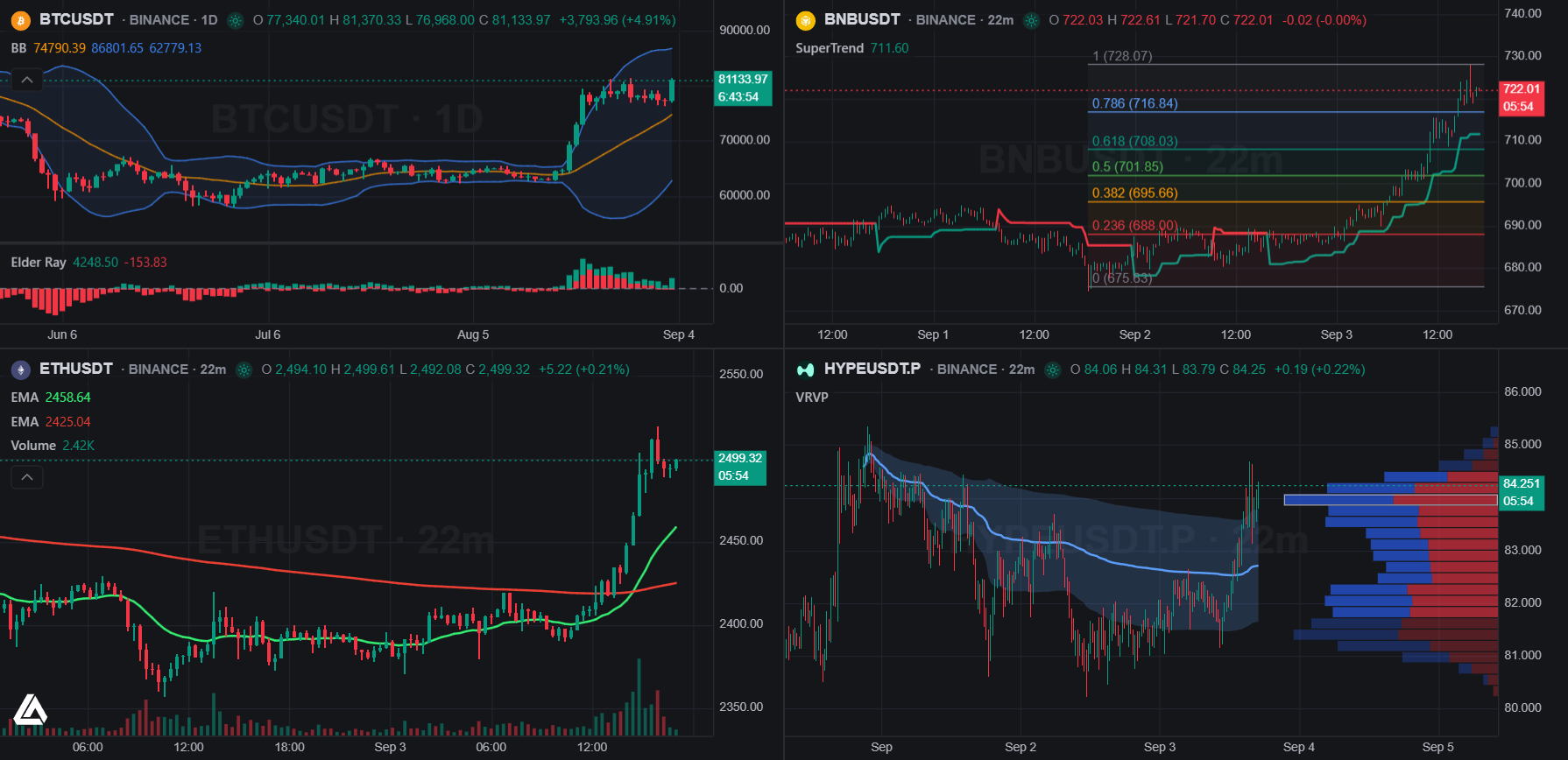
@luxalgo/vela: the headless chart. Data model, engines, drawings, providers,@luxalgo/vela/workspace: the full chart app. One chart or a grid of them under0 for symbol search, a digit 1–9 for timeframe entry, ? for the shortcuts
panel), named cells, sync groups, and one persisted state document.
@luxalgo/vela/ui: the component kit the app is built on. Design tokens, overlayKeymapManager.
@luxalgo/vela/plugin: the extension SDK. Chart types, renderer layers, native@luxalgo/vela/providers/*: data providers (Binance, Coinbase, Hyperliquid),npm install @luxalgo/vela
The fastest path is the workspace, a complete chart app in one call:
import { VelaWorkspace } from '@luxalgo/vela/workspace';
import { BinanceProvider } from '@luxalgo/vela/providers/binance';
const chart = new VelaWorkspace('#chart', {
    layout: false, // one chart; '2h' | '4' | '8' | … for a multi-chart grid
    symbol: 'BTCUSDT',
    timeframe: '60',
    live: true,
    theme: 'dark',
    providers: { binance: () => new BinanceProvider() },
    persist: true, // restore market, style, timezone, drawings and indicators from localStorage
});
Prefer full control? Use the headless core directly:
import { Vela } from '@luxalgo/vela';
import { BinanceProvider } from '@luxalgo/vela/providers/binance';
const chart = new Vela('#chart', { symbol: 'binance:BTCUSDT', timeframe: '60', live: true });
chart.data.registerProvider('binance', new BinanceProvider());
await chart.ready();
No provider, no network? Pass your own bars via the data option. See the
quickstart.
The package also ships self-contained browser builds for script-tag usage:
dist/vela.global.js (readable, development) and dist/vela.global.min.js (minified,
production). Either file attaches the library's public API, including the bundled
providers, to window.Vela.
Vela™ ships 70+ built-in studies — moving averages, bands and channels, momentum oscillators, trend and volatility measures, volume studies, and price-anchored overlays such as VWAP, SuperTrend, and Pivot Points. They compute from the chart's own bars (no scripting engine), and each one gets a legend row, a settings dialog, and persistence across reloads. Volume and the visible-range volume profile sit alongside them.
Custom scripts still run through pluggable engines. Vela™ ships none: install the
addon for the language you want, or write one against the public ScriptingEngine port.
Pine Script® lives in @luxalgo/vela-pinets
(npm i @luxalgo/vela-pinets pinets), which is AGPL-3.0 because the PineTS runtime it
executes is. Vela™ itself stays Apache-2.0 and carries no Pine code:
import { PineEngine } from '@luxalgo/vela-pinets';
chart.registerEngine('pine', new PineEngine());
chart.addIndicator(`//@version=6
indicator("EMA 20", overlay=true)
plot(ta.ema(close, 20), color=color.orange, linewidth=2)`);
Host tooling can execute-and-inject safely with chart.runIndicator(source) (structured
errors, no dead legend rows) and read a running script's state, including its return
value, via handle.context() (read-only snapshots, worker-safe). See the
API reference, and
Scripting engines for the addon and for writing your own.
The workspace takes an indicator manifest**: inline JSON, a URL returning it, or an
async loader (() => Promise):
new VelaWorkspace('#chart', {
    // …
    engines: { pine: () => new PineEngine() },
    indicators: '/indicators.json', // or an inline [{ name, script | url, language?, enabled? }]
});
Custom chart types and canvas layers register through the public SDK, no fork needed:
import { registerChartType, registerRendererLayer } from '@luxalgo/vela/plugin';
// A new price style: bar transform + optional per-bar data engine + ticker modifier.
registerChartType({
    id: 'renko-like',
    label: 'Renko-like',
    barTransform: { full: (bars) => transformAll(bars), next: (bar) => transformOne(bar) },
});
// A custom canvas layer, painted every frame with the chart (its id = its data channel).
registerRendererLayer({
    id: 'renko-like',
    placement: 'above-data',
    create: () => ({ mount(canvas) {/ keep it /}, render({ bars, data, coords, scale, bounds }) {/ paint /} }),
});
A registered chart type automatically appears in the workspace's style dropdown, and a
chart type's dataEngine pushes to its layer's channel with zero extra wiring. See
docs/contributing/plugin-sdk.md.
Full documentation lives in docs/: user guides (quickstart, the workspace, options, API reference), architecture, and contributing guides including the plugin SDK.
npm install
npm run playground   # vite playground on http://localhost:5190
npm test             # vitest
npm run build        # tsup → dist/
Vela™ is licensed under the Apache License, Version 2.0 (see LICENSE). The NOTICE file adds an attribution requirement, and redistributions must include it per Apache-2.0 §4(d):
chart.renderer.set('attribution', false)) only ifThis is the same licensing model used by other popular charting libraries, and we're grateful when the watermark stays in a visible spot.
No scripting engine ships with this package; the Pine Script® addon
(@luxalgo/vela-pinets) is AGPL-3.0 and licensed separately (see Indicators).
[homepage]: https://velacharts.dev
[npm-version-img]: https://img.shields.io/npm/v/%40luxalgo%2Fvela.svg [npm-downloads-img]: https://img.shields.io/npm/dm/%40luxalgo%2Fvela.svg [npm-link]: https://www.npmjs.com/package/@luxalgo/vela
[license-img]: https://img.shields.io/badge/license-Apache--2.0-blue.svg [license-link]: LICENSE
→ →
→ →
→ →
→ →
→ →
→ →
→ →
→