1
 →
→
🚀 A self-hostable personal dashboard built for you. Includes status-checking, widgets, themes, icon packs, a UI editor and tons more!
lissy93/dashy is an open-source project on GitHub, mainly written in Vue. 🚀 A self-hostable personal dashboard built for you. Includes status-checking, widgets, themes, icon packs, a UI editor and tons more! It currently holds 26,670 stars and 1,952 forks with 0 open issues, and was last pushed on an unknown date (repository created unknown).
Git Homed tracks it on the Today's Trending board.
The most customizable dashboard for self-hosters
Dashy is the homepage for your homelab

User Showcase | Live Demo | Getting Started | Documentation | GitHub
Kindly sponsored by
 SSD Nodes Affordable VPS hosting for self-hosters |
 Umbrel Personal home cloud and OS for self-hosting |
 TestMu AI Full-stack Agentic AI Quality Engineering platform |
Live Instances: Demo (Live Demo) ┆ Dev Preview (Dev Preview)
Screenshots: Checkout the Showcase, to see example dashboards from the community
Try it yourself: docker run -p 8080:8080 lissy93/dashy
---
For full setup instructions, see: Deployment
You will need Docker installed on your system
docker run -p 4000:8080 lissy93/dashy
Or
docker run -d \
  -p 4000:8080 \
  -v /path/to/your/user-data:/app/user-data \
  --name my-dashboard \
  --restart=always \
  lissy93/dashy:latest
To use with compose, see our sample docker-compose.yml.
The mounted /app/user-data directory must contain at least a conf.yml.
It can also hold sub-config files, item icons, fonts, custom CSS, or anything else you want served from the web root.
Dashy is distributed both on DockerHub (lissy93/dashy) and GHCR (ghcr.io/lissy93/dashy).
You can either use :latest or pin to specific versions (like 4.0.0).
All images are multi-arch (works on amd64 and arm64).
Once you've got Dashy running, see the docs for configuration references and usage guides.
You'll need up-to-date Node LTS installed, as well as git and yarn enabled.
git clone https://github.com/Lissy93/dashy.git and cd dashy./user-data/conf.ymlyarnyarn buildyarn startSee docs: Full list of Dashy's commands
Dashy supports 1-Click deployments on several popular cloud platforms. To spin up a new instance, just click a link below:
 Deploy to Hostinger
 Deploy to Netlify
 Deploy to Vercel
 Deploy to Render
 Deploy to Railway
 Deploy to GCP
 Deploy to Easypanel
 Deploy to EdgeOne
For more 1-click cloud deployments, see Cloud Deployment
---
For full configuration documentation, see: Configuring
Dashy is configured through a YAML file, located at ./user-data/conf.yml. In addition, you can find a complete list of available options in the Configuring Docs. The config can also be edited and saved directly through the UI.
---
For full theming documentation, see: Theming
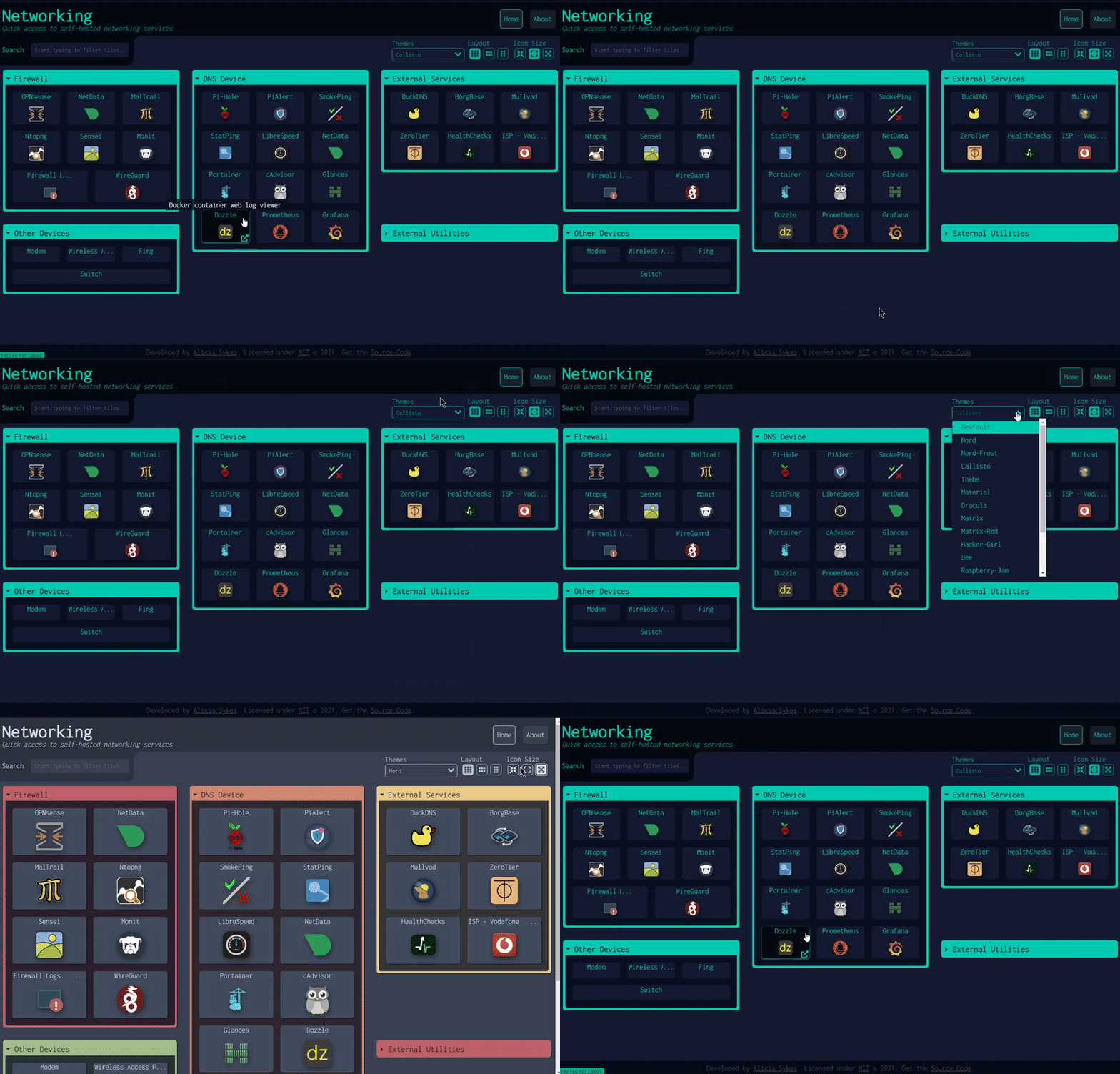
Dashy comes pre-bundled with several built-in themes, which you can preview, apply and edit through the UI. With the theme configurator and support for custom CSS, everything is in place to quickly develop your own unique-looking dashboard.


---
For full iconography documentation, see: Icons
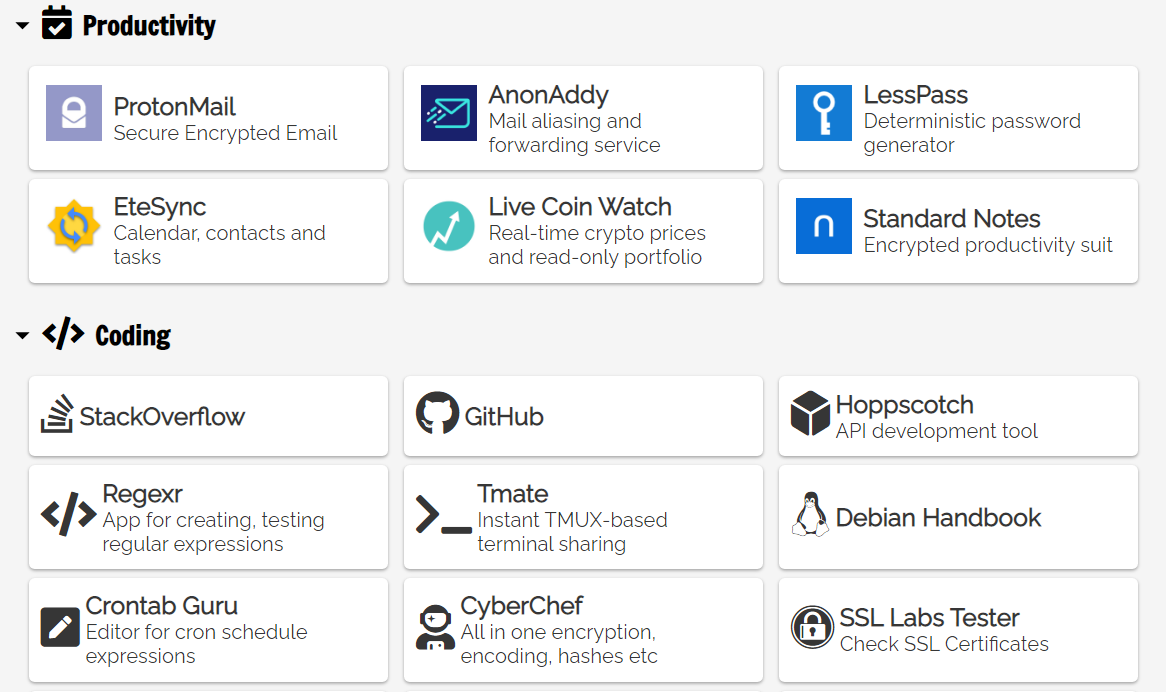
Both sections and items can have an icon associated with them, defined under the icon attribute. With several different icon packs supported, you'll be able to find the perfect thumbnail for any app or service.
The following icon types are supported:
[font-awesome]: https://fontawesome.com/icons [simple-icons]: https://simpleicons.org/ [material icons]: https://github.com/Templarian/MaterialDesign [selfh.st/icons]: https://selfh.st/icons [dashboard-icons]: https://github.com/homarr-labs/dashboard-icons
---
For full monitoring documentation, see: Status Indicators
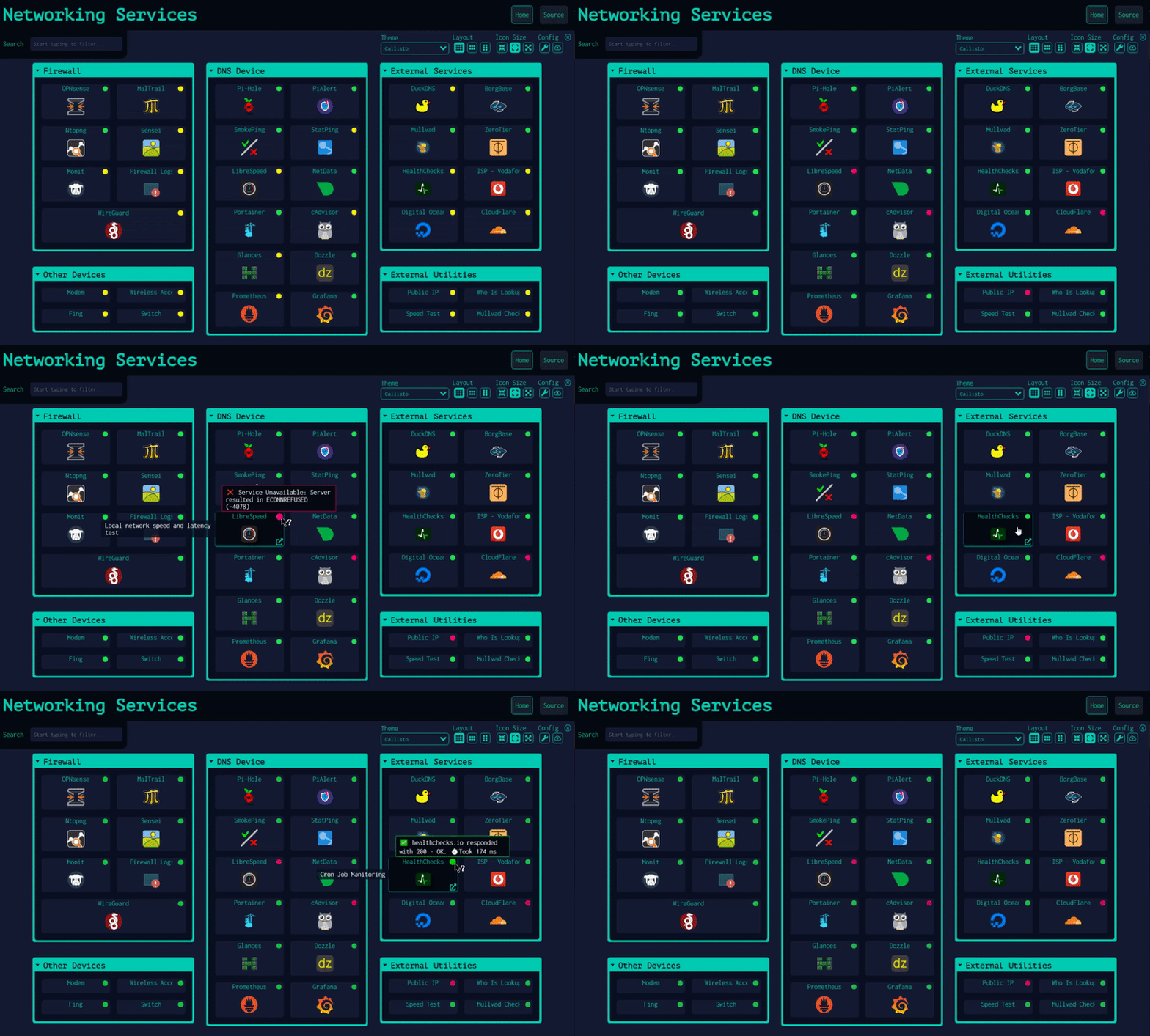
Dashy has two optional features to check if each app/service or host is up and responding, then display a small status indicator icon. Hovering over it will show additional stats like response time and status code.
App/Service status is checked by calling an URL and analyzing its HTTP response code. Host status is checked by sending a real ping ICMP request to the host. Both checks can be done at the same time on the same item. In this case, two status indicators will show up and behave independently according to the global and item settings for each feature.
Status indicators can be globally enabled by setting appConfig.statusCheck: true for app/service and appConfig.pingCheck: true for hosts or enabled/disabled on a per-item basis. Statuses are checked on page load, but you can allow continuous polling by specifying a time interval between checks, in seconds under appConfig.statusCheckInterval and appConfig.pingCheckInterval. You can also use a different endpoint for app/service status checking, with statusCheckUrl, and if needed, pass in custom headers under statusCheckHeaders.
---
For full widget documentation, see: Widgets
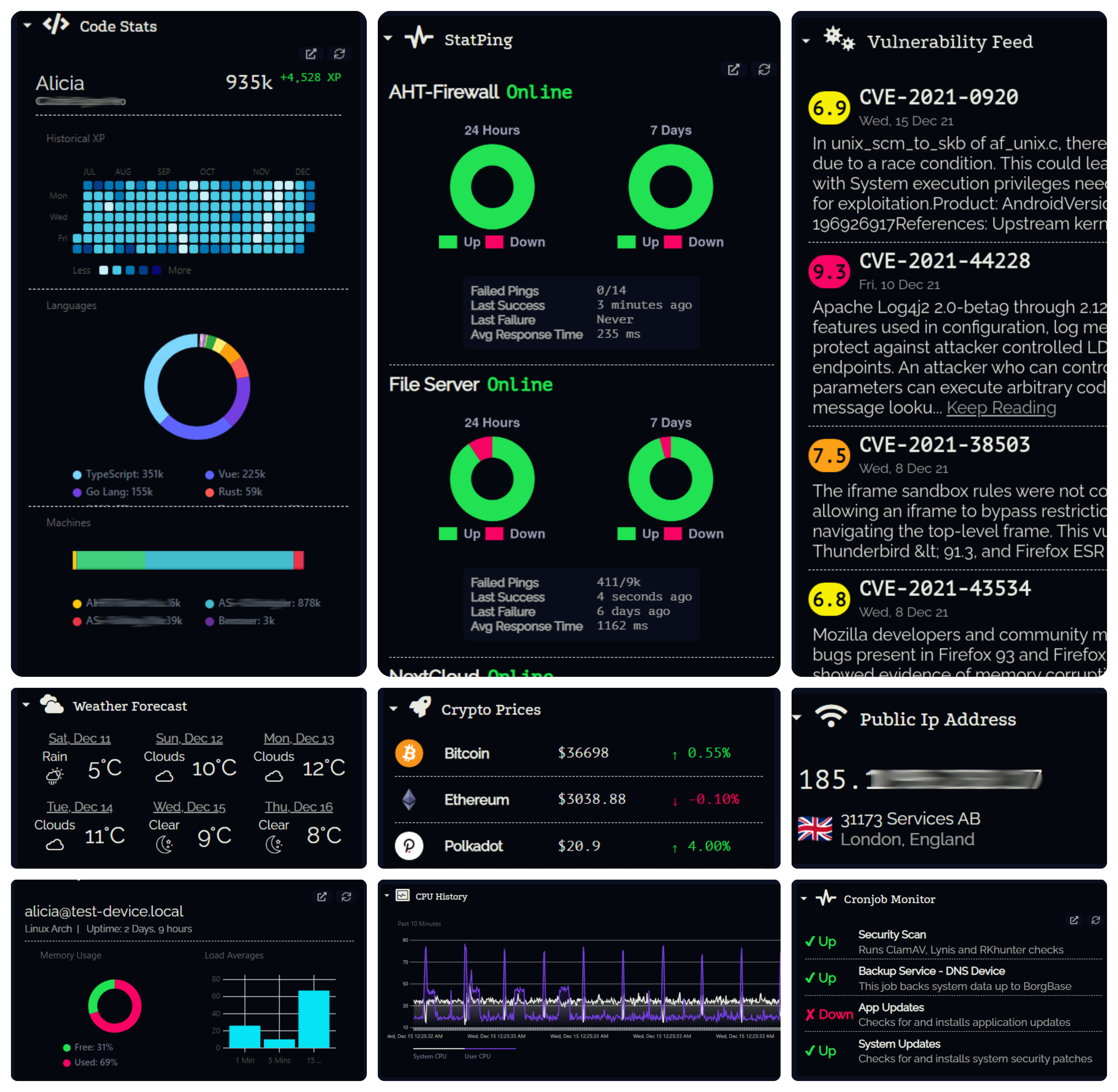
You can display dynamic content from services in the form of widgets. There are several pre-built widgets available for showing useful info, and integrations with commonly self-hosted services, but you can also easily create your own for almost any app.
---
For full authentication documentation, see: Authentication
Dashy has full support for secure single-sign-on using Keycloak for secure, easy authentication, see setup docs for a full usage guide.
There is also a basic auth feature, which doesn't require additional setup. To enable this, add an auth attribute under appConfig, containing an array of users, each with a username, SHA-256 hashed password and optional user type. Basic auth also supports several access control features, including read-only guest access and granular controls.
appConfig:
auth:
users:
- user: alicia
hash: 4D1E58C90B3B94BCAD9848ECCACD6D2A8C9FBC5CA913304BBA5CDEAB36FEEFA3
type: admin
Other access control systems are also supported, see the Alternative Auth Methods docs.
---
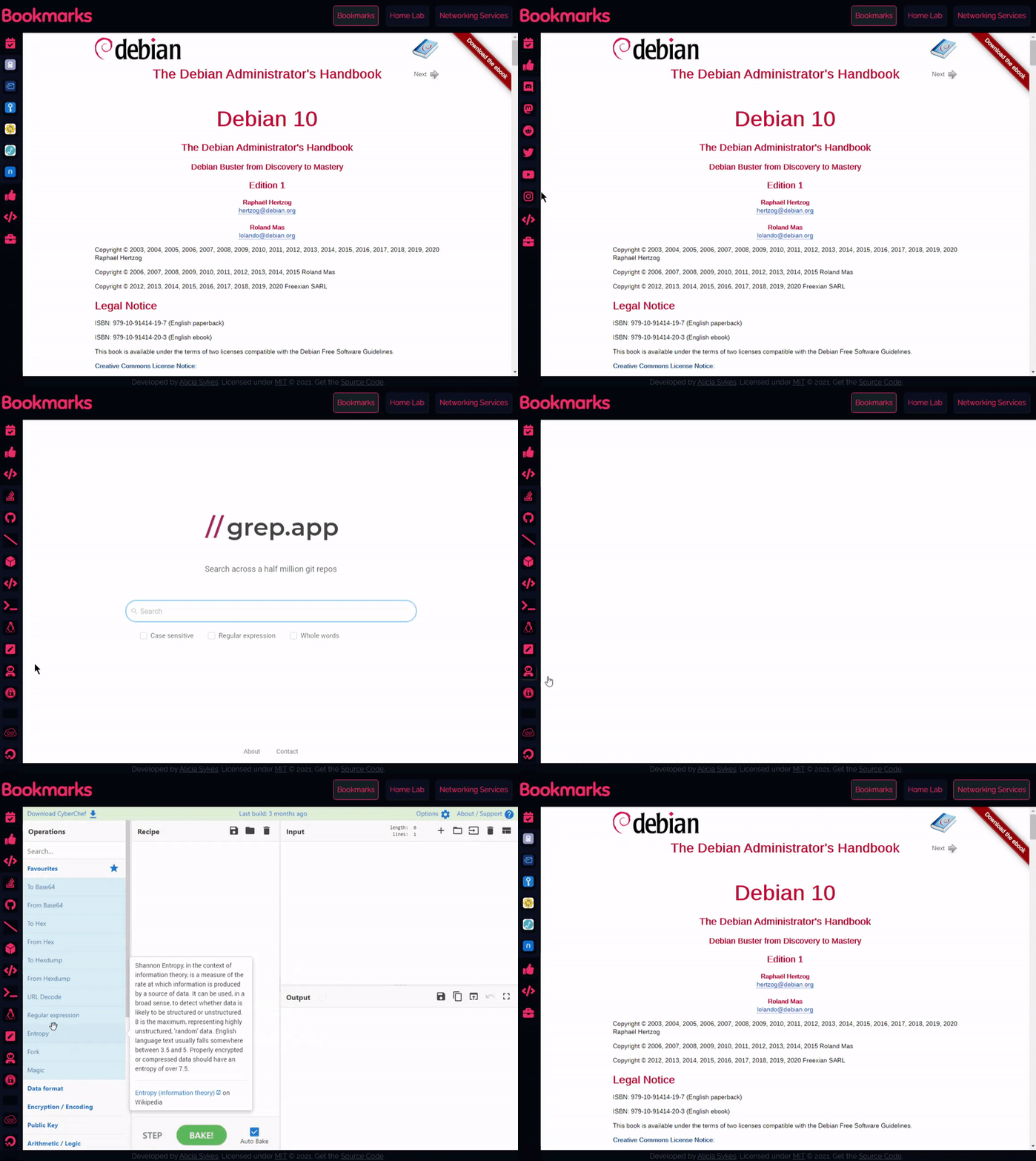
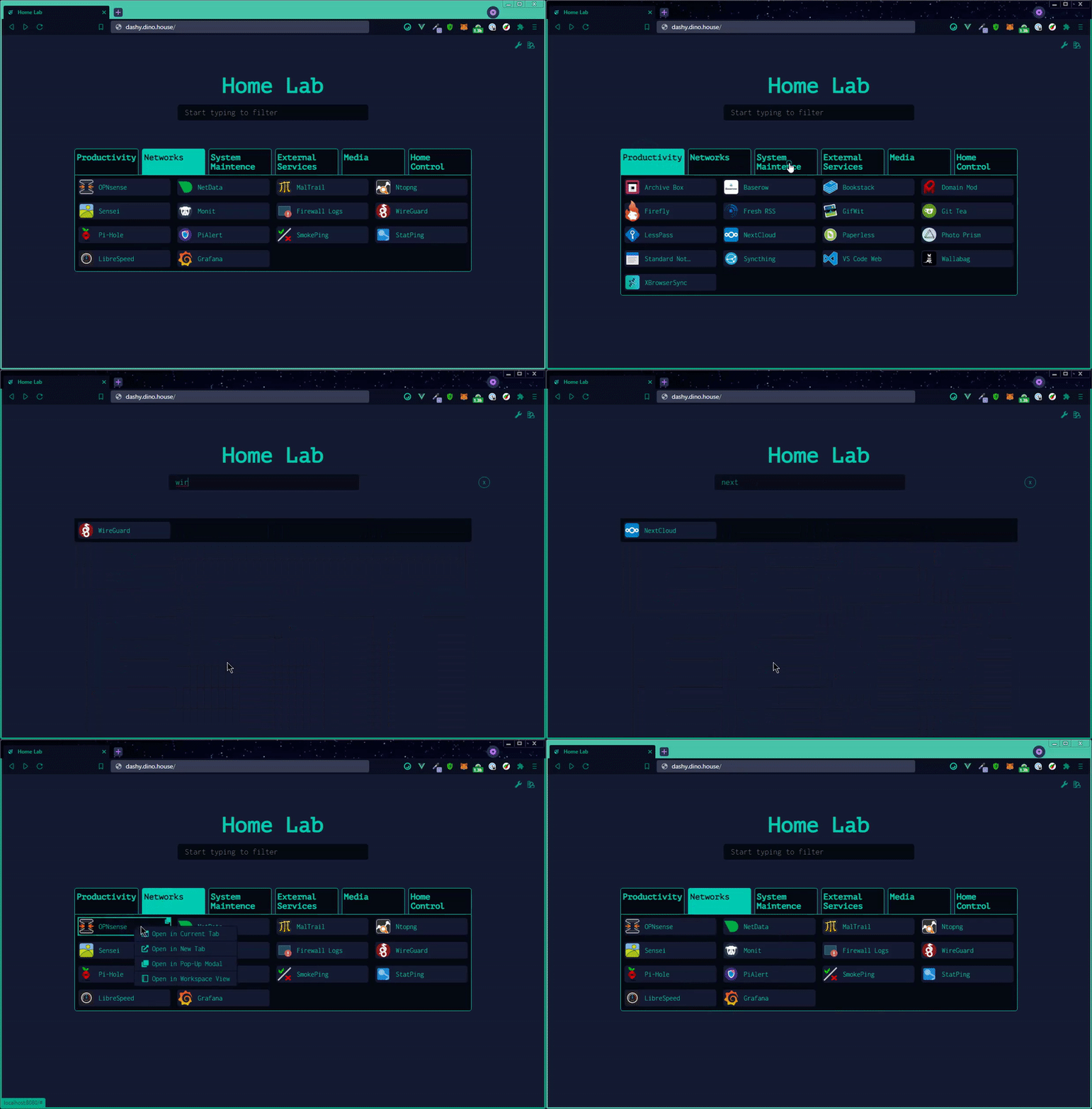
As well as the default homepage, there is also:
appConfig.startingView attribute.
Example of Workspace View
Example of Minimal View
---
For full documentation on views and opening methods, see: Alternate Views
There are several different ways you can launch apps. You can specify the default opening method for any given item under the target attribute or set a site-wide default under appConfig.defaultOpeningMethod. Right-click on an item for all options. The following options are supported:
sametab - The app will be launched in the current tabnewtab - The app will be launched in a new tab (or use Ctrl + Click)modal - Launch app in a resizable/ movable popup modal on the current page (or use Alt + Click)workspace - Changes to Workspace view and launches appclipboard - Copy the app's URL to your system clipboardtop - Opens in the top-most browsing context, useful if you're accessing Dashy through an iframe---
For full documentation on searching, see: Searching & Shortcuts
Quickly finding and launching applications is the primary aim of Dashy. To that end, instant search and customizable keyboard shortcuts are built-in.
To start filtering, start typing—no need to select the search bar or use any special key. Then use either the tab key or arrow keys to select and move between results, and hit enter to launch the currently selected application.
For apps that you use regularly, you can set a custom keybinding. Use the hotkey parameter on a certain item to specify a numeric key between 0 - 9. You can then launch that app by just pressing that key.
You can also add custom tags to a given item to make finding them based on keywords easier. For example, in the following example, searching for 'Movies' will show 'Plex'
items:
- title: Plex
hotkey: 8
icon: favicon
description: Media library
url: https://plex.lab.local
tags: [ movies, videos, music ]
To search the web directly through Dashy, just press enter after typing your query. Options for web search are set under appConfig.webSearch. There is built-in support for 10+ search engines, or use your own custom provider or self-hosted instance. With the web search, you can also define your bangs to redirect results to any given app, website, or search engine, when the query is preceded with a certain character sequence (usually beginning in /, ! or :).
webSearch:
  searchEngine: duckduckgo
  openingMethod: newtab
  searchBangs:
    /r: reddit
    /w: wikipedia
    /s: https://whoogle.local/search?q=
    ':wolf': wolframalpha
    ':so': stackoverflow
    ':git': github
Hit Esc at any time to close any open apps, clear the search field, or hide any modals.
---
For full config documentation, see: Configuring
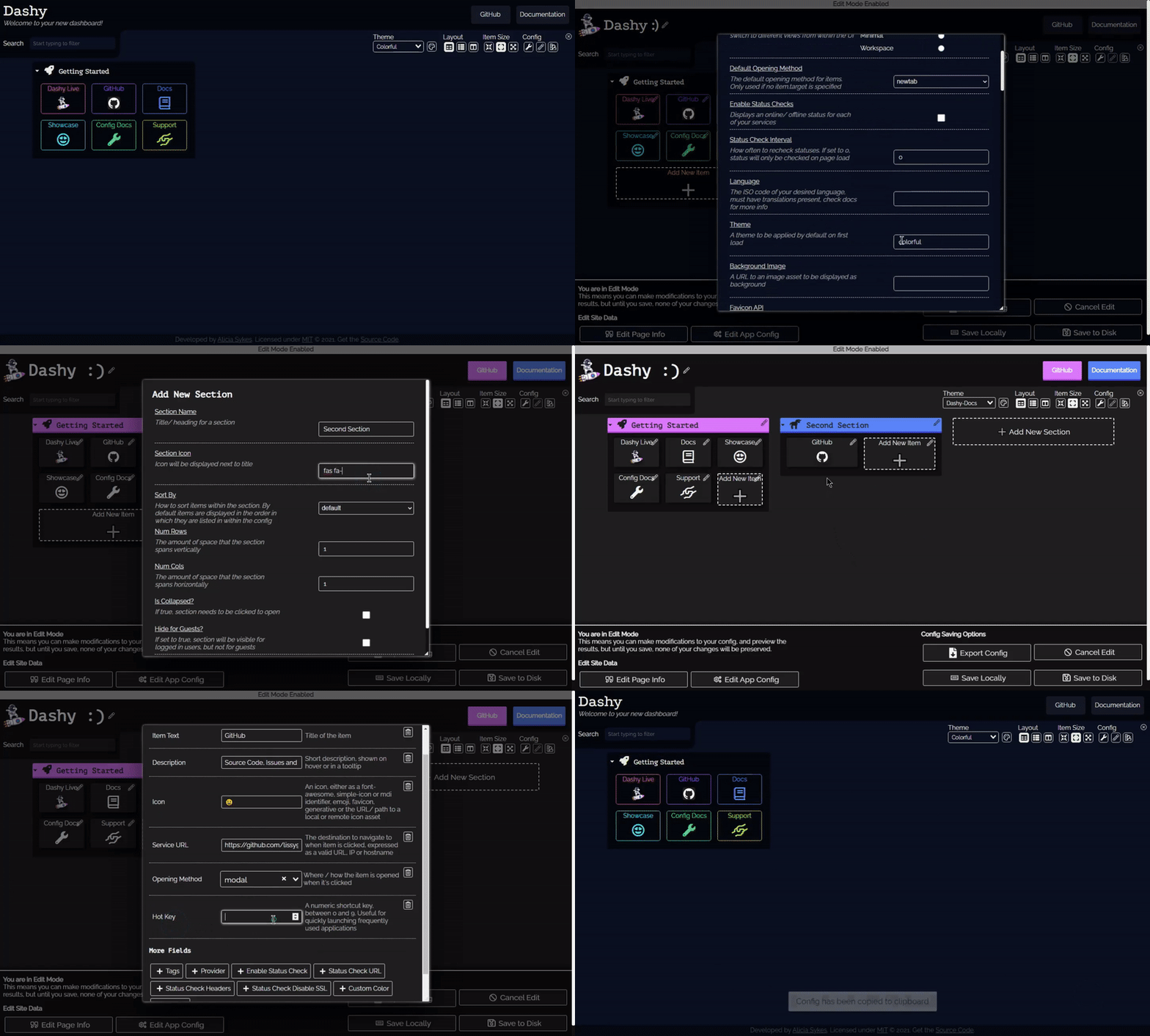
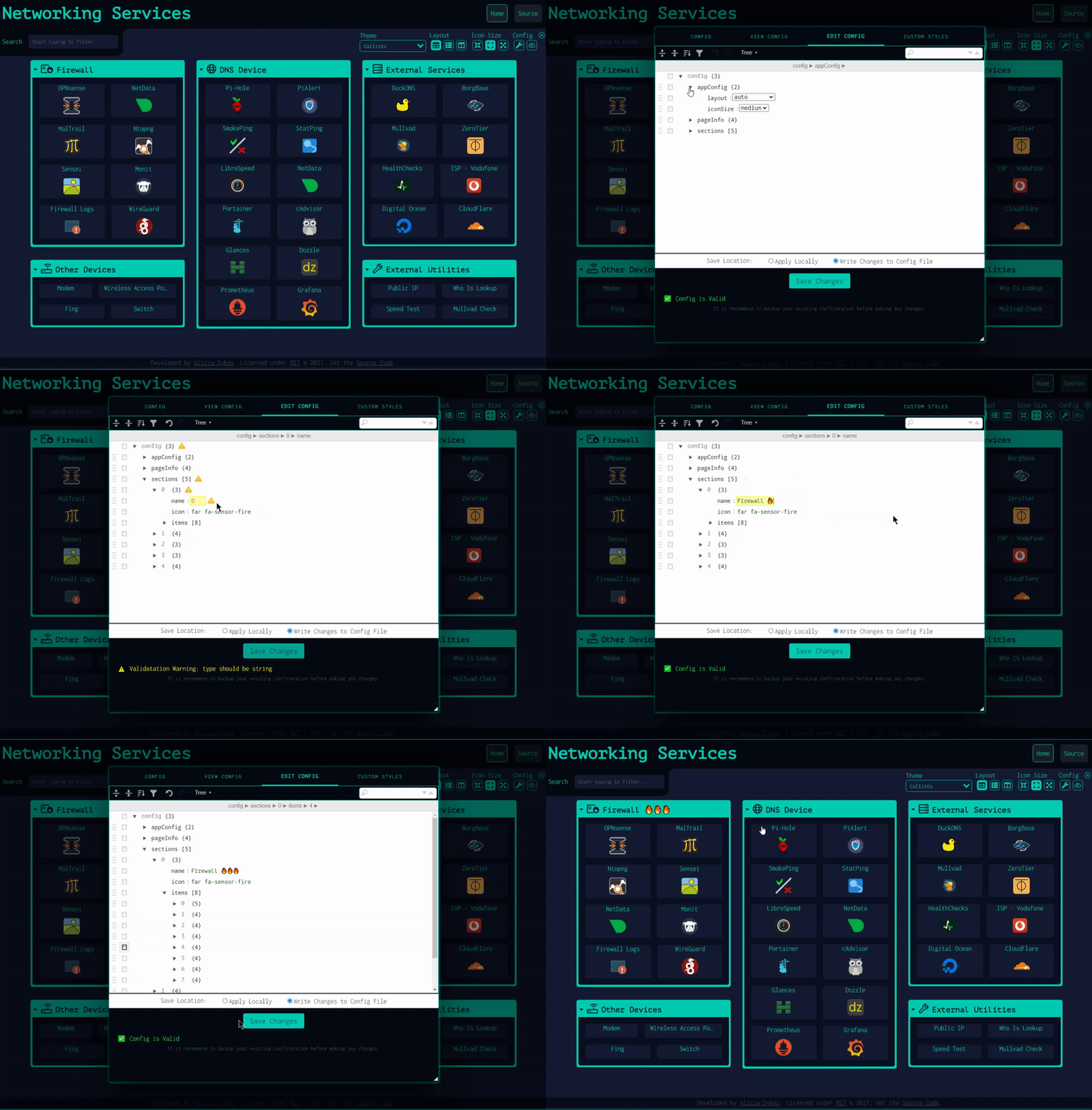
As well as passing in a YAML config file, you can also configure the app directly through the UI and preview changes live.
To edit any section or item, right-click on it, and select "Edit", or enter the Edit Mode (using the Pen icon in the top-right), then click any part of the page to edit. Changes will be visible immediately but will not be saved until clicking "Save to Disk" or "Save Locally".
Under the config menu, you can export, view, backup, or reset app config and edit the raw config file in a text editor with built-in schema validation. It's recommended to keep a backup of your config.
---
For full backup documentation, see: Cloud Backup & Sync
Dashy has an optional built-in feature for securely backing up your config to a hosted cloud service and then restoring it on another instance. This is useful not only for backing up your configuration off-site but also enables Dashy to be used without having to write a YAML config file.
All data is fully E2E encrypted before being sent to the backend (done in CloudBackup.js using crypto.js 's AES method). The data is then sent to a Cloudflare worker and stored in a KV data store.
---
For full internationalization documentation, see: Multi-Language Support
Dashy supports multiple languages and locales. When available, your language should be automatically detected and applied on load. But you can also select a language through the UI (under config --> Switch Language) or set appConfig.language to your language (specified as a 2-digit ISO 639-1 code), as seen below, e.g. language: de.
en - _Default_en-GBar - Contributed by @kayedspaceaz - Contributed by @jamalkamaladdinbn - Contributed by @soaibsafibg - Contributed by @asenovzh-CN - Contributed by @FormatTodaycs - Contributed by @Tuzi555da - Contributed by @lordpansarnl - Contributed by @evroonfr - Contributed by @EVOTkde - Contributed by @Niklashereel - Contributed by @aviolarishi - _Auto-generated_ (needs human review!)hu - Contributed by @apgyorfiid - Contributed by @Yoruxyvit - Contributed by @alexdelpreteja - _Auto-generated_ (needs human review!)ko - Contributed by @boggy-csky - Contributed by @noblepower1337nb - Contributed by @rubjopl - Contributed by @skaarj1989pt - Contributed by @LeoColmanro - Contributed by @z3r0l1nkgl - Contributed by @pvillaverderu - Contributed by @sasetzsk - Contributed by @Smexhysl - Contributed by @UrekDes - Contributed by @lu4tsv - Contributed by @BOZGsw - Contributed by @Daniel-wambuazh-TW - Contributed by @stanly0726tr - Contributed by @imsakguk - Contributed by @allozavrrpirate - Contributed by @Lissy93---
For full multi-page documentation, see: Pages & Sections
Within your dashboard, you can have as many sub-pages as you require. To load additional pages, specify a name, and path to a config file under pages. The config file can be either local (stored in /public), or remote (located anywhere accessible).
pages:
- name: Networking Services
path: 'networking.yml'
- name: Work Stuff
path: 'work.yml'
Or
pages:
- name: Getting Started
path: 'https://snippet.host/tvcw/raw'
- name: Homelab
path: 'https://snippet.host/tetp/raw'
- name: Browser Startpage
path: 'https://snippet.host/zcom/raw'
---
If running on bare metal, Dashy requires Node LTS (24.x) is recommended.
If running in Docker container, the recommended base image is Alpine (3.21)
The hardware requirements vary depending on where and how you are running Dashy. Gener
→ →
→ →
→ →
→ →
→ →
→ →
→ →
→