1
 →
→
Pre-indexed code knowledge graph, auto syncs on code changes, for Claude Code, Codex, Gemini, Cursor, OpenCode, AntiGravity, Kiro, CoPilot, and Hermes Agent — fewer tokens, fewer tool calls, 100% local
Already installed? Run codegraph upgrade
Follow @getcodegraph on X for updates.
The fastest complete code graph · surgical context · built for how agents actually work · 100% local

















The CodeGraph platform is coming — for every PR, know exactly what to test, what could break, which flows are affected, and whether business logic is compromised.

Get early beta access to the hosted product · getcodegraph.com
No Node.js required — one command grabs the right build for your OS:
# macOS / Linux
curl -fsSL https://raw.githubusercontent.com/colbymchenry/codegraph/main/install.sh | sh
Windows (PowerShell)
irm https://raw.githubusercontent.com/colbymchenry/codegraph/main/install.ps1 | iex
npm i -g @colbymchenry/codegraph
CodeGraph bundles its own runtime — nothing to compile, no native build, works the same everywhere. The installer puts codegraph on your PATH but doesn't change your current shell — open a new terminal before the next step so the command resolves.
Upgrade any time with codegraph upgrade — it detects how you installed (bundle, npm, or npx) and updates in place. Add --check to see if an update is available, or codegraph upgrade to pin one.
In a new terminal, run the installer to connect CodeGraph to the agents you use:
codegraph install
Detects and auto-configures Claude Code, Cursor, Codex CLI, opencode, Hermes Agent, Gemini CLI, Antigravity IDE, Kiro, and GitHub Copilot (VS Code, Copilot CLI, JetBrains IDEs) — wiring the CodeGraph MCP server into each. This is the step that connects CodeGraph to your agent; installing the CLI in step 1 does not do it on its own. It only wires up your agent — it does not index any code; building each project's graph is the separate codegraph init in step 3. (Shortcut: npx @colbymchenry/codegraph downloads and runs this in one go.)
cd your-project
codegraph init
codegraph init creates the local .codegraph/ directory and builds the full graph in the same step — one command, done.
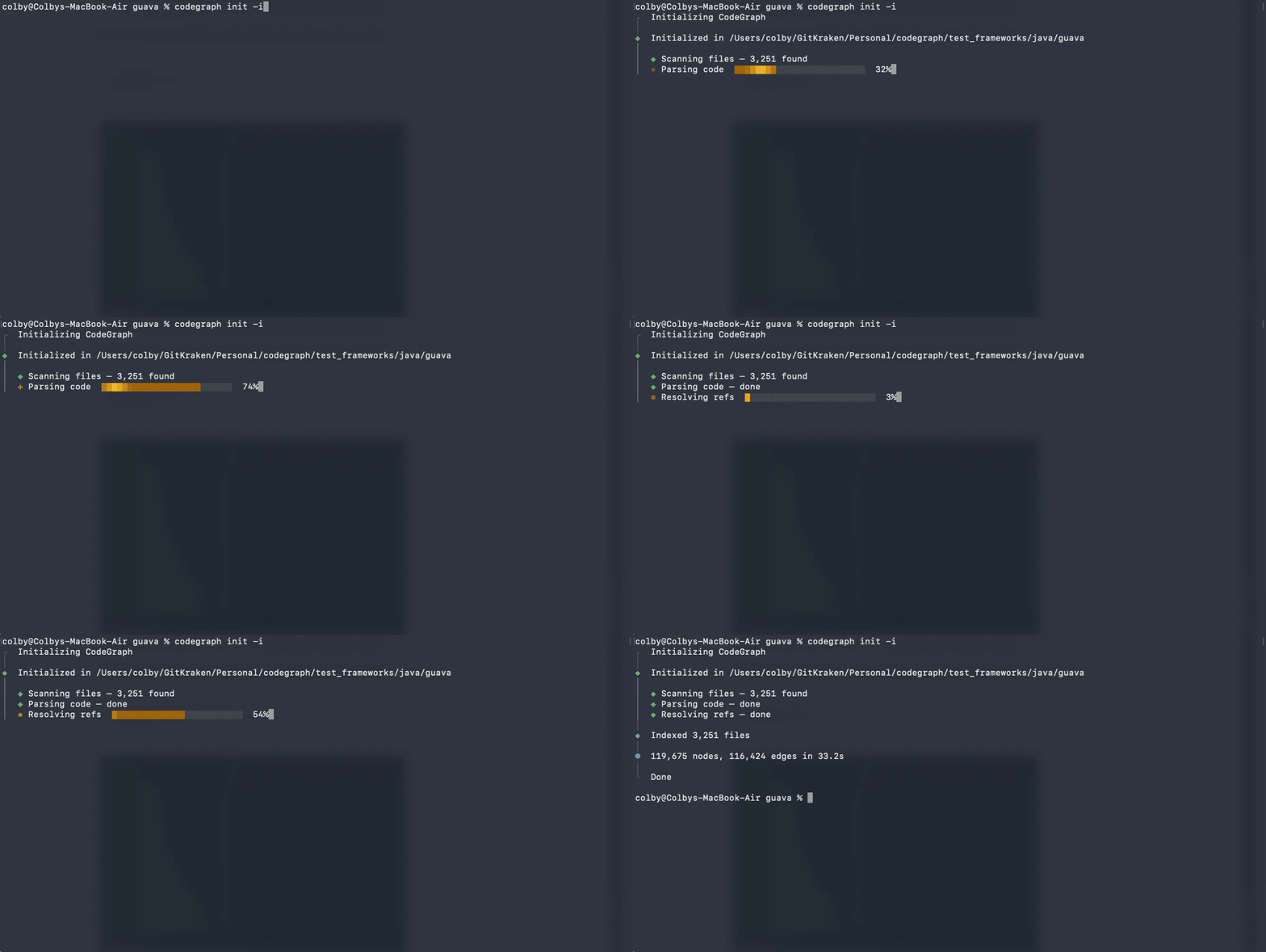
Auto-sync is enabled by default. CodeGraph watches the project and updates the graph on every file change — while your agent edits code, or you add, modify, or delete files. The index is never stale, and there is nothing to re-run.
codegraph ui
Opens the graph in your browser at http://127.0.0.1:4747 — callers on the left, the symbol's
source in the middle, what it calls on the right. See
Read your graph in the browser.
Changed your mind? One command removes CodeGraph from every agent it configured and the CLI itself — every install it finds (standalone bundle, npm global package, launcher link), shown to you before anything is deleted:
codegraph uninstall
Pass --keep-cli to remove only the agent configurations and keep the CLI installed.
Reverses the installer — strips CodeGraph's MCP server config, instructions, and permissions from each configured agent. Your project indexes (.codegraph/) are left untouched; remove those per-project with codegraph uninit. Use --target to remove from specific agents, or --yes to run non-interactively.
---
Every language below gets the same treatment — full structural extraction and cross-file resolution into one graph, no per-language setup:





Per-language details — extensions, frameworks, and what exactly gets extracted — in Supported Languages.
---
When an AI agent needs to understand code — to answer a question or make a change — it discovers structure the slow way: grep, glob, and Read, one file at a time, rebuilding call paths and dependencies by hand. That's a pile of tool calls and round-trips before it even starts the real work.
CodeGraph hands the agent the exact code it needs in one call. It's a pre-built knowledge graph of every symbol, call edge, and dependency in your codebase — so instead of crawling files, the agent asks one question and gets back the relevant source, the call paths between those symbols (including dynamic-dispatch hops grep can't follow), and the blast radius of a change. Surgical context, not a file-by-file search — which means fewer tool calls and faster answers on every codebase, large or small.
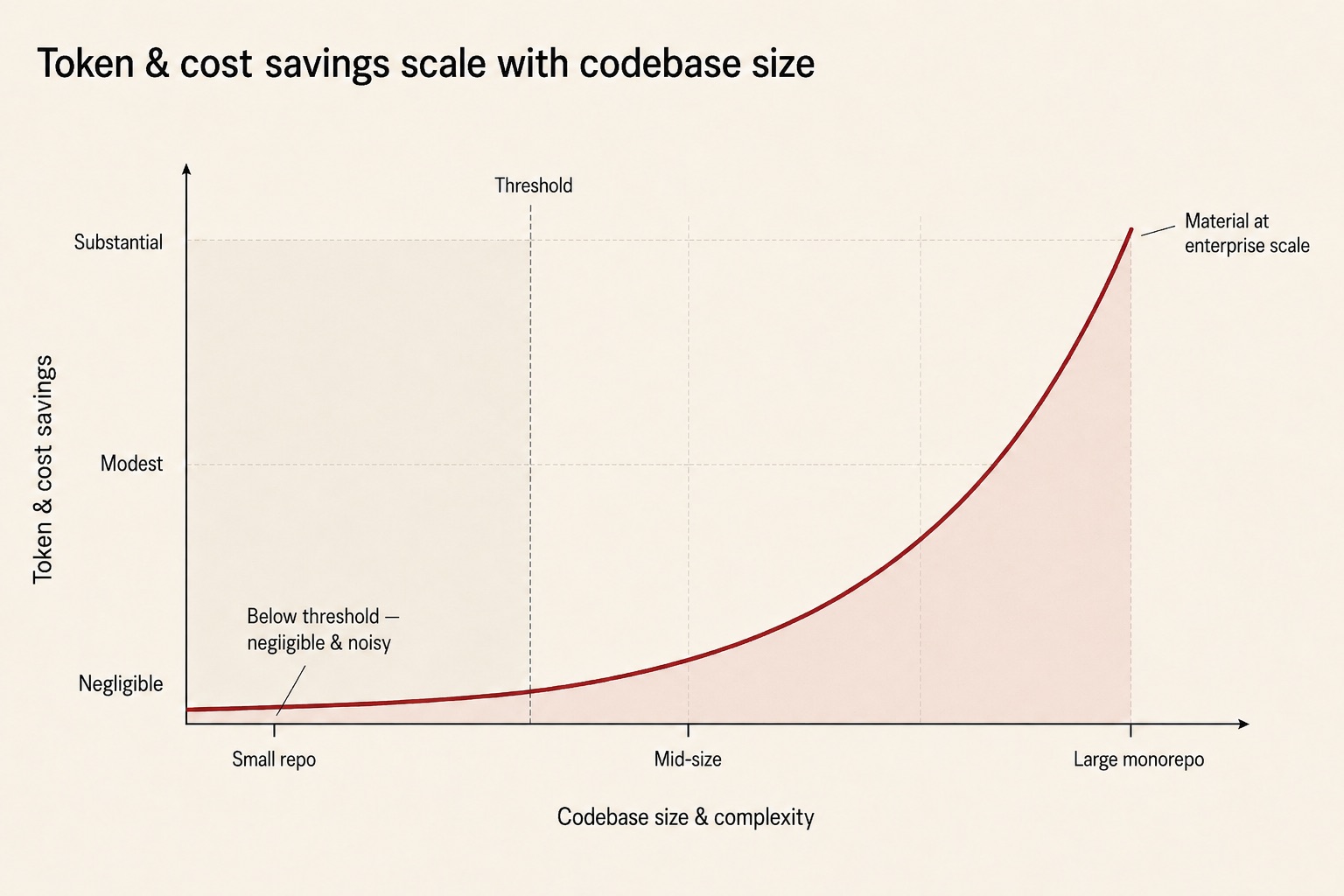
A note on cost: CodeGraph's win on every codebase is precision — the agent stops crawling files and answers from the graph. On current models that precision is also a large direct saving: the 2026-08 re-measurement, on a harness that blocks the CLI in both arms, put it at 44% lower cost and 62% fewer tokens on average across the seven benchmark repos, because a strong model without the graph burns its budget re-deriving structure. Cost tracks how much discovery a question demands more than raw repo size: 57–78% on questions the file-reading agent needed 28–43 tool calls to answer, near-even where it got there in 7.
A note on context: the numbers above measure throughput — tokens processed, tools called, dollars spent to reach one answer. They don't measure what is still sitting in your context window afterward, and on that axis CodeGraph costs more, not less. Across the same seven repos in multi-turn sessions, CodeGraph's responses leave about 80% more retrieval context resident at the end of a session than a file-reading agent's do — on VS Code, 67k tokens against 18k. The mechanism is the same one that makes it fast: CodeGraph returns one dense, verbatim payload that answers the question and then stays in the window, where a grep-and-read agent churns through many small results that get evicted. Fewer tokens processed and a larger persistent footprint are both real at once. If you run long sessions in a small window, budget for it. Measured per-repo: docs/benchmarks/residual-context-occupancy.md.
Tested across 7 real-world open-source codebases spanning 7 languages, comparing an agent (Claude Code, headless) answering one architecture question with and without CodeGraph, at the median of 4 runs per arm. _Re-measured 2026-08-05 on Claude Opus 4.8 against the current build, on a harness that blocks the codegraph CLI in both arms — contamination row: 0 of 28 without-arm runs._
The universal win — every repo, every size: 88% fewer tool calls · 53% faster · 62% fewer tokens · 44% cheaper · file reads cut to zero on all seven repos.
With the index available, the agent answers from one to four codegraph_explore calls and stops. Without it, the agent burns its budget on discovery — up to 43 tool calls and 19 file reads re-deriving what the graph already knew. Every repo was faster with CodeGraph in this measurement — by 35% on the narrowest question, by 3.6× on the widest.
| Codebase | Language | Tool calls | Time | File reads | Tokens | Cost | |----------|----------|------------|------|------------|--------|------| | VS Code | TypeScript · ~11k files | 2 vs 28 | 2.2× faster (58s vs 2m 10s) | 0 vs 12 | 77% fewer | 71% cheaper | | Excalidraw | TypeScript · ~640 | 2 vs 43 | 3.6× faster (45s vs 2m 42s) | 0 vs 18 | 84% fewer | 78% cheaper | | Django | Python · ~3k | 3 vs 14 | 35% faster (54s vs 1m 23s) | 0 vs 8.5 | 41% fewer | 13% cheaper¹ | | Tokio | Rust · ~790 | 3 vs 29 | 2.6× faster (1m 3s vs 2m 43s) | 0 vs 19 | 65% fewer | 64% cheaper | | OkHttp | Java · ~645 | 1 vs 6 | 43% faster (33s vs 58s) | 0 vs 2 | 54% fewer | 21% cheaper | | Gin | Go · ~110 | 1 vs 7 | 39% faster (28s vs 46s) | 0 vs 4 | 52% fewer | ~even¹ | | Alamofire | Swift · ~110 | 4 vs 33 | 2.6× faster (54s vs 2m 22s) | 0 vs 16.5 | 59% fewer | 57% cheaper |
¹ Cost tracks how much discovery the question demanded, which is why it varies far more than the other columns: 57–78% on repos where the file-reading arm needed 28–43 tool calls, but only 13% on Django and even on Gin, where it got there in 14 and 7. The with-arm still answered in 3 and 1 calls with zero file reads. File reads = median files opened — the surgical-context win in one column: the agent never reads a file on any of the seven repos when CodeGraph is present.
| Codebase | Metric | WITH cg | WITHOUT cg | |---|---|---|---| | VS Code | Time / Tools / Tokens / Cost | 58s / 2 / 155k / $0.53 | 2m 10s / 28 / 670k / $1.80 | | Excalidraw | Time / Tools / Tokens / Cost | 45s / 2 / 156k / $0.54 | 2m 42s / 43 / 991k / $2.43 | | Django | Time / Tools / Tokens / Cost | 54s / 3 / 183k / $0.55 | 1m 23s / 14 / 309k / $0.63 | | Tokio | Time / Tools / Tokens / Cost | 1m 3s / 3 / 201k / $0.66 | 2m 43s / 29 / 573k / $1.83 | | OkHttp | Time / Tools / Tokens / Cost | 33s / 1 / 107k / $0.39 | 58s / 6 / 230k / $0.50 | | Gin | Time / Tools / Tokens / Cost | 28s / 1 / 87k / $0.31 | 46s / 7 / 180k / $0.31 | | Alamofire | Time / Tools / Tokens / Cost | 54s / 4 / 209k / $0.54 | 2m 22s / 33 / 505k / $1.27 |
Methodology. Each arm is claude -p (Claude Opus 4.8, claude-opus-4-8) run headlessly against the repo with --strict-mcp-config: WITH = CodeGraph's MCP server enabled, WITHOUT = an empty MCP config. Built-in Read/Grep/Bash stay available to both. Same question per repo, 4 runs per arm, median reported. Cost = the run's total_cost_usd; Tokens = total tokens processed, summed per assistant turn (input incl. cache reads + cache creation + output); Time = wall-clock; Tool calls = every tool invocation, including those inside any sub-agents the model spawns. Repos cloned at --depth 1 and indexed by the same CodeGraph build that served them. Re-measured 2026-08-05 on the current build.
The codegraph CLI is blocked in both arms. A sanitized PATH plus a PreToolUse hook denies any Bash invocation of the CLI, in the WITHOUT arm as well as the WITH arm. This matters: without that block the control arm is not a control. On an unblocked harness we measured the WITHOUT agent finding the CLI on PATH and reaching CodeGraph through Bash in 26 of 28 runs — which distorts the comparison in both directions, since a CLI call is not counted as a tool call and its output still enters the window. Earlier published figures were produced without this block. In the run reported above, all 28 WITHOUT runs attempted the CLI and all 28 were blocked — 0 contaminated.
Queries: | Codebase | Query | |----------|-------| | VS Code | "How does the extension host communicate with the main process?" | | Excalidraw | "How does Excalidraw render and update canvas elements?" | | Django | "How does Django's ORM build and execute a query from a QuerySet?" | | Tokio | "How does tokio schedule and run async tasks on its runtime?" | | OkHttp | "How does OkHttp process a request through its interceptor chain?" | | Gin | "How does gin route requests through its middleware chain?" | | Alamofire | "How does Alamofire build, send, and validate a request?" |
Why CodeGraph wins: with the index available, the agent answers directly — usually one codegraph_explore returns the relevant source — and stops, with zero file reads on every benchmark repo. Without it, the agent spends most of its budget on discovery (find/ls/grep) before reading the right code. CodeGraph only helps when queried directly, so its instructions steer agents to answer directly rather than delegate exploration to file-reading sub-agents — otherwise a sub-agent reads files regardless and CodeGraph becomes overhead.
---
CodeGraph's parsing engine is a native Rust kernel: 20 languages — TypeScript, JavaScript, Java, Python, Go, C, C++, Rust, C#, Ruby, PHP, Swift, Kotlin, Scala, Dart, R, Lua, Luau (Metal and CUDA ride the C++ path) — parse in compiled code with one boundary crossing per file. Every language shipped only after its graphs proved byte-for-byte identical to the reference engine on real repositories, from small libraries up to the Linux kernel; platforms without a prebuilt binary and files with syntax errors fall back per-file automatically, same graph either way.
And it scales itself to the machine it's on. Worker pools, parallel resolution, and analysis caches are sized from what the system actually has — real core counts (container/cgroup-aware, so a VPS that grants 2 cores gets sized for 2, not the host's 64), honestly-measured available RAM on macOS and Linux, and the measured cost of your project's resolution work:
| | | |---|---| | Native Rust Kernel | Parsing and extraction run in a compiled Rust engine for 20 languages — with graphs verified byte-for-byte identical to the reference engine, and automatic per-file fallback so nothing ever breaks | | Adapts to Your Machine | Sizes its worker pools and caches from what the system actually has — real core counts (container-aware), honest available RAM, measured per-project cost. A workstation gets the full parallel pipeline; a 2-core VPS gets one tuned to finish reliably | | Surgical Context | One tool call returns entry points, related symbols, and code snippets — no slow file-by-file exploration | | Full-Text Search | Find code by name instantly across your entire codebase, powered by FTS5 | | Impact Analysis | Trace callers, callees, and the full impact radius of any symbol before making changes | | Always Fresh | File
→ →
→ →
→ →
→ →
→ →
→