1
 →

Apache Airflow - A platform to programmatically author, schedule, and monitor workflows
apache/airflow is an open-source project on GitHub, mainly written in Python. Apache Airflow - A platform to programmatically author, schedule, and monitor workflows It currently holds 47,584 stars and 18,364 forks with 1,953 open issues, and was last pushed on 2026-11-21 (repository created 2015-04-13).
Git Homed tracks it on the Today's Trending board, currently at rank #90 with 29 new stars today.
| Category | Badges |
|------------|--------------------------------------------------------------------------------------------------------------------------------------------------------------------------------------------------------------------------------------------------------------------------------------------------------------------------------------------------------------------------------------------------------------------------------------------------------------------------------------------------------------------------------------|
| License |  |
| PyPI |


|
| Containers |


|
| Community |

|
| Dev tools |
|
| Version | Build Status |
|---------|-----------------------------------------------------------------------------------------------------------------------------------------------------------------|
| Main | 
 |
| 3.x |

 |

Apache Airflow (or simply Airflow) is a platform to programmatically author, schedule, and monitor workflows.
When workflows are defined as code, they become more maintainable, versionable, testable, and collaborative.
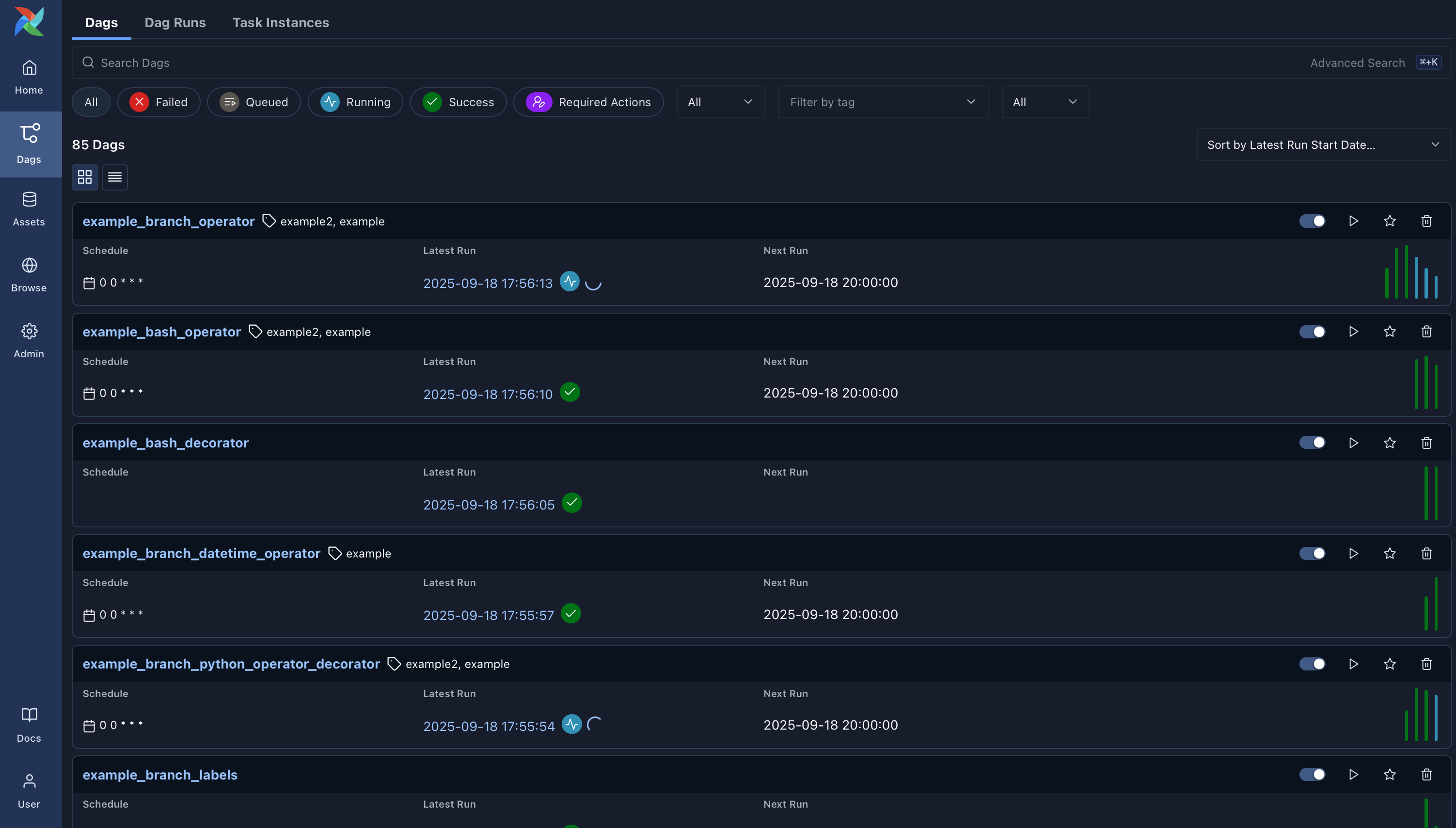
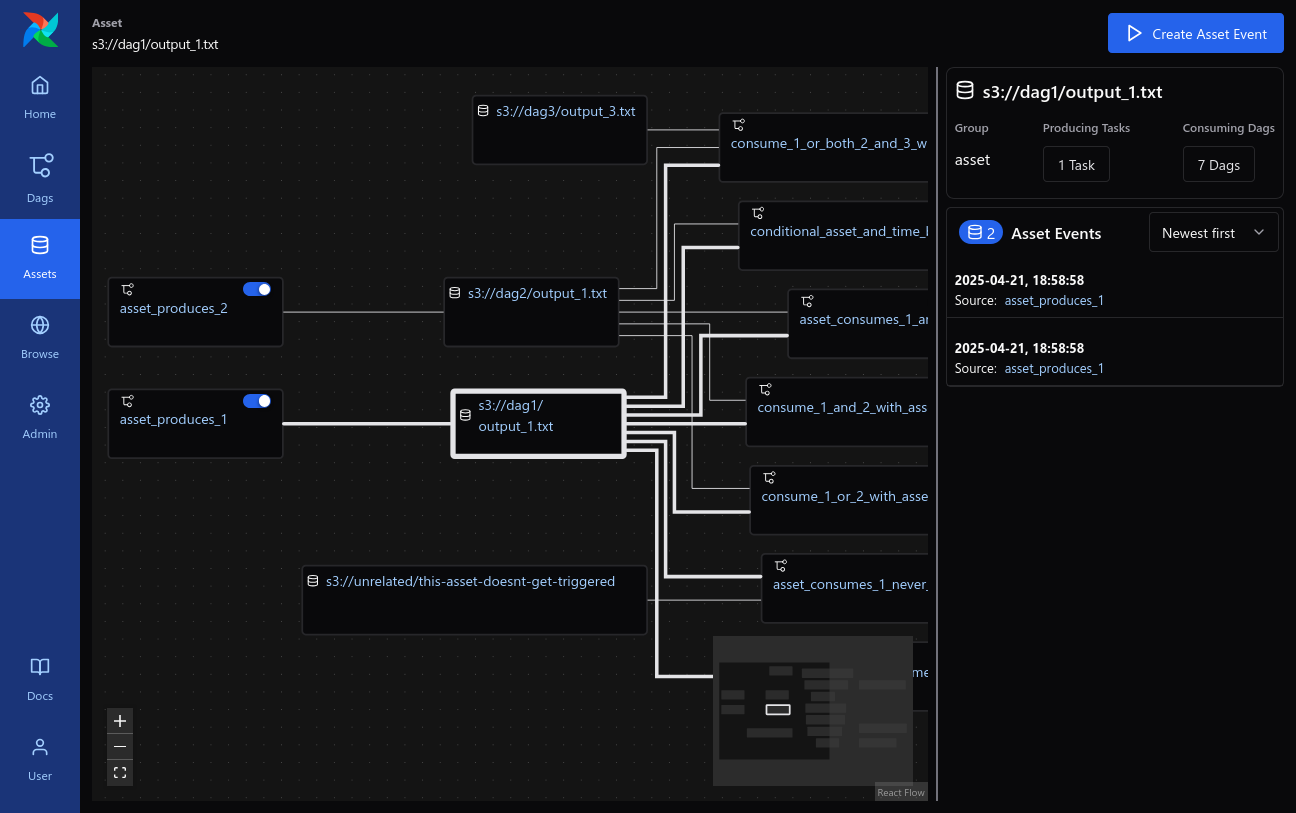
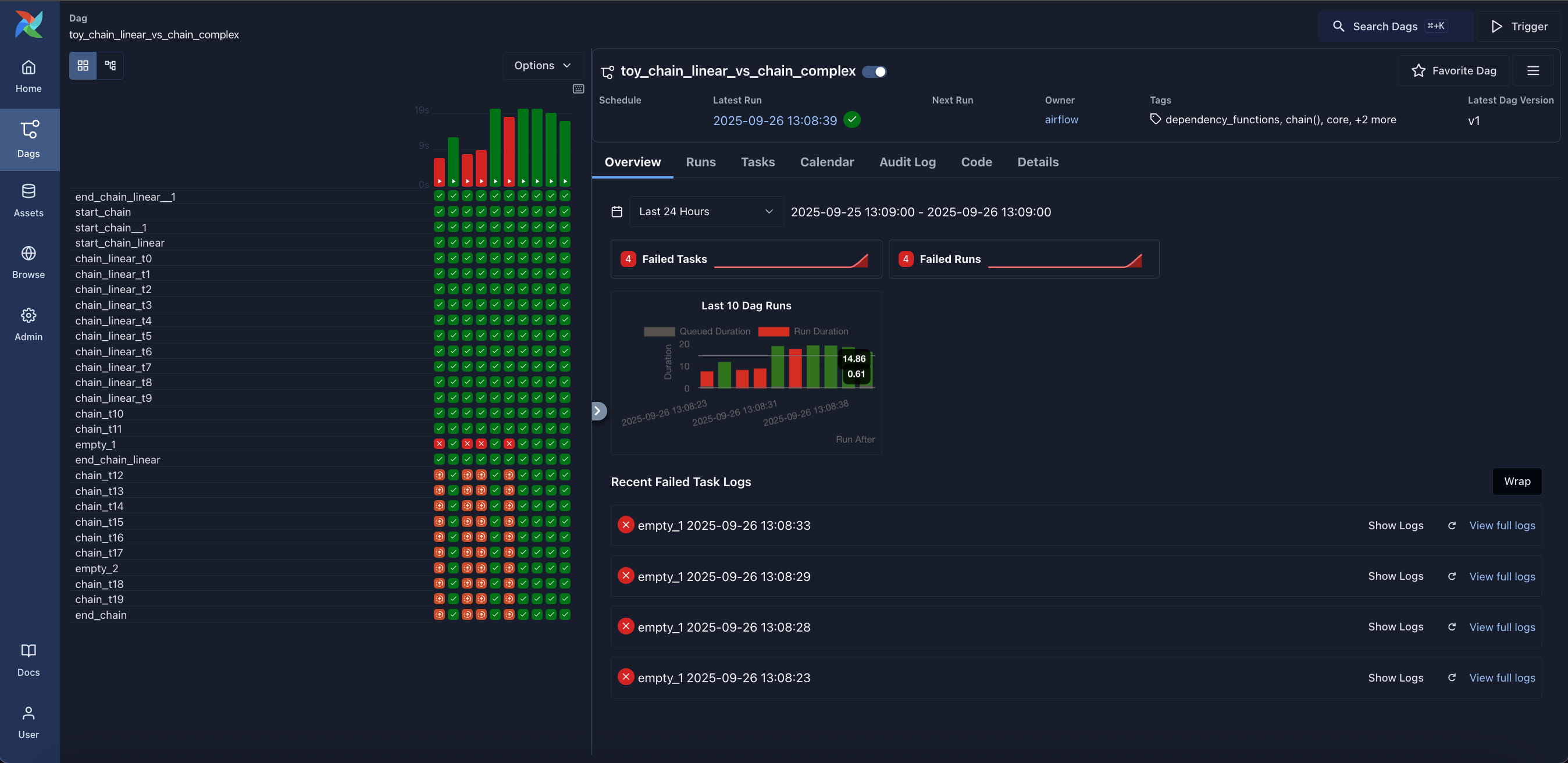
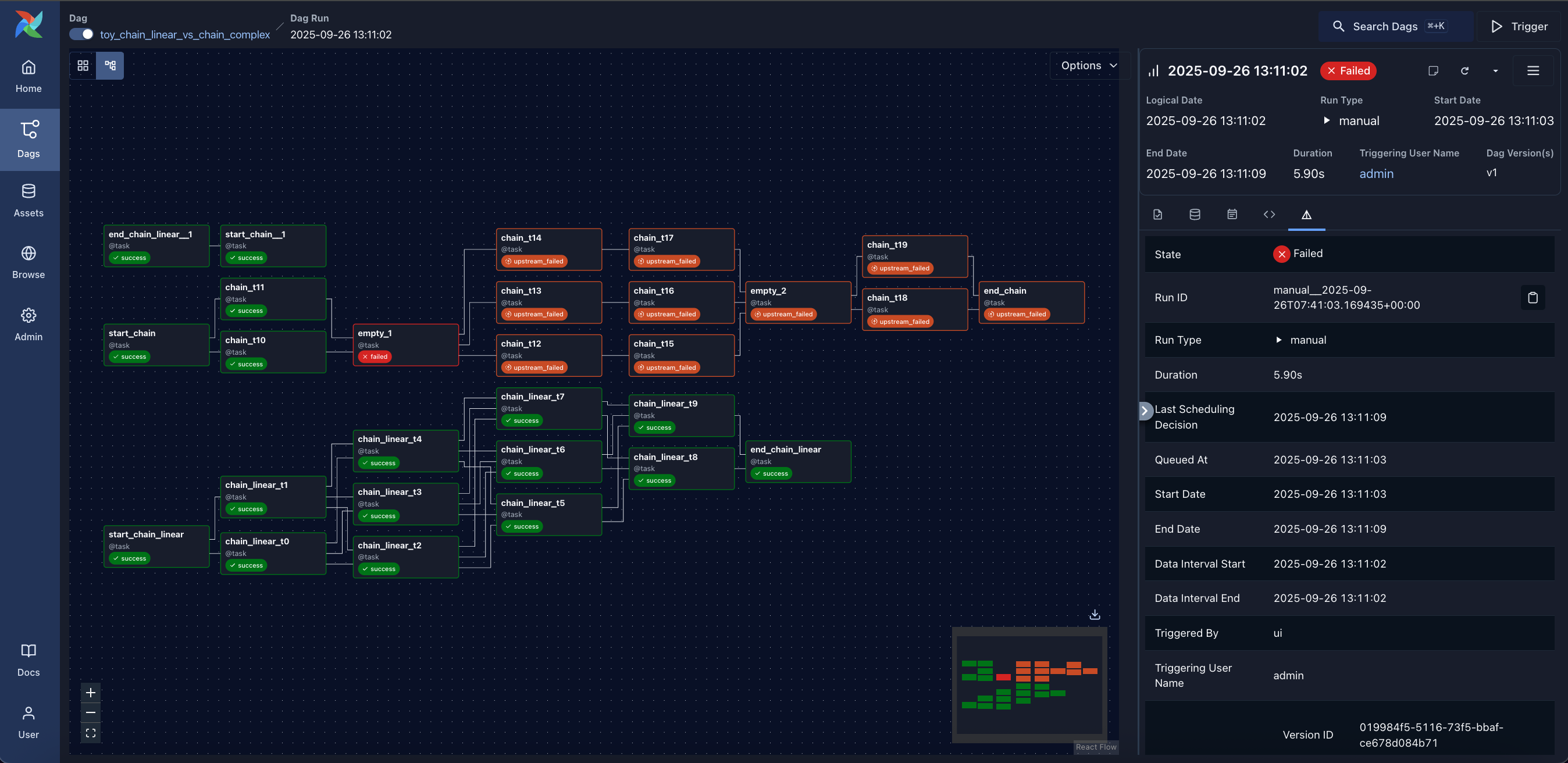
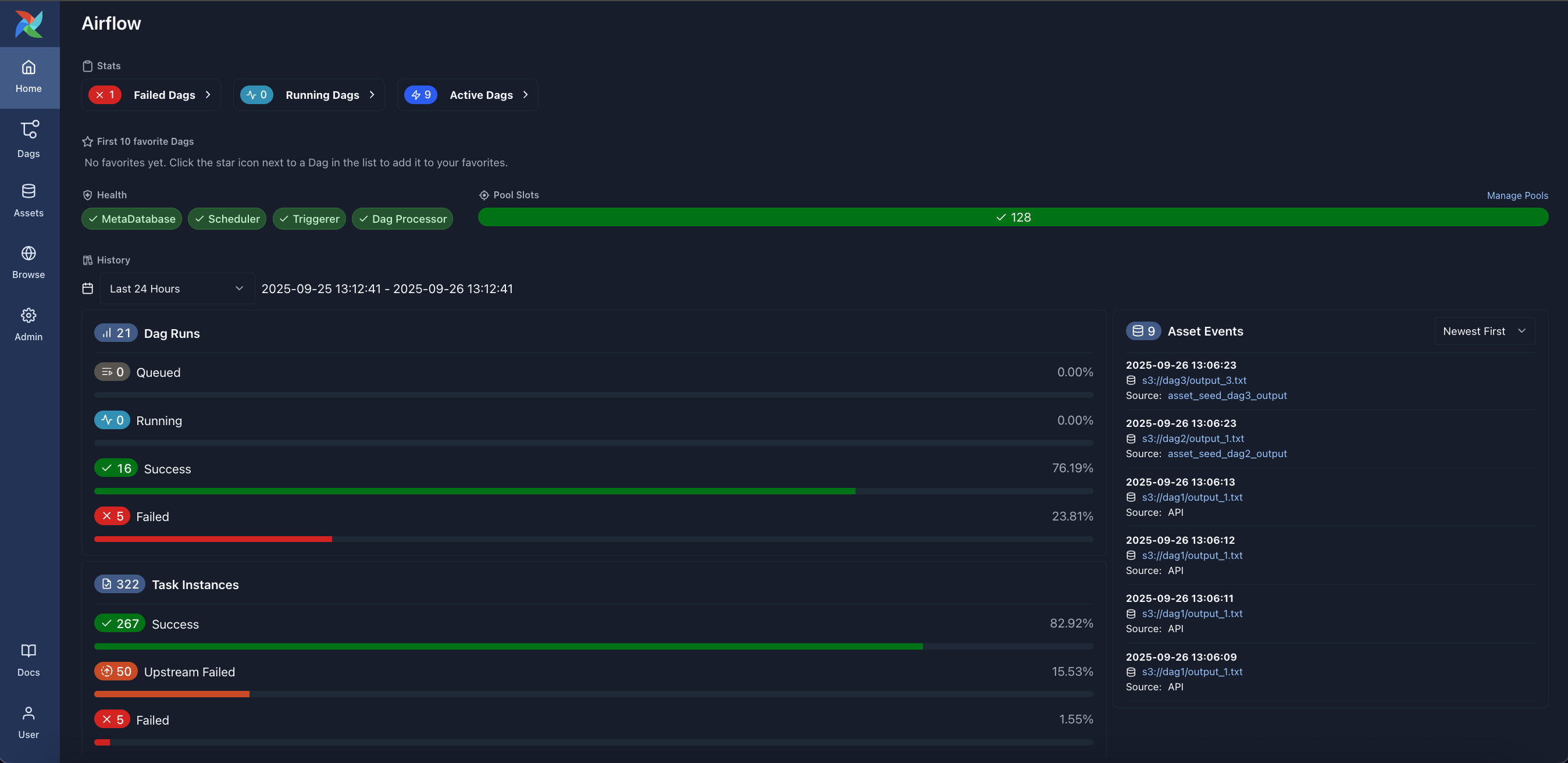
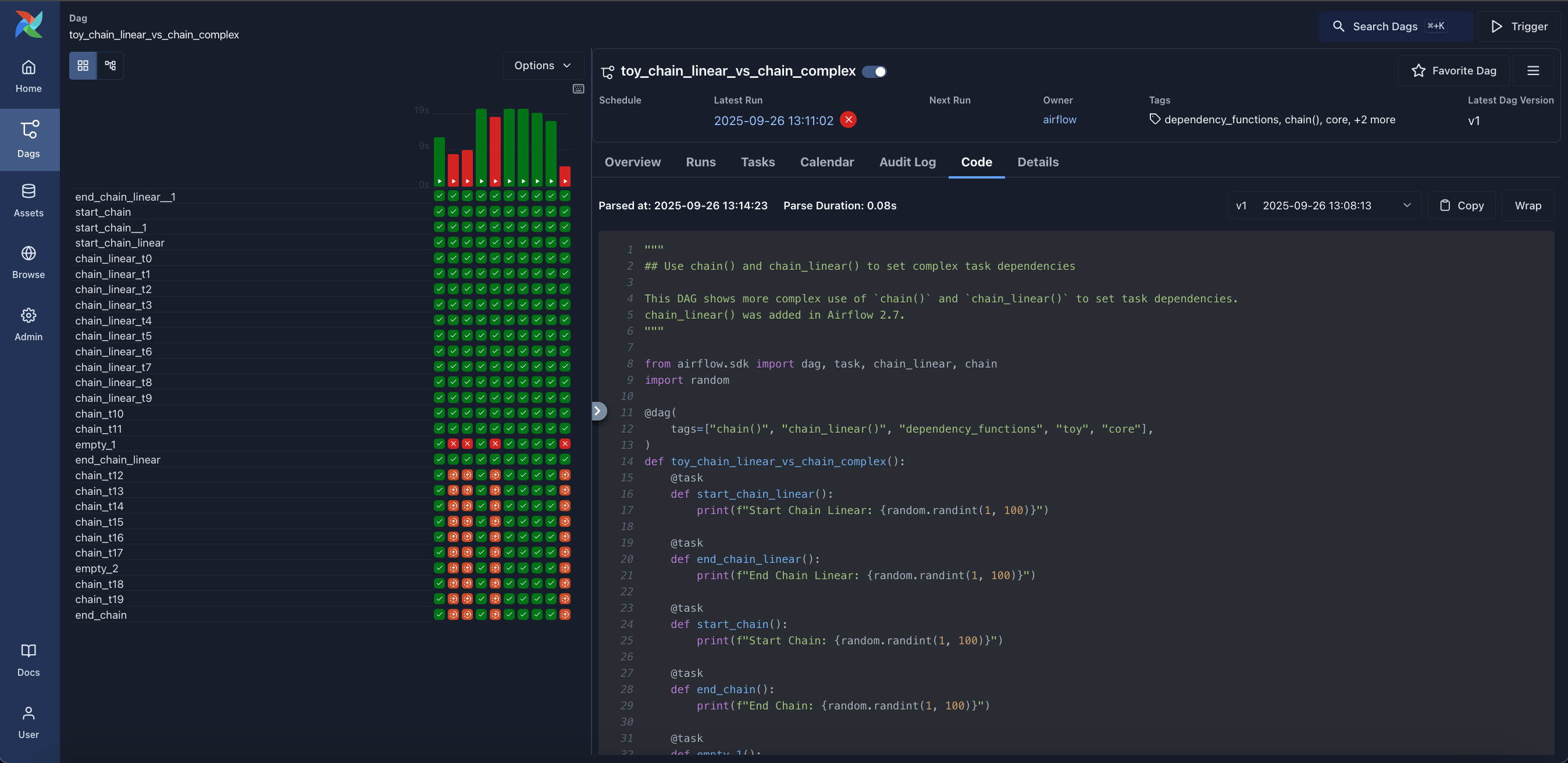
Use Airflow to author workflows (Dags) that orchestrate tasks. The Airflow scheduler executes your tasks on an array of workers while following the specified dependencies. Rich command line utilities make performing complex surgeries on Dags a snap. The rich user interface makes it easy to visualize pipelines running in production, monitor progress, and troubleshoot issues when needed.
Table of contents
Airflow works best with workflows that are mostly static and slowly changing. When the Dag structure is similar from one run to the next, it clarifies the unit of work and continuity. Other similar projects include Luigi, Oozie and Azkaban.
Beyond traditional data pipelines, Airflow is widely used to orchestrate machine learning workflows — training, retraining, evaluation, and deployment — and increasingly to orchestrate agentic and LLM-based workloads, coordinating the steps of an AI pipeline (data prep, tool calls, model invocation, evaluation) rather than acting as the agent itself. This isn't a new direction: teams have run ML and AI workloads on Airflow for years, and the ecosystem of providers supporting these use cases (see the AI & ML section of the Airflow registry) continues to grow.
Airflow is commonly used to process data, but has the opinion that tasks should ideally be idempotent (i.e., results of the task will be the same, and will not create duplicated data in a destination system), and should not pass large quantities of data from one task to the next (though tasks can pass metadata using Airflow's XCom feature). For high-volume, data-intensive tasks, a best practice is to delegate to external services specializing in that type of work.
Airflow is not a streaming solution, but it is often used to process real-time data, pulling data off streams in batches.
Apache Airflow is tested with:
| | Main version (dev) | Stable version (3.4.0) | |------------|------------------------------------------|------------------------------------------| | Python | 3.11, 3.12, 3.13, 3.14 | 3.11, 3.12, 3.13, 3.14 | | Platform | AMD64/ARM64 | AMD64/ARM64 | | Kubernetes | 1.31, 1.32, 1.33, 1.34, 1.35, 1.36, 1.37 | 1.31, 1.32, 1.33, 1.34, 1.35, 1.36, 1.37 | | PostgreSQL | 15, 16, 17, 18 | 14, 15, 16, 17, 18 | | MySQL | 8.0, 8.4, Innovation | 8.0, 8.4, Innovation | | SQLite | 3.15.0+ | 3.15.0+ |
Note: MariaDB is not tested/recommended.
Note: SQLite is used in Airflow tests. Do not use it in production. We recommend using the latest stable version of SQLite for local development.
Note: Airflow currently can be run on POSIX-compliant Operating Systems. For development, it is regularly
tested on fairly modern Linux Distros and recent versions of macOS.
On Windows you can run it via WSL2 (Windows Subsystem for Linux 2) or via Linux Containers.
The work to add Windows support is tracked via #10388, but
it is not a high priority. You should only use Linux-based distros as "Production" execution environment
as this is the only environment that is supported. The only distro that is used in our CI tests and that
is used in the Community managed DockerHub image is
Debian Bookworm.
Visit the official Airflow website documentation (latest stable release) for help with installing Airflow, getting started, or walking through a more complete tutorial.
Note: If you're looking for documentation for the main branch (latest development branch): you can find it on s.apache.org/airflow-docs.
For more information on Airflow Improvement Proposals (AIPs), visit the Airflow Wiki.
Documentation for dependent projects like provider distributions, Docker image, Helm Chart, you'll find it in the documentation index.
We publish Apache Airflow as apache-airflow package in PyPI. Installing it however might be sometimes tricky
because Airflow is a bit of both a library and application. Libraries usually keep their dependencies open, and
applications usually pin them, but we should do neither and both simultaneously. We decided to keep
our dependencies as open as possible (in pyproject.toml) so users can install different versions of libraries
if needed. This means that pip install apache-airflow will not work from time to time or will
produce unusable Airflow installation.
To have repeatable installation, however, we keep a set of "known-to-be-working" constraint
files in the orphan constraints-main and constraints-2-0 branches. We keep those "known-to-be-working"
constraints files separately per major/minor Python version.
You can use them as constraint files when installing Airflow from PyPI. Note that you have to specify
correct Airflow tag/version/branch and Python versions in the URL.
1. Installing just Airflow:
Note: Onlypipanduvinstallation is currently officially supported.
While it is possible to install Airflow with tools like Poetry or
pip-tools, they do not share the same workflow as
pip - especially when it comes to constraint vs. requirements management.
Installing via Poetry or pip-tools is not currently supported.
If you wish to install Airflow using those tools, you should use the constraint files and convert them to the appropriate format and workflow that your tool requires.
pip install 'apache-airflow==3.4.0' \
 --constraint "https://raw.githubusercontent.com/apache/airflow/constraints-3.4.0/constraints-3.10.txt"
2. Installing with extras (i.e., postgres, google)
pip install 'apache-airflow[postgres,google]==3.4.0' \
 --constraint "https://raw.githubusercontent.com/apache/airflow/constraints-3.4.0/constraints-3.10.txt"
For information on installing provider distributions, check providers.
For comprehensive instructions on setting up your local development environment and installing Apache Airflow, please refer to the INSTALLING.md file.
Apache Airflow is an Apache Software Foundation (ASF) project, and our official source code releases:
Following the ASF rules, the source packages released must be sufficient for a user to build and test the release provided they have access to the appropriate platform and tools.
There are other ways of installing and using Airflow. Those are "convenience" methods - they are
not "official releases" as stated by the ASF Release Policy, but they can be used by the users
who do not want to build the software themselves.
Those are - in the order of most common ways people install Airflow:
pip tooldocker tool, use them in Kubernetes, Helm Charts, docker-compose, docker swarm, etc. You can
read more about using, customizing, and extending the images in the
Latest docs, and
learn details on the internals in the images document.
All those artifacts are not official releases, but they are prepared using officially released sources. Some of those artifacts are "development" or "pre-release" ones, and they are clearly marked as such following the ASF Policy.
As of Airflow 2.0.0, we support a strict SemVer approach for all packages released.
There are few specific rules that we agreed to that define details of versioning of the different packages:
google 4.1.0 and amazon 3.1.1 providers can happily be installed
with Airflow 2.1.2. If there are limits of cross-dependencies between providers and Airflow packages,
they are present in providers as install_requires limitations. We aim to keep backwards
compatibility of providers with all previously released Airflow 2 versions but
there will sometimes be breaking changes that might make some, or all
providers, have minimum Airflow version specified.
Apache Airflow version life cycle:
| Version | Current Patch/Minor | State | First Release | Limited Maintenance | EOL/Terminated | |-----------|-----------------------|-------------|-----------------|-----------------------|------------------| | 3 | 3.4.0 | Maintenance | Apr 22, 2025 | TBD | TBD | | 2 | 2.11.2 | EOL | Dec 17, 2020 | Oct 22, 2025 | Apr 22, 2026 | | 1.10 | 1.10.15 | EOL | Aug 27, 2018 | Dec 17, 2020 | June 17, 2021 | | 1.9 | 1.9.0 | EOL | Jan 03, 2018 | Aug 27, 2018 | Aug 27, 2018 | | 1.8 | 1.8.2 | EOL | Mar 19, 2017 | Jan 03, 2018 | Jan 03, 2018 | | 1.7 | 1.7.1.2 | EOL | Mar 28, 2016 | Mar 19, 2017 | Mar 19, 2017 |
Limited support versions will be supported with security and critical bug fix only. EOL versions will not get any fixes nor support. We always recommend that all users run the latest available minor release for whatever major version is in use. We highly recommend upgrading to the latest Airflow major release at the earliest convenient time and before the EOL date.
As of Airflow 2.0, we agreed to certain rules we follow for Python and Kubernetes support. They are based on the official release schedule of Python and Kubernetes, nicely summarized in the Python Developer's Guide and Kubernetes version skew policy.
1. We drop support for Python and Kubernetes versions when they reach EOL. Except for Kubernetes, a version stays supported by Airflow if two major cloud providers still provide support for it. We drop support for those EOL versions in main right after EOL date, and it is effectively removed when we release the first new MINOR (Or MAJOR if there is no new MINOR version) of Airflow. For example, for Python 3.10 it means that we will drop support in main right after 27.06.2023, and the first MAJOR or MINOR version of Airflow released after will not have it.
2. We support a new version of Python/Kubernetes in main after they are officially released, as soon as we make them work in our CI pipeline (which might not be immediate due to dependencies catching up with new versions of Python mostly) we release new images/support in Airflow based on the working CI setup.
3. This policy is best-effort which means there may be situations where we might terminate support earlier if circumstances require it.
The Airflow Community provides conveniently packaged container images that are published whenever we publish a
→ →
 →
 →
 →
 →
 →
 →