





1
 →
→
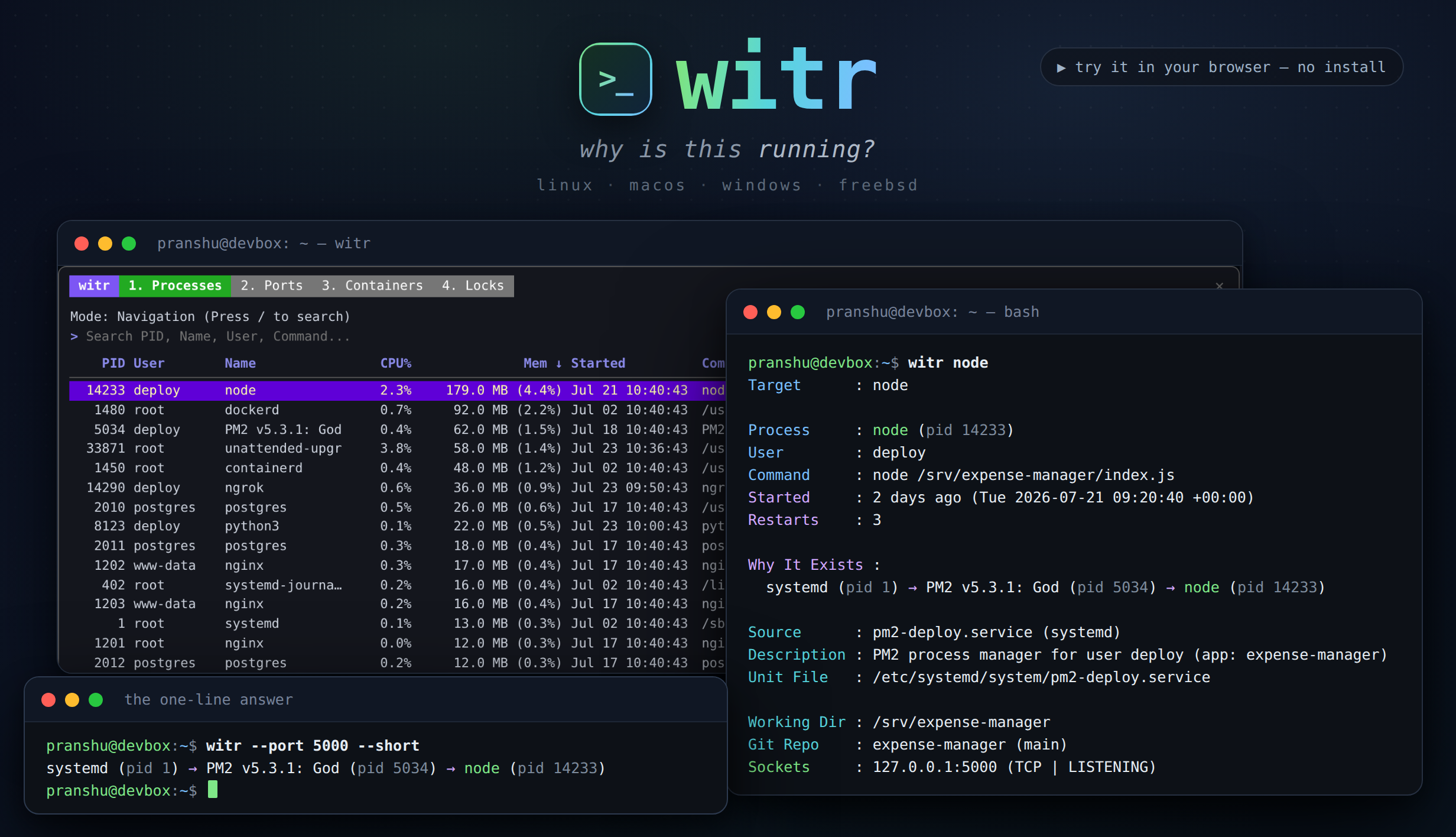
Why is this running? Trace any process, port, container, or file back to what started it - CLI + TUI.





---
Purpose • Installation • TUI • Flags • Core Concept • Examples
Output Behavior • Platforms • Success Criteria • Sponsors
---
witr exists to answer a single question:
Why is this running?
When something is running on a system, whether it is a process, a service, or something bound to a port, there is always a cause. That cause is often indirect, non-obvious, or spread across multiple layers such as supervisors, containers, services, or shells.
Existing tools (ps, top, lsof, ss, systemctl, docker ps) expose state and metadata. They show _what_ is running, but leave the user to infer _why_ by manually correlating outputs across tools.
witr makes that causality explicit.
It explains where a running thing came from, how it was started, and what chain of systems is responsible for it existing right now, in a single, human-readable output or an interactive TUI dashboard.
📖 Curious how witr came to be? Read the story or browse the Hacker News discussion.
---
witr is distributed as a single static binary for Linux, macOS, FreeBSD, and Windows.
witr is also independently packaged and maintained across multiple operating systems and ecosystems. An up-to-date overview of packaging status is available on Repology. Please note that community packages may lag GitHub releases due to independent review and validation.
[!TIP]
If you use a package manager (Homebrew, Conda, Winget, etc.), we recommend installing via that for easier updates. Otherwise, the install script is the quickest way to get started.
---
curl -fsSL https://raw.githubusercontent.com/pranshuparmar/witr/main/install.sh | bash
The script will:
linux, darwin or freebsd)amd64 or arm64)/usr/local/bin/witr/usr/local/share/man/man1/witr.1irm https://raw.githubusercontent.com/pranshuparmar/witr/main/install.ps1 | iex
The script will:
witr.exe to %LocalAppData%\witr\bin.PATH.---

You can install witr from the official Debian and Ubuntu repositories (Ubuntu 26.04+, Debian sid and later), as well as derivative distributions like Kali Linux, Devuan, and Raspbian:
sudo apt install witr
Note: The apt-shipped version may lag the latest GitHub release. For the newest features, use the install script or another installation method.

You can install witr using conda, mamba, or pixi on macOS, Linux, and Windows:
conda install -c conda-forge witr
alternatively using mamba
mamba install -c conda-forge witr
alternatively using pixi
pixi global install witr

On Arch Linux and derivatives, install from the AUR package:
yay -S witr-bin
alternatively using paru
paru -S witr-bin
or use your preferred AUR helper

You can install witr on FreeBSD from the FreshPorts port:
pkg install witr
or
pkg install sysutils/witr
Or build from Ports:
cd /usr/ports/sysutils/witr/
make install clean

You can install witr using aqua:
# Add package
aqua g -i pranshuparmar/witr
Install package
aqua i pranshuparmar/witr
witr provides native packages for major Linux distributions. You can download the latest .deb, .rpm, or .apk package from the GitHub releases page.
curl: # Replace
curl -LO https://github.com/pranshuparmar/witr/releases/latest/download/
  sudo dpkg -i ./witr-*.deb
  # Or, using apt for dependency resolution:
  sudo apt install ./witr-*.deb
sudo rpm -i ./witr-*.rpm
sudo apk add --allow-untrusted ./witr-*.apk
---
You can install the latest version directly from source:
go install github.com/pranshuparmar/witr/cmd/witr@latest
This will place the witr binary in your $GOPATH/bin or $HOME/go/bin directory. Make sure this directory is in your PATH.
If you prefer manual installation, follow these simple steps for your platform:
Unix (Linux, macOS, FreeBSD)
# 1. Determine OS and Architecture
OS=$(uname -s | tr '[:upper:]' '[:lower:]')
ARCH=$(uname -m)
[ "$ARCH" = "x86_64" ] && ARCH="amd64"
[ "$ARCH" = "aarch64" ] && ARCH="arm64"
2. Download the binary
curl -fsSL "https://github.com/pranshuparmar/witr/releases/latest/download/witr-${OS}-${ARCH}" -o witr
3. Verify checksum (Optional)
curl -fsSL "https://github.com/pranshuparmar/witr/releases/latest/download/SHA256SUMS" -o SHA256SUMS
grep "witr-${OS}-${ARCH}" SHA256SUMS | (sha256sum -c - 2>/dev/null || shasum -a 256 -c - 2>/dev/null)
rm SHA256SUMS
4. Rename and install
chmod +x witr
sudo mkdir -p /usr/local/bin
sudo mv witr /usr/local/bin/witr
5. Install man page (Optional)
sudo mkdir -p /usr/local/share/man/man1
sudo curl -fsSL https://github.com/pranshuparmar/witr/releases/latest/download/witr.1 -o /usr/local/share/man/man1/witr.1
Windows (PowerShell)
# 1. Determine Architecture
if ($env:PROCESSOR_ARCHITECTURE -eq "AMD64") {
    $ZipName = "witr-windows-amd64.zip"
} elseif ($env:PROCESSOR_ARCHITECTURE -eq "ARM64") {
    $ZipName = "witr-windows-arm64.zip"
} else {
    Write-Error "Unsupported architecture: $($env:PROCESSOR_ARCHITECTURE)"
    exit 1
}
2. Download the zip
Invoke-WebRequest -Uri "https://github.com/pranshuparmar/witr/releases/latest/download/$ZipName" -OutFile "witr.zip"
3. Extract the binary
Expand-Archive -Path "witr.zip" -DestinationPath "." -Force
4. Verify checksum (Optional)
Invoke-WebRequest -Uri "https://github.com/pranshuparmar/witr/releases/latest/download/SHA256SUMS" -OutFile "SHA256SUMS"
$hash = Get-FileHash -Algorithm SHA256 .\witr.zip
$expected = Select-String -Path .\SHA256SUMS -Pattern $ZipName
if ($expected -and $hash.Hash.ToLower() -eq $expected.Line.Split(' ')[0]) { Write-Host "Checksum OK" } else { Write-Host "Checksum Mismatch" }
5. Install to local bin directory
$InstallDir = "$env:LocalAppData\witr\bin"
New-Item -ItemType Directory -Path $InstallDir -Force | Out-Null
Move-Item .\witr.exe $InstallDir\witr.exe -Force
6. Add to User Path (Persistent)
$UserPath = [Environment]::GetEnvironmentVariable("Path", "User")
if ($UserPath -notlike "$InstallDir") {
    [Environment]::SetEnvironmentVariable("Path", "$UserPath;$InstallDir", "User")
    $env:Path += ";$InstallDir"
    Write-Host "Added to Path. You may need to restart PowerShell."
}
7. Cleanup
Remove-Item witr.zip
Remove-Item SHA256SUMS
---
If you use Nix, you can build witr from source and run without installation:
nix run github:pranshuparmar/witr -- --help
---
witr --version
man witr
witr supports tab completion for all flags. To enable it, add the appropriate line to your shell configuration:
Bash
echo 'eval "$(witr completion bash)"' >> ~/.bashrc
source ~/.bashrc
Zsh
echo 'eval "$(witr completion zsh)"' >> ~/.zshrc
source ~/.zshrc
Fish
witr completion fish | source
To make it permanent:
witr completion fish > ~/.config/fish/completions/witr.fish
PowerShell
witr completion powershell | Out-String | Invoke-Expression
To make it permanent, add the above line to your $PROFILE
If you installed via a package manager (Homebrew, Conda, etc.), please use the respective uninstall command (e.g., brew uninstall witr).
To completely remove script/manual installation of witr:
Unix (Linux, macOS, FreeBSD)
sudo rm -f /usr/local/bin/witr
sudo rm -f /usr/local/share/man/man1/witr.1
Windows
Remove-Item -Recurse -Force "$env:LocalAppData\witr"
---
Running witr without any arguments or with the -i flag launches the Interactive Mode (TUI). This provides a real-time, terminal-based dashboard with four tabs for exploring processes, ports, containers, and file locks.
a.a to switch into "all open files" mode, where locked entries are merged with every interesting open fd; type into / to search across the merged set. -c, --container strings container(s) to look up (repeatable)
--env show environment variables for the process
-x, --exact use exact name matching (no substring search)
-f, --file strings file(s) held open by a process (repeatable)
-h, --help help for witr
-i, --interactive interactive mode (TUI)
--json show result as JSON
--no-color disable colorized output
-p, --pid strings pid(s) to look up (repeatable)
-o, --port strings port(s) to look up (repeatable)
-s, --short show only ancestry
-t, --tree show only ancestry as a tree
--verbose show extended process information
-v, --version version for witr
--warnings show only warnings
Positional arguments (without flags) are treated as process or service names. Multiple names can be passed. By default, name matching uses substring matching (fuzzy search). Use --exact to match only processes with the exact name.
All target flags (--pid, --port, --file, --container) are repeatable and can be mixed with each other and with positional name arguments. When multiple targets are provided, results are shown sequentially with labeled dividers. All output modes (standard, short, tree, JSON, env, warnings, verbose) work with multiple inputs.
The --container flag searches across Docker, Podman, nerdctl, K8s/crictl, Incus, LXC, LXD, and FreeBSD jails, and matches against container name, image, command, and compose project/service labels.
The TUI is launched if no arguments or relevant flags (--pid, --port, --file, --container) are provided, or if the --interactive flag is explicitly used.
---
witr treats everything as a process question.
Ports, services, containers, and commands all eventually map to PIDs. Once a PID is identified, witr builds a causal chain explaining _why that PID exists_.
At its core, witr answers:
1. What is running? 2. How did it start? 3. What is keeping it running? 4. What context does it belong to?
---
💡 Prefer learning by doing? The interactive browser tutorial walks you through outputs like these live on a simulated box — for a better feel of witr, no install required.
witr node
Target      : node
Process     : node (pid 14233)
User        : pm2
Command     : node index.js
Started     : 2 days ago (Mon 2025-02-02 11:42:10 +05:30)
Why It Exists :
  systemd (pid 1) → pm2 (pid 5034) → node (pid 14233)
Source      : pm2
Working Dir : /opt/apps/expense-manager
Git Repo    : expense-manager (main)
Sockets     : 127.0.0.1:5001 (TCP | LISTENING)
---
witr --port 5000 --short
systemd (pid 1) → PM2 v5.3.1: God (pid 1481580) → python (pid 1482060)
---
witr --pid 143895 --tree
systemd (pid 1)
  └─ init-systemd(Ub (pid 2)
    └─ SessionLeader (pid 143858)
      └─ Relay(143860) (pid 143859)
        └─ bash (pid 143860)
          └─ sh (pid 143886)
            └─ node (pid 143895)
              ├─ node (pid 143930)
              ├─ node (pid 144189)
              └─ node (pid 144234)
Note: _Tree view includes child processes (up to 10) and highlights the target process._
---
witr ng
Multiple matching processes found:
[1] nginx (pid 2311)
    nginx -g daemon off;
[2] nginx (pid 24891)
    nginx -g daemon off;
[3] ngrok (pid 14233)
    ngrok http 5000
Re-run with:
  witr --pid
To avoid substring matching and only find processes with an exact name, use the --exact flag:
witr nginx -x
---
witr --file /var/lib/dpkg/lock
Explains the process holding a file open.
---
witr --container redis
Looks up a container by name, image, command, or compose project/service across every detected runtime (Docker, Podman, nerdctl, K8s/crictl, Incus, LXC, LXD, FreeBSD jails). Pass --verbose to include mounts, networks, and compose metadata in the output.
---
witr nginx --port 5432 --pid 1234
----- [name: nginx] -----
Target      : nginx
Process     : nginx (pid 2311)
...
----- [port: 5432] -----
Target      : postgres
Process     : postgres (pid 891)
...
----- [pid: 1234] -----
Target      : node
Process     : node (pid 1234)
...
All target flags are repeatable and can be mixed. Results appear in the order you typed them. All output modes (--short, --tree, --json, --env, --warnings, --verbose) work with multiple inputs.
---
→ →
→ →
→ →
→ →
→ →
→