1
 →
→
Agent-driven research knowledge base. Agents collect, search, and synthesize web research into a persistent, searchable wiki.





---
Hyperresearch turns Claude Code into a deep research agent: one that currently leads the DeepResearch-Bench RACE leaderboard (benchmarked internally). A tier-adaptive 16-step pipeline takes one prompt and produces an adversarially-audited report with full source provenance. Every source it reads lands in a persistent, searchable vault, so each session starts smarter than the last.
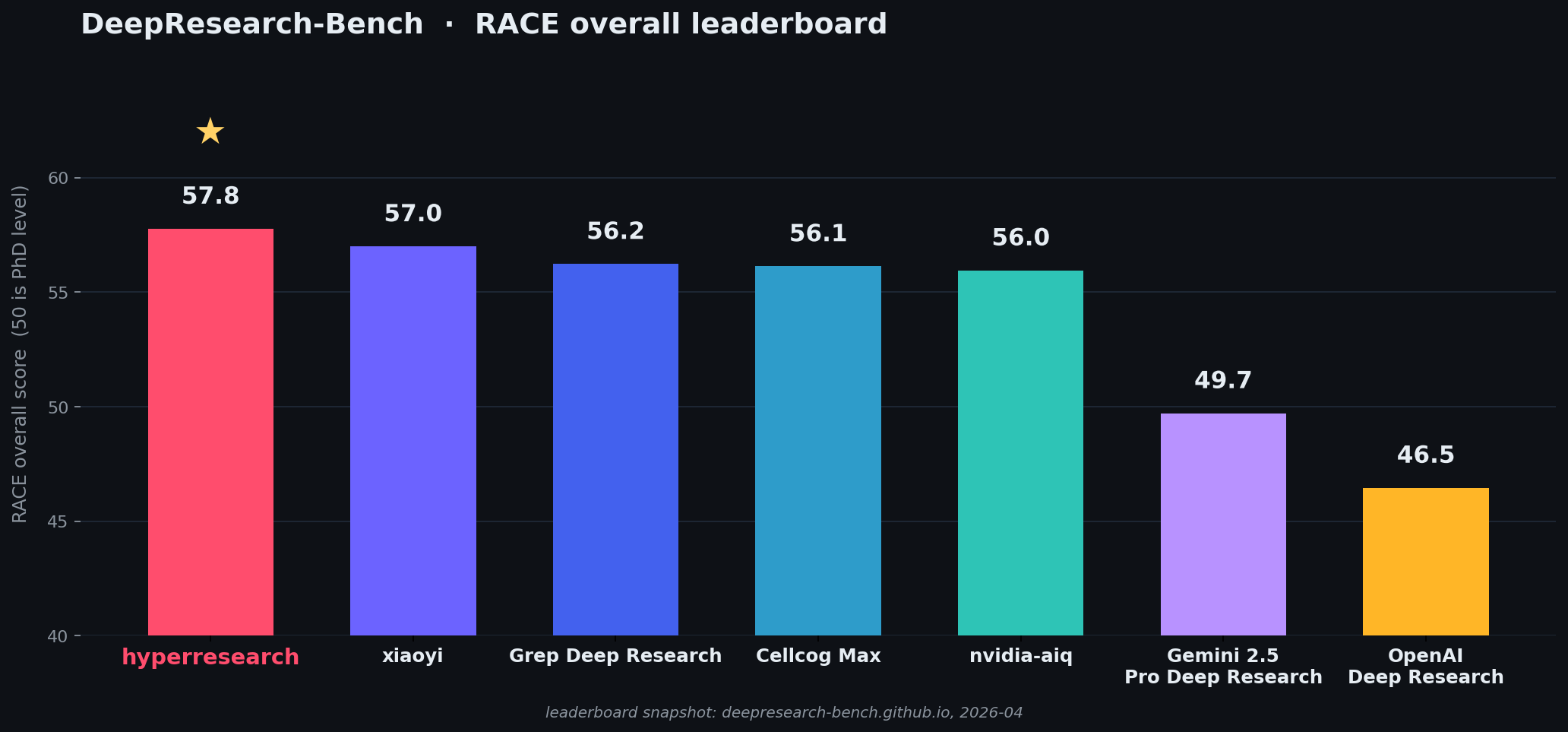
Forward-looking projection from a stratified pilot against the DeepResearch-Bench leaderboard snapshot (https://huggingface.co/spaces/muset-ai/DeepResearch-Bench-Leaderboard). Third party validation is pending.
premier scale profile targets 100–130 in the width sweep alone; citation chasing and gap-fill fetches more than double what actually lands in the corpus.hpr scholar search hits OpenAlex, Crossref, CORE, DOAB, ClinicalTrials.gov, SEC EDGAR and FRED through one client layer and returns a single list deduplicated by DOI and title. Books, trials and filings come back alongside papers, each tagged so the pipeline knows which is which. The humanities and social sciences are covered on purpose, not as an afterthought.run resume picks up at the exact step where it died.cd your-project
pip install hyperresearch && hyperresearch install
Then /hyperresearch in Claude Code.
Python 3.11–3.13. (3.14 not yet supported. Usepyenv install 3.13,uv venv -p 3.13, orpy -3.13 -m venv .venv.)
> Power users:hyperresearch install --globalmakes/hyperresearchreachable from every Claude Code session anywhere, at the cost of ~15 lines in every session's system reminder. Per-project install (above) keeps unrelated CC sessions clean.
---
The entry skill is a thin router. It pins down the canonical research query, then invokes one step skill per phase via Claude Code's Skill tool. Each step's procedure loads into context only when that step actually runs. That's what stops a long pipeline from quietly dropping steps as its context rots.
| # | Step | What it does | Tiers | |---|---|---|---| | 1 | Decompose | Canonical query → atomic items + coverage matrix + tier classification | all | | 1.5 | Chapter partition | Group atomic items into 4–10 chapters; steps 2–10 then loop per chapter | dissertation | | 2 | Width sweep | Multi-perspective search plan + parallel fetcher waves | all | | 3 | Contradiction graph | Pair contradictions across the corpus into ranked clusters | full | | 4 | Loci analysis | Two parallel loci-analysts → scored loci with source budgets | full | | 5 | Depth investigation | K parallel depth-investigators → interim notes with committed positions | full | | 6 | Cross-locus reconcile | Reconcile committed positions → comparisons.md | full | | 7 | Source tensions | Extract expert disagreements → source-tensions.json | full | | 8 | Corpus critic | "What source would overturn this?" + targeted gap-fill fetch | full | | 9 | Evidence digest | Top claims + verbatim quotes → evidence-digest.md | full | | 10 | Triple draft | Per-angle source curation + 3 parallel draft sub-orchestrators (light: single draft) | all | | 11 | Synthesize | Plan + outline + spawn synthesizer subagent → final_report.md | full | | 12 | Critics | 4 adversarial critics in parallel → findings JSONs | full | | 13 | Gap-fetch | Targeted fetch wave for critic-identified vault gaps | full | | 14 | Patcher | Surgical Edit hunks applied to draft (tool-locked Read+Edit) | full | | 14.5 | Cite-check | Verify citation-sentence bindings; skeptical LLM spot-check; second surgical patch pass | full | | 15 | Polish | Hygiene + filler pass (tool-locked Read+Edit subagent) | all | | 16 | Readability audit | Recommender writes JSON suggestions; orchestrator selectively applies | all |
Tiers route per query. Step 1 auto-classifies light vs full. dissertation is opt-in only; ask for it in your prompt.
| Tier | What runs | Typical time |
|---|---|---|
| light | bounded factual queries, surveys, comparisons: 1 → 2 → 10 → 15 → 16 | ~30–40 min |
| full (default) | deep argumentative analysis with adversarial review: all 16 steps + cite-check | ~1.5–2.5 h at full gear |
| dissertation | chaptered mega-runs: 300–450 sources across 4–10 chapters, 25K–80K words | ~4–8 hours |
Gears set the scale of the standard pipeline: the source targets, depth budgets, and word targets rendered into the step skills.
hyperresearch profile list           # all profiles + descriptions + current gear
hyperresearch profile use premier    # 100–130 sources, doubled depth budget (~3–5 h)
hyperresearch profile use full       # back to the 55–80-source baseline
The gear persists per project and survives reinstalls. Custom gears: define [profile.] in .hyperresearch/config.toml (any knob: source targets, loci caps, draft counts, word targets, per-agent models) and profile use .
Tiers and gears set how much work happens. Levers set what kind of report comes out, and step 1 picks them from your prompt's verb shape. An explicit directive in your prompt always wins.
| Lever | Values | What changes |
|---|---|---|
| register | teach / survey / analyze / advocate | "Teach me X" gets a pedagogical explainer; "what's the landscape" gets a map of the field with no verdict; analyze (the default) gets the evaluative argument; advocate defends one named thesis |
| domain_notes | freeform | Sourcing strategy, evidence norms, recency window for the field in question |
| inference_depth | surface / standard / deep | The rabbithole dial. Step 4 can upgrade it after seeing what the corpus actually holds |
The levers render into role-scoped shim files that spawn templates paste verbatim into subagent prompts, so the critics move with the register instead of undoing it. In survey register the dialectic critic flags unfair representation rather than missing commitment, and the polish auditor stops striking hedges. In advocate all of them tighten instead.
The cite-checker and the ship gate receive no shim at all. Verification never softens by mode.
hyperresearch levers set  inference_depth=deep --rerender   # go deeper mid-run
hyperresearch run status -j                                      # see what step 1 chose
1. Patch, never regenerate. After step 11 produces the synthesized report (or step 10 for light tier), the only modifications are surgical Edit hunks. The patcher and polish auditor are tool-locked to [Read, Edit] at the Claude Code allowlist level so they physically cannot Write a new draft. Per-hunk caps make "just rewrite it" mechanically impossible. Critic findings that don't fit a small hunk escalate as structural issues.
2. Canonical research query is gospel. The verbatim user prompt is persisted to research/runs/<vault_tag>/query.md once and re-read by every subsequent step and every spawned subagent. Wrapper requirements (save paths, citation format, terminal sections) are a separate contract.
Models are profile config, not hardcode. The table shows the shipped defaults, and you can override any of them in .hyperresearch/config.toml: [profile.full] with models = { fetcher = "haiku" } swaps every fetcher to Haiku on the next install or profile use.
| Agent | Default model | Role |
|---|---|---|
| hyperresearch-fetcher | Sonnet | URL fetching via crawl4ai; runs 8–12 in parallel per wave |
| hyperresearch-source-analyst | Sonnet | End-to-end digest of any single long source >5000 words |
| hyperresearch-loci-analyst | Sonnet | Reads the width corpus, returns 1–8 depth loci with rationale |
| hyperresearch-depth-investigator | Sonnet | Investigates one locus, writes one interim note with a committed position |
| hyperresearch-corpus-critic | Sonnet | "What source would overturn the current direction?" pre-draft gap analysis |
| hyperresearch-draft-orchestrator | Opus | One per draft angle; reads its curated source list and writes one draft |
| hyperresearch-synthesizer | Opus | Reads all 3 drafts, writes the final report (two-pass write, Read+Write locked) |
| hyperresearch-dialectic-critic | Opus | Counter-evidence the draft missed |
| hyperresearch-depth-critic | Opus | Shallow spots interim notes could fill |
| hyperresearch-width-critic | Opus | Topical corners the corpus supports but the draft ignores |
| hyperresearch-instruction-critic | Opus | Structural mismatches against the prompt's atomic items |
| hyperresearch-patcher | Opus | Tool-locked [Read, Edit]. Applies critic findings as surgical Edit hunks |
| hyperresearch-cite-checker | Sonnet | Skeptically verifies sampled citation-sentence bindings before ship |
| hyperresearch-polish-auditor | Opus | Tool-locked [Read, Edit]. Cuts filler, strips hygiene leaks |
| hyperresearch-readability-recommender | Opus | Writes JSON suggestions for paragraph rhythm and list/table conversion |
| hyperresearch-browser-fetcher | Sonnet | Drains the escalation queue by driving your real Chrome (Claude-in-Chrome) |
---
Most deep research harnesses are one-shot: report out, everything else discarded. Hyperresearch keeps what it reads. Every fetched source lands in a SQLite-indexed vault that future sessions search before they fetch.
hyperresearch search "ion-trap gate fidelity" -j           # Full-text search
hyperresearch search "quantum" --include-body -j           # Full-body search
hyperresearch note show    -j               # Batch-read notes
hyperresearch graph hubs -j                                # Most-connected notes
hyperresearch graph backlinks  -j                      # Reverse links
hyperresearch lint -j                                      # Health check (broken links, missing tags)
Markdown is truth, SQLite is cache. Notes live as plain markdown with YAML frontmatter in research/notes/. The SQLite index is fully rebuildable: delete it and hyperresearch sync reconstructs it from the markdown. Open the vault in any editor, version it in git. You don't need the tool installed to read your own research.
PDFs fetch directly. hyperresearch fetch auto-detects PDF URLs (arXiv, NBER, SSRN, direct .pdf links) and extracts full text via pymupdf. Raw PDFs land in research/raw/.pdf and the note's raw_file: frontmatter links back.
Provenance breadcrumbs. Every fetched source carries a --suggested-by link back to whatever surfaced it. The chain forms a rooted tree from seed fetches; the provenance lint rule catches disconnected components.
Semantic search, if you want it. hyperresearch embed sync populates embeddings (provider-pluggable: voyage, openai, or the default none, which needs zero API keys) and search --semantic blends vector similarity with full-text ranking.
Every session ends with a curation pass, and notes move through draft → review → evergreen, or stale → deprecated → archive as material ages out. That's what keeps a vault from turning into a landfill of half-read pages.
hyperresearch note update  --summary "..." --add-tag  -j   # promote a draft
hyperresearch dedup -j                                            # near-duplicate pairs by content similarity
hyperresearch topic tree -j                                       # the topic hierarchy
hyperresearch index build -j                                      # regenerate index pages
hyperresearch batch set-status stale --tag  -j                 # bulk lifecycle moves
hyperresearch link --note  --dry-run -j                       # wiki-links the linker would add
The vault is markdown in a directory. Everything below is a convenience on top of that, not a dependency.
hyperresearch export json -o out.json # every note as structured JSON
hyperresearch export vault       # a filtered subset to another directory
hyperresearch import             # pull an existing markdown collection in
hyperresearch git changed -j          # notes with uncommitted changes
hyperresearch git log -j              # notes touched by recent commits
hyperresearch watch                   # auto-sync while you edit in your own editor
---
An MCP server. pip install hyperresearch[mcp], then hyperresearch mcp speaks stdio, so Claude Desktop, Cursor, or anything else that speaks MCP can work the same vault. Thirteen tools: search_notes, read_note, read_many, list_notes, get_backlinks, get_hubs, vault_status, lint_vault, check_source, list_sources, fetch_url, create_note, update_note.
A local web UI. hyperresearch serve --open starts a stdlib HTTP server on port 8080 with note browsing, tag pages, search, and an interactive link graph. No build step and no JavaScript dependencies.
---
Every source accumulates a composite quality_score built from source-type tier, fetch-time utility, citation authority (from OpenAlex / Semantic Scholar, including retraction flags), and vault PageRank centrality:
hyperresearch sources score -j             # Enrich DOI-bearing notes: citations, venue, retractions
hyperresearch graph rank -j                # PageRank over the link + provenance graph
hyperresearch search "q" --ranked -j       # Quality-weighted full-text search
hyperresearch sources independence -j      # Cluster syndicated/derivative copies: 5 copies of one press release = 1 vote
hyperresearch claims search "q" -j         # Query extracted claims across all sources
Retracted sources are floored to near-zero quality, and a ship-time retraction sweep re-checks every cited DOI fresh, so a retraction published yesterday is caught today. Even on vault sources reused from old runs.
---
Every run owns an isolated workspace (research/runs/<vault_tag>/) and a manifest. Concurrent runs never collide, and a crashed run resumes exactly where it stopped:
hyperresearch run status -j          # Step-by-step status, spend, escalation queue depth
hyperresearch run resume -j          # Exact next step + Skill invocation to continue
hyperresearch run report -j          # Per-step wall-time / spend / source-yield telemetry
hyperresearch run verify  -j    # Ship gate: headings, length, citation density, cite-check resolution
run init --budget 50 caps estimated API-equivalent spend; crossing the cap blocks the run rather than letting it quietly balloon. And before any report ships, the verification battery runs: quote-integrity (every quoted span must exist verbatim in a vault note), retracted-citations (citing a retracted source unacknowledged blocks the ship), numeric-consistency (numbers untraceable to evidence get flagged), plus the cite-check step's per-citation binding audit.
---
scaffold-prompt lint blocks if the scaffold doesn't open with the user's exact prompt[Read, Edit]. They cannot regenerate the draftpatch-surgery lint surfaces any critical finding the patcher couldn't applyquote-integrity lint blocks any quoted span that doesn't appear verbatim in a vault note; hallucinated quotes cannot shiptier, content_type, and type are SQLite CHECK-constrained vocabularies; corrupted frontmatter cannot poison the index fence on both note show and search`, so a page telling the agent to ignore its instructions is read as contentA research agent reads hundreds of pages it did not choose, and any one of them can contain text addressed to the agent rather than to you.
Every body fetched from the web is served wrapped in ` delimiters with an inline treat-as-data preamble, on both paths that serve bodies (note show in single, batch, and JSON forms, and search with bodies included). Notes your own pipeline subagents wrote pass through unwrapped. Forged fence tags inside a fetched body are neutralized and left visible for forensics, the url attribute is HTML-escaped with control characters stripped, and in search` the wrapping happens after token-budget truncation so the closing fence can never be severed. The fetcher, depth-investigator, draft-orchestrator, and source-analyst prompts all carry a policy block telling them not to launder a fenced page's directives into trusted output.
Resolved URLs from third-party APIs get the same treatment. An open-access location arrives inside someone else's JSON, so it's checked for scheme, embedded credentials, and publicly-routable resolution before anything fetches it.
---
The [web] provider setting in .hyperresearch/config.toml picks how pages are fetched and, for the providers that support it, how the web is searched. All are optional extras except the default.
builtin (default) — plain HTTP fetch with no search. Zero extra dependencies; the starting point everything else improves on.crawl4ai — headless browser fetch with stealth, PDF extraction and the browser-escalation lane. The one the pipeline is tuned for. pip install "hyperresearch[crawl4ai]".exa — neural web search and page extraction. Needs an API key. pip install "hyperresearch[exa]".tavily — search and extraction built for agents. Needs an API key. pip install "hyperresearch[tavily]".parallel — Parallel's Search MCP endpoint, which needs no account or key. Search only — bulk fetch waves degrade to per-URL, so it is a good search provider rather than a replacement for the crawl4ai fetch path. Every request from one process carries a random session ID that Parallel uses for correlation and rate limiting on its side. pip install "hyperresearch[parallel]".serply — Serply's Google search API, with page fetch through the same key (API docs). Search results are fetched to full page text, falling back to the snippet when a page cannot be fetched. Needs an API key; no extra install.# .hyperresearch/config.toml
[web]
provider = "crawl4ai"
---
Fetch from LinkedIn, Twitter, paywalled sites or anything you can log into:
hyperresearch setup # Browser opens. Log into your sites. Done.
LinkedIn, Twitter, Facebook, Instagram, and TikTok automatically use a visible browser to avoid session kills.
Blocked fetches escalate instead of dying. When headless crawling hits a login wall or bot wall mid-run, the URL queues as an escalation (hyperresearch escalation list -j). If you have the Claude-in-Chrome extension, the browser-fetcher agent drains the queue by driving your real, logged-in Chrome. Hard boundary: CAPTCHAs, 2FA, and logins are never solved automatically. They're consolidated into one message and handed to you.
---
For any topic with a research literature, search the scholarly sources BEFORE web search. They return citation-ranked canonical works; web search returns derivative commentary. That advice used to be delivered as a list of URL templates the agent was trusted to assemble by hand — no retry, no rate limiting, no dedup, no tests. It is now a real client layer:
hpr scholar search "Byzantine iconoclasm" -j                # every available source, merged
hpr scholar search "GLP-1 cardiovascular outcomes" --scope papers -j
hpr scholar search "credit default swaps" -s edgar -s fred -j
hpr scholar sources                                          # what is wired, what each covers
One call queries every configured source, merges records that are the same work (by DOI first, then by normalized title and year), and returns one list. A work found by two providers carries both in also_in, with the higher citation count and the longer abstract. Every provider shares one cache, one per-host courtesy rate limiter, and one result shape.
The literature sources:
→ →
→ →
→ →
→ →
→ →
→